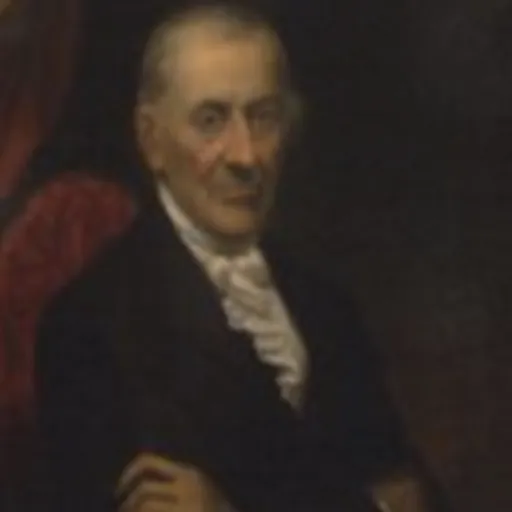
Joseph Campau
About Joseph Campau
Lived 1769 – 1863 (aged 94).
Joseph Campau (February 20, 1769 – May 13, 1863) was a merchant and landowner native to Detroit, considered one of the "Barons of Detroit". He belonged to the Campau family, one of the city's original settler families. At the beginning of the 19th century, he was among the wealthiest citizens in Michigan and is believed to have been the first millionaire in the state. He was an early benefactor of the University of Michigan.
Born in Detroit in 1769, Campau found success in business at an early age. He operated three trading posts and a merchant store in Detroit until the early 1800s. He held several public offices in the city and served as an officer in the Michigan Territory Militia during the War of 1812. He was known as Chemokamun ("big shot") by Chief Joshua Wawanosh and other Native American chiefs. Along with his nephew, John R. Williams, he founded the Democratic Free Press and Michigan Intelligencer, which would later become the Detroit Free Press. At the time of his death, he was the largest landowner in Michigan, holding a significant percentage of the stock in both the Michigan Central Railroad and the Bank of Michigan.
Campau was a somewhat controversial figure; contemporary publications labeled him a slumlord. He died in 1863 and was buried in Elmwood Cemetery rather than the traditional Catholic burial site at Mount Elliott Cemetery, as he had been excommunicated from the Catholic Church in 1817 following heated disagreements with Gabriel Richard, the rector of Ste. Anne.
Joseph Campau Street in Hamtramck and Detroit was named for him, Antoine de la Mothe Cadillac founded Fort Pontchartrain du Détroit in 1701 and sold 68 land grants between 1707 and 1710, two of which were sold to the Campau brothers. Jacques had previously served as a secretary and an officer to Cadillac. Jacques sold furs, grains, and bread at "one of the finest merchant stores" in Detroit by the 1740s, according to Clarence M. Burton. Campau spoke the languages of several Native American tribes, French and English to his customers at his three trading posts at Saginaw, on Lake St. Clair, and on Lake Erie. He was called Chemokamun ("big shot") by Chief Wawanosh of Sarnia and Chief Maccounse of Lake St. Clair.
Campau was the first in the city's real estate industry to sell and lease houses that had been built on vacant lots. He had become the state's largest landowner, owning property worth more than $10 million.
He served in the Michigan Territory Militia as captain in 1806. During the War of 1812, he was a major in the U.S. Army.
With his nephew, John R. Williams, Campau operated the Democratic Free Press and Michigan Intelligencer, which eventually evolved into the Detroit Free Press.
His wife was buried at Catholic Mount Elliott Cemetery, as are some of his children.
Campau bought a nine-year-old African boy in Montreal as a slave who was to be freed at 21 years of age. Campau and Father Gabriel Richard, the priest of St. Anne's Church, engaged in "heated disagreements" about Campau's having sold whiskey to Native Americans and joining the Masons. As a result, he was excommunicated from the Catholic Church in 1817. It was also located between Shelby and Griswold on Jefferson Avenue. Burton states that the house was "erected" in 1813 and the Detroit Historical Society said that it was built in 1815.
The Joseph Campau House on 2910 East Jefferson Avenue in Detroit is attributed to Campau, but it is said that he never lived there. One of the oldest residences in Detroit, it was built on land that was originally part of the Joseph Campau farm. It came into the Campau family in 1734 when it was awarded to his grandfather.
Don’t just read it —
keep it.
Full-length biographies made to live with: read them, listen on the way to work, watch them tonight.
- E-book
- Audio
- Video
Instant download · yours to keep · every purchase keeps this site free
Important facts
People in Joseph Campau's life
Named in this biography and alive at the same time
Contemporaries
People whose lives overlapped Joseph Campau's






Frequently asked questions
Who was Joseph Campau?
(1769-1863)
When was Joseph Campau born?
Joseph Campau was born on 2 February 1769.
When did Joseph Campau die?
Joseph Campau died on 23 July 1863.
Sources & further reading
Cite this page
APA: Biography.guide. (2026). Joseph Campau. https://biography.guide/joseph-campau/
MLA: "Joseph Campau." Biography.guide, https://biography.guide/joseph-campau/.
Chicago: "Joseph Campau." Biography.guide. https://biography.guide/joseph-campau/.
Data last updated: 2026-09-24 · Spot an error? Report a correction.
Portrait: Wikimedia Commons · author & licence
Page generated 2026-09-27 05:08 UTC