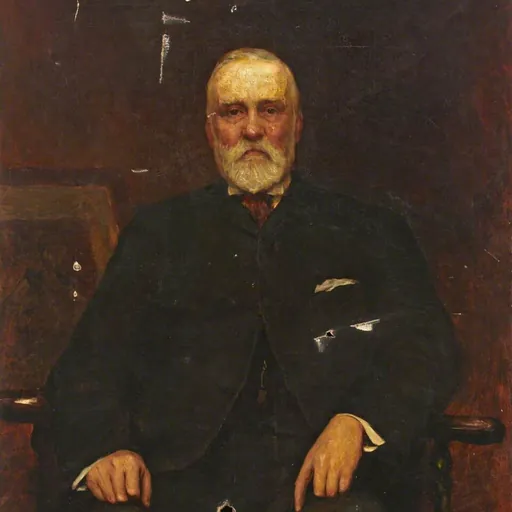
About Joseph Bennett
Lived 1831 – 1911 (aged 79). Joseph Bennett was a British journalist, music critic, librettist and musicographer.
Joseph Bennett (29 November 1831 – 12 June 1911) was an English music critic and librettist. After an early career as a schoolmaster and organist, he was engaged as a music critic by The Sunday Times in 1865. Within five years he was appointed chief music critic of The Daily Telegraph, a post he held from 1870 to 1906.
Among Bennett's other work was writing or adapting libretti for cantatas and other large-scale orchestral and choral works by British composers such as Arthur Sullivan, Frederic Cowen and Alexander Mackenzie.
Life and career
Early years Bennett was born in Berkeley, Gloucestershire. He attended the local church, and became a member of its choir, and joined a local musical society in whose orchestra he played the viola. When he reached the age of 18, his friends encouraged him to become a minister in the Congregational church, but after long consideration he decided that he could not accept all the doctrines of the church. In 1870, J W Levy, proprietor of The Daily Telegraph, invited Bennett to join the staff of the paper as chief music critic. |
Bennett was inadvertently responsible for naming a long-lived movement in British music, known as the "English Musical Renaissance". In 1882, in a review of Hubert Parry's First Symphony, he wrote that the work gave "capital proof that English music has arrived at a renaissance period." Bennett developed the theme in 1884, singling out for praise Frederic Cowen's Third Symphony (the Scandinavian) and operas by Arthur Goring Thomas (Esmeralda), Charles Villiers Stanford (Savonarola) and Mackenzie (Columba). This idea of an English musical renaissance was taken up with zeal by the music critic of The Times, J A Fuller Maitland. After the success of The Golden Legend, the friendship became less close, probably, according to Bennett, because he did not conceal his disappointment that Sullivan persisted in writing comic opera and indulging in "West-End life", instead of concentrating on serious music. |group= n
An article published in 1946 suggested that Bennett's high profile position at The Daily Telegraph (then claimed to have the largest circulation in the world) held back the development of English music because of his antipathy to Wagner, leaving Bernard Shaw (with an equally perverse antipathy to Brahms) as "the only modern critic" in the late eighties and early nineties.
Librettist and musicologist As well as his journalistic work, Bennett was highly regarded for the analytical notes he wrote for the programmes of the Philharmonic Society and other concerts. From these, he progressed to supplying libretti for cantatas and other large-scale choral works. Among the composers with whom he collaborated on one or two works were C. Lee Williams, Herbert Brewer and Frederick Bridge. With Cowen, Bennett collaborated on five large-scale works, and with Mackenzie on six, including the composer's best-known oratorio, The Rose of Sharon. He contributed the libretto to Villiers Stanford's opera, The Canterbury Pilgrims, "laboriously compiled from Chaucer", which premiered in 1884. Bennett's last libretto was for Sullivan's 1886 cantata The Golden Legend, based on the 1851 poem of the same name by Longfellow.
Between 1877 and 1891, Bennett contributed to The Musical Times a series entitled, "The great composers sketched by themselves", dealing with the life and works of more than 30 composers. The music publisher Novello & Co reprinted five of these articles, those on Berlioz, Chopin, Rossini, Cherubini and Meyerbeer, as separate volumes. After his retirement, Bennett published a book of memoirs, Forty Years of Music.
Bennett retired to Purton in Gloucestershire, not far from his birthplace. He died there at the age of 79.
Notes and references
Don’t just read it —
keep it.
Full-length biographies made to live with: read them, listen on the way to work, watch them tonight.
- E-book
- Audio
- Video
Instant download · yours to keep · every purchase keeps this site free
Important facts
People in Joseph Bennett's life
Named in this biography and alive at the same time
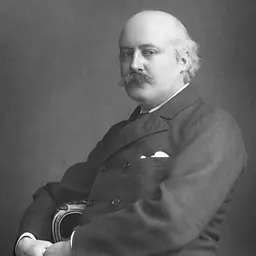



Related people
Same field, nearest in time
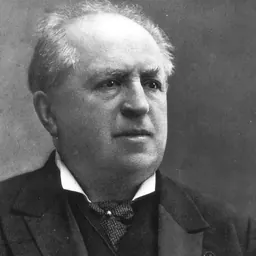
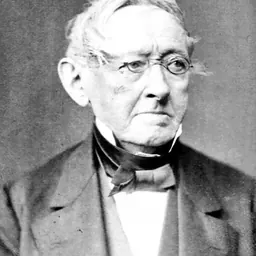
Contemporaries
People whose lives overlapped Joseph Bennett's




Frequently asked questions
Who was Joseph Bennett?
British music critic and librettist
When was Joseph Bennett born?
Joseph Bennett was born on 29 November 1831.
When did Joseph Bennett die?
Joseph Bennett died on 12 June 1911.
What was Joseph Bennett's occupation?
Joseph Bennett was a journalist, music critic, librettist and musicographer.
What nationality was Joseph Bennett?
Joseph Bennett was British.
Sources & further reading
· DBpedia: Joseph Bennett (critic)
Cite this page
APA: Biography.guide. (2026). Joseph Bennett. https://biography.guide/joseph-bennett-journalist/
MLA: "Joseph Bennett." Biography.guide, https://biography.guide/joseph-bennett-journalist/.
Chicago: "Joseph Bennett." Biography.guide. https://biography.guide/joseph-bennett-journalist/.
Data last updated: 2026-09-22 · Spot an error? Report a correction.
Portrait: Wikimedia Commons · author & licence
Page generated 2026-09-27 05:02 UTC