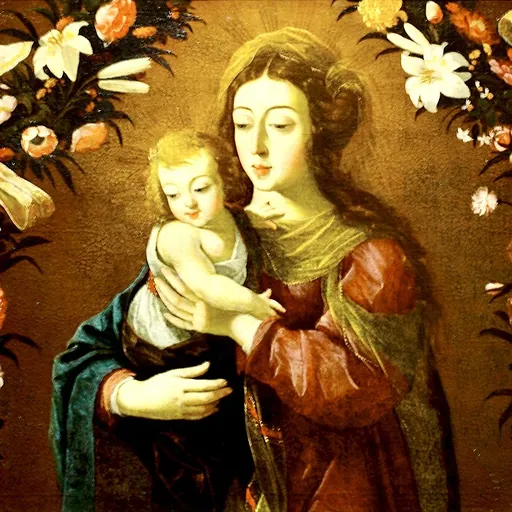
About Josefa de Óbidos
Lived 1630 – 1684 (aged 53–54). Josefa de Óbidos was a Spanish painter and artist.
Josefa de Óbidos (; – 22 July 1684 ) was a Spanish-born Portuguese painter. Her birth name was Josefa de Ayala Figueira, but she signed her work as "Josefa em Óbidos" or "Josefa de Ayalla". All of her work was executed in Portugal, her father's native country, where she lived from the age of four. Approximately 150 works of art have been attributed to Josefa de Óbidos, making her one of the most prolific Baroque artists in Portugal. her godfather was the notable Sevillian painter Francisco de Herrera the Elder. In the same year, she completed other small paintings on copper, including a Nativity Scene with St. Francis and Saint Clare Adoring the Newborn Christ (private collection).
Sometime before 1653, she and her family left Coimbra and settled in Óbidos, where she contributed an allegory of Wisdom to the Novos estatutos da Universidade de Coimbra, the book of rules for the University of Coimbra, whose frontispiece was being decorated by her father.
Still Life with Sweets (c. 1679). Santarém, Municipal Library During the decades that followed, Josefa executed several religious altarpieces for churches and convents in central Portugal, as well as paintings of portraits and still-life for private customers.
Josefa's will is dated 13 June 1684. In this document, the artist is described as having been "emancipated with the consent of her parents" and a "virgin who never married." Taken as a whole, these paintings represent the passage of time, the inevitability of death, and the possibility of rebirth. A subsequent investigation proved to be inconclusive despite having included laboratory examinations of samples removed by the Judiciary Police at the scene of the incident, and concluded that contextualized painting pigments from the 17th century were in fact identified, namely white lead pigment and ochre.
Historiography Josefa de Óbidos was included in several treatises and collections of biographies of artists written in the seventeenth through nineteenth centuries. Vitor Serrão has noted that in many of these writings, "Josefa de Ayala took on mythic proportions by authors awed by the fact that the artist was a woman." In 1736, Damião de Froes Perym praised her "talent, beauty, and honesty," as well as her "attractiveness." In the nineteenth-century unpublished text Memorias historicas e diferentes apontamentos acerca das antiguidades de Óbidos, by an anonymous author, Josefa is described as being "well known in and outside the kingdom for her paintings, in which she was unique during the time she flourished, as someone who practiced the perfections of art to notable applause and honest praise, living all her life in chaste celibacy."
Exhibitions Exposição das pinturas de Josefa de Óbidos (Ayala), Museu Nacional de Arte Antiga, Lisbon, 1949 Josefa de Óbidos e o tempo barroco, Galeria de Pintura do Rei D. Luis, Lisbon, 1991 The Sacred and the Profane: Josefa de Óbidos of Portugal, The National Museum of Women in the Arts, Washington, DC, 1997 Josefa de Óbidos e a invenção do Barroco Português, Museu Nacional de Arte Antiga, Lisbon, 2015 The National Gallery, London held a conference 3 July 2026 to highlight the work of Josepha de Obridos in international collections.
Gallery
Don’t just read it —
keep it.
Full-length biographies made to live with: read them, listen on the way to work, watch them tonight.
- E-book
- Audio
- Video
Instant download · yours to keep · every purchase keeps this site free
Important facts
more
Josefa de Ayala, Óbidos, Josefa d' Ayala, Josefa De Obidas Ayala, Josefa Figueira de Aiala, Josefa de Ayala e Cabrera, Josefa de Obidas, Josepha de Ayala y Cabreira, Josefa D'Ayala, Josefa de Aiala, Josefa d' Ayala e Cabrera, Josefa, Josefa d' Aiala, Josefa em Óbidos, Josefa de AyallaRelated people
Same field, nearest in time


Contemporaries
People whose lives overlapped Josefa de Óbidos's





Frequently asked questions
Who was Josefa de Óbidos?
Portuguese and Spanish artist (1630-1684)
When was Josefa de Óbidos born?
Josefa de Óbidos was born in 1630 in Seville.
When did Josefa de Óbidos die?
Josefa de Óbidos died on 22 July 1684 in Óbidos.
What was Josefa de Óbidos's occupation?
Josefa de Óbidos was a painter and artist.
What nationality was Josefa de Óbidos?
Josefa de Óbidos was Spanish.
Sources & further reading
Cite this page
APA: Biography.guide. (2026). Josefa de Óbidos. https://biography.guide/josefa-de-obidos/
MLA: "Josefa de Óbidos." Biography.guide, https://biography.guide/josefa-de-obidos/.
Chicago: "Josefa de Óbidos." Biography.guide. https://biography.guide/josefa-de-obidos/.
Data last updated: 2026-09-23 · Spot an error? Report a correction.
Portrait: Wikimedia Commons · author & licence
Page generated 2026-09-27 05:06 UTC