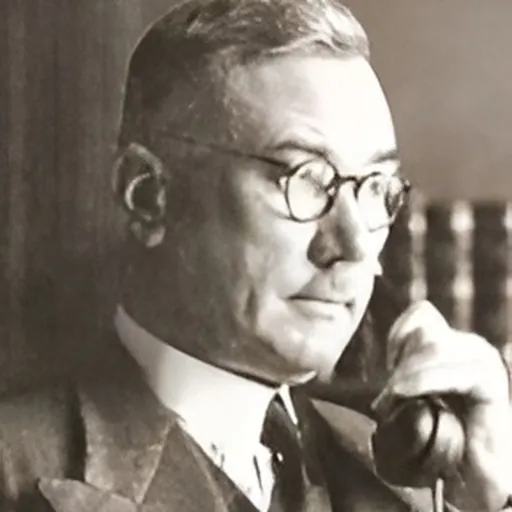
About Josef Hoop
Lived 1895 – 1959 (aged 63). Josef Hoop was a Liechtensteiner statesperson, politician, orientalist and head of government.
Early tenure alt=Members of the government of Liechtenstein in 1928. Sitting from the left are Josef Hoop, Peter Büchel, Josef Gassner and Ferdinand Risch. Hoop's government was responsible for continuing economic recovery after the 1927 Rhine flood. In 1929, it was faced with the effects of the Great Depression: rising unemployment, a collapse in industry, and lower livestock sales due to deflation. The economic struggles of the Depression led to periodic worker demonstrations from 1931 to 1934, primarily organized by the Liechtenstein Workers' Association; the association convinced Hoop's government to initiate a number of public-works projects to create jobs.
To combat the Depression, Hoop encouraged new businesses, public works, and social protection policies. The canal was approved in 1930; construction began the following year, and was completed in 1943. Franz got along well with Hoop and frequently consulted with him; he approved of Hoop's efforts to increase employment, and gave the Landtag relative legislative freedom. After the 1930 by-election, the FBP became the first (and only) party to hold an absolute majority in the Landtag in its history; the majority held until the 1932 election.
Rotter kidnapping
After the rise of Nazi Germany in 1933, Liechtenstein received a large number of Jewish refugees. Hoop's government pioneered a financial naturalization method for Jews to obtain Liechtenstein citizenship. The 1931 naturalization of Alfred and Fritz Rotter, two Jews, led to a deterioration in relations between Liechtenstein and Germany. Liechtenstein was attacked by the German press, who falsely accused the Rotters of bankruptcy fraud and transferring their money abroad. Demands were made for the extradition of the men to Germany to face trial. Hoop tried to use private contacts to end the press attacks, considering an appeal to German president Otto Meissner.
Four Liechtensteiners sympathetic to Germany, acting on demands by the German press, tried to kidnap Fritz and Alfred Rotter and extradite them to Germany; they hired five Germans to help, and intended the kidnapping to coincide with the formation of a Nazi party in Liechtenstein. Most of the Landtag approved of Hoop's actions but members of the Patriotic Union (VU) called for his resignation, believing that the search was unconstitutional. It was decided that two special judges would determine the legal implications of the case. In July 1937, both judges concluded that Hoop had not acted unconstitutionally by ordering the search.
1938–1939 crisis
alt=A photograph of four prominent Liechtenstein politicians in 1938. Standing from the left are Alois Vogt, Otto Schaedler, Josef Hoop and Ludwig Marxer. Hoop was in Vienna during the Anschluss on 12 March 1938, and returned to Liechtenstein on 14 March. His immediate concern was the potential annexation of Liechtenstein by Germany, and he sought reassurance from Nazi officials that Liechtenstein would remain independent. On 18 March, Adolf Hitler blocked interference in Liechtenstein because he did not want to complicate relations with Switzerland.
That month, at the initiative of heir presumptive Franz Joseph, the FBP and VU began negotiations to form a coalition government. Hoop agreed to allow the VU to enter the government and to introduce proportional representation in Liechtenstein, despite its rejection by referendum three years earlier; the coalition became effective on 30 March 1938. His second cabinet was succeeded by a third, with members of both parties. Hoop's deputy prime minister, FBP member Anton Frommelt, was succeeded by Alois Vogt of the VU.
The day after the coalition became effective, Franz I made Franz Joseph his regent and moved to a family estate in Feldsberg (now Valtice), Czechoslovakia; he died there on 25 July. Franz Joseph succeeded him as Franz Joseph II. Although Franz I said that he gave the regency to Franz Joseph due to old age, it was speculated that he did not want to remain in control of the principality if Germany invaded; his wife, Elsa, was Jewish. As a reaction to the coalition government, Liechtenstein Nazis formed the German National Movement in Liechtenstein (VDBL) in 1938.
That year, Hoop was pressured to transfer the Ellhorn to Switzerland. He favored the transfer, saying that Liechtenstein should be fairly compensated for its loss of territory with the transfer of Swiss land elsewhere or greater banking cooperation between the countries. The proposition faced resistance from the residents in Balzers, and was not approved by Franz Joseph II. Also facing unofficial objection from Germany, Hoop ended negotiations with Switzerland.
Relations with Germany and 1939 putsch
alt=German and Liechtenstein officials stand on the steps outside the Reich Chancellery in Berlin on 2 March 1939. Hoop can be partially seen on the left, behind Franz Joseph II. Franz Josef II, Hoop, and Vogt made a 2–3 March 1939 courtesy visit to Berlin, where they met Adolf Hitler and Joachim von Ribbentrop. Hitler met Franz Joseph II and Hoop for thirty minutes and discussed safeguarding Liechtenstein's independence and neutrality while maintaining good relations, but no negotiations took place.
An attempted putsch took place on 24 March 1939. The VDBL planned to march on the capital, Vaduz, which they hoped would trigger clashes between them and the government; German troops from Feldkirch would move into Liechtenstein in response to a call for help, and incorporate the country into Germany. The plan failed when the VDBL was stopped by opponents outside Schaan, and a German invasion was blocked by Vogt, Meissner, and Heinrich Georg Stahmer; Stahmer had advised Hitler and von Ribbentrop against invading Liechtenstein.
On the day of the attempted coup, Hoop called Berlin from Lugano and was assured that orders forbade a German invasion of Liechtenstein. Hoop then reported to Hermann E. Sieger (his primary German contact since 1933) that the attempted coup had been conducted by a small extremist group, that Liechtenstein wished to remain in a customs union with Switzerland, and Hoop's government wanted to preserve diplomatic relations with Germany; Sieger forwarded Hoop's report to the Foreign Office. Hoop met on 27 March with local authorities in Feldkirch, who denied any involvement in the attempted coup.
Sieger, who had long urged Hoop to consider a customs union with Germany, renewed his efforts after the attempted coup; Hoop rejected this, saying that the vast majority of Liechtensteiners would not be willing to give up the customs union with Switzerland. Despite Hoop's objections, Sieger reported to the Foreign Office that public opinion in Liechtenstein was shifting toward economic integration with Germany and Hoop should be pressured "personally and privately" to move toward it. The office rejected the idea, however, and ordered Sieger not to take any more steps toward it.
World War II
Hoop considered friendly, non-binding, non-provocative diplomacy, combined with courteous gestures, appropriate towards Germany during World War II. In a 1940 lecture in Stuttgart, he expressed respect for the German army. Despite this, the VDBL instigated political unrest such as fights, bombing attacks, and burning of swastikas. Hoop tried to temper relations between the groups and prevent tensions from escalating into violence. Swiss distrust of Liechtenstein's official stance grew (primarily due to the VDBL), and the Swiss government demanded that Hoop's government declare allegiance to Switzerland; it did so on 5 November 1940. In exchange, Switzerland agreed to allow Liechtenstein workers to travel and work freely in Switzerland.
Resignation In September 1945, after serving as prime minister for seventeen years, Hoop resigned due to his worsening heart condition and his desire to leave the role. He said that Franz Joseph II had pressured him to do so because the prince believed that post-war Liechtenstein required a change in leadership. This stemmed from a diplomatic crisis involving the pro-Axis First Russian National Army, led by General Boris Smyslovsky, which had taken refuge in Liechtenstein a few months earlier. The de facto dismissal of Hoop angered many in the FBP. He studied law at the University of Zurich and the University of Innsbruck (where he received a doctoral degree in 1948), and worked as a lawyer in Vaduz.
Personal life and death Hoop married Emilie Gstöhl (27 February 1898 – 11 February 1997) in 1920; they had no children. Through his sister's marriage, he was the brother-in-law of Eugen Schädler. Hoop's niece Emma Eigenmann-Schädler was the first female member of the Landtag, serving from 1986 to 1993.
Hoop, a likfelong smoker, died on 19 October 1959 at age 63 from heart failure after surgery. He was buried in his hometown of Eschen, and his funeral was attended by Franz Joseph II and Princess Gina. A street in Eschen is named after him.
He was well-regarded by Franz Joseph II for his efforts to protect Liechtenstein's independence during World War II, and Franz said that "Hoop saved the country".
Honours
Grand Cross of the Order of Merit of the Principality of Liechtenstein (1937)
Don’t just read it —
keep it.
Full-length biographies made to live with: read them, listen on the way to work, watch them tonight.
- E-book
- Audio
- Video
Instant download · yours to keep · every purchase keeps this site free
Important facts
People in Josef Hoop's life
Named in this biography and alive at the same time




Related people
Same field, nearest in time





Contemporaries
People whose lives overlapped Josef Hoop's
Frequently asked questions
Who was Josef Hoop?
Liechtenstein Prime Minister (1895-1959)
When was Josef Hoop born?
Josef Hoop was born on 14 December 1895 in Eschen.
When did Josef Hoop die?
Josef Hoop died on 19 October 1959 in Chur.
What was Josef Hoop's occupation?
Josef Hoop was a statesperson, politician, orientalist and head of government.
What nationality was Josef Hoop?
Josef Hoop was Liechtensteiner.
Sources & further reading
Cite this page
APA: Biography.guide. (2026). Josef Hoop. https://biography.guide/josef-hoop/
MLA: "Josef Hoop." Biography.guide, https://biography.guide/josef-hoop/.
Chicago: "Josef Hoop." Biography.guide. https://biography.guide/josef-hoop/.
Data last updated: 2026-09-20 · Spot an error? Report a correction.
Portrait: Wikimedia Commons · author & licence
Page generated 2026-09-27 04:58 UTC