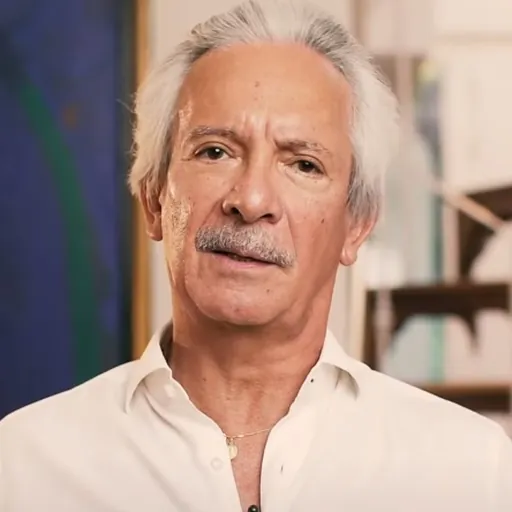
About José Rubén Zamora
Born 1956. José Rubén Zamora is a Guatemalan journalist.
José Rubén Zamora Marroquín (born August 19, 1956 ) is a Guatemalan industrial engineer, entrepreneur, and the founder of three Guatemalan newspapers: Siglo Veintiuno ("21st Century") in 1990, El Periódico ("The Newspaper") in 1996, and Nuestro Diario ("Our Daily") in 1998. He has been threatened and attacked on several occasions for his work, including being held hostage in his home in 2003 and being kidnapped and beaten in 2008.
Zamora has received numerous international prizes and distinctions. He was awarded the Maria Moors Cabot Prize from Columbia University in 1994, an International Press Freedom Award from the Committee to Protect Journalists in 1994, was named as one of 50 World Press Freedom Heroes of the 20th century by the International Press Institute in 2000, and the John S. and James L. Knight Foundation awarded him its International Journalism Award in 2003.
On July 29, 2022, Zamora was arrested on charges of money laundering that are widely seen as a retaliation against his coverage of corruption in the Guatemalan government. In 2023, he was sentenced to 6 years in prison. That conviction was overturned by another court, and a new trial ordered. A court ordered his release on May 15, 2024, with the judge ruling that he was not considered a flight risk or a threat to the investigation. The Media Development Investment Fund, which had invested in one of his newspapers, said it welcomed his conditional release but called on the judiciary to "deliver timely justice in the other pending case against him."
Education and early career Zamora began working as a reporter in La Hora ("The Hour"), a newspaper owned by his family, when he was 17. He earned degrees in industrial engineering and business administration and in 1986 founded ANC, a documentary and news production company in 1985.
The newspaper conducted a lengthy investigation into links between the government of President Alfonso Portillo and organized crime, the results of which were published in November 2002. The government then sent auditors to the Periódico offices for 40 days, withdrawing them only after a complaint by the World Association of Newspapers (WAN). The attackers beat Zamora's children and forced him to strip and kneel at gunpoint. According to Zamora, one of the gang stated: "If you value your children stop bothering the people above. I don't know who you've annoyed high up the ladder, but we have orders that someone up high despises you. Whatever you do, do not report this." The US government condemned the attack and called for an investigation. Two years later, former member of the military Eduviges Funes was later sentenced to sixteen years' imprisonment for his role in the attack. Another former soldier, Belter Álvarez, was acquitted.
On August 20, 2008, Zamora was kidnapped and beaten after a dinner with friends in Guatemala City, and was left unconscious and nearly naked in Chimaltenango, away.
Awards
In 1995, Zamora and the Siglo Veintiuno staff won International Press Freedom Awards from the Committee to Protect Journalists, which recognize courage in defending press freedom despite facing attacks, threats, or imprisonment. In the same year, he won the Maria Moors Cabot Prize from Columbia University "for promoting press freedom and inter-American understanding". In 2000, he was named one of 50 World Press Freedom Heroes of the 20th century by the International Press Institute.
In Guatemala, he was recognized as a Distinguished Engineer by the Professional College of Engineers in 2014 and as an Illustrious Graduate of the Universidad de San Carlos de Guatemala in 2015. He was also awarded the Myrna Mack Prize for the defense of human rights by the Guatemalan Human Rights Commission in 2015.
Arrest On July 29, 2022, Zamora was arrested on charges of money laundering. However, his arrest was widely seen as a retaliation against his coverage of corrupt practices by the Guatemalan government under president Alejandro Giammattei and was criticized locally and internationally by journalists, freedom of the press activists, political opposition in Guatemala, human rights NGOs, the business sector, the United States, Canada, and the European Union. He was sentenced to 6 years in prison on June 15, 2023. Zamora denied all charges and alleged that he had been given no rights to a defense.
On May 15, 2024, Judge Verónica Ruiz of the Ninth Sentencing Court granted Zamora house arrest after Ruiz found little risk of Zamora fleeing the country or obstructing the investigation against him. He was moved to his residence on 18 October. However, his house arrest was reversed following an appeal by prosecutors in November. In March 2025, Zamora was returned to prison.
On 12 February 2026, a judge ordered Zamora to be placed under house arrest pending his trial.
Don’t just read it —
keep it.
Full-length biographies made to live with: read them, listen on the way to work, watch them tonight.
- E-book
- Audio
- Video
Instant download · yours to keep · every purchase keeps this site free
Important facts
People in José Rubén Zamora's life
Named in this biography and alive at the same time



Related people
Same field, nearest in time



Contemporaries
People whose lives overlapped José Rubén Zamora's

Frequently asked questions
Who is José Rubén Zamora?
Guatemalan journalist
When was José Rubén Zamora born?
José Rubén Zamora was born on 19 August 1956.
What is José Rubén Zamora's occupation?
José Rubén Zamora is a journalist.
What nationality is José Rubén Zamora?
José Rubén Zamora is Guatemalan.
Sources & further reading
· Wikipedia: José Rubén Zamora
Cite this page
APA: Biography.guide. (2026). José Rubén Zamora. https://biography.guide/jose-ruben-zamora/
MLA: "José Rubén Zamora." Biography.guide, https://biography.guide/jose-ruben-zamora/.
Chicago: "José Rubén Zamora." Biography.guide. https://biography.guide/jose-ruben-zamora/.
Data last updated: 2026-09-22 · Spot an error? Report a correction.
Portrait: Wikimedia Commons · author & licence
Page generated 2026-09-27 05:00 UTC