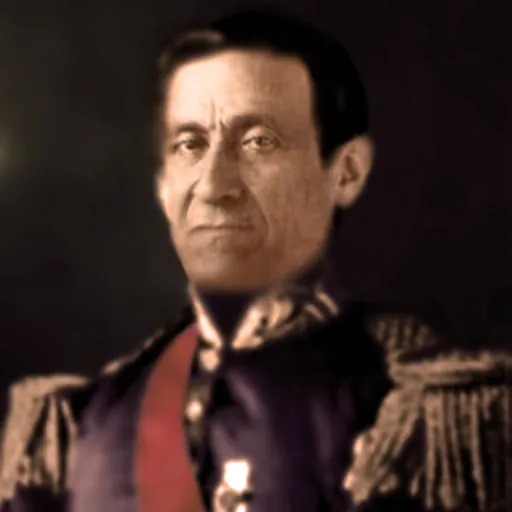
About José María Melo
Lived 1800 – 1860 (aged 59). José María Melo was a Colombian politician and military officer.
José María Dionisio Melo y Ortiz (October 9, 1800 – June 1, 1860) was a Colombian general and political figure who fought in the South American wars of independence, and who rose to power and briefly held the presidency of Colombia in 1854. Of Pijao ancestry, he is considered the country's first and only indigenous president.
Joining the revolutionary army of Simón Bolívar in 1819, Melo distinguished himself in numerous battles of the wars of independence, including the decisive Battle of Ayacucho. During the collapse of Gran Colombia he was exiled to Venezuela. After participating in another failed revolution.
Melo returned to Colombia in 1840 and became involved in the , reformist political groups made up of middle-class artisans. He supported the presidency of José Hilario López, the first Liberal to take power in the country. Amidst a schism in the Liberal Party and a deteriorating political situation in the capital, Melo took power in a coup d'etat in 1854. He ruled for eight months until he was overthrown by an alliance of Conservatives and rival Liberals.
Once again exiled to Central America, Melo fought against the invasion of Nicaragua by American mercenary William Walker, and pledged his support to Mexican President Benito Juárez at the outset of the Reform War. He was captured by conservative troops in Chiapas in 1860 and executed.
Melo is a controversial figure in Colombian history. After his death, his regime was characterized as an apolitical military dictatorship, and his role in the 19th century struggle between liberals and conservatives was generally minimized or forgotten. In the late 20th century, however, historians began to reexamine his legacy.
Early life José María Dionisio Melo y Ortiz was born to Manuel Antonio Melo and María Antonia Ortiz in Chaparral, a small town in the Mariquita Province of the Viceroyalty of New Granada, on October 9, 1800. He was raised in Ibagué, the provincial capital.
Melo was of indigenous Pijao ancestry, and is considered the only Colombian president with a strong claim to indigenous ancestry. Urdaneta and his supporters, Melo included, were imprisoned in the Castillo San Fernando in Cartagena, before they were deported to Dutch Curaçao in August 1831.
First exile Melo traveled to Venezuela, settling in Caracas; here he married Urdaneta's sister-in-law, María Teresa Vargas y París.
In 1835, the group, led by revolutionary hero Santiago Mariño, rose up in what became known as the Revolution of the Reforms, demanding the restoration of Gran Colombia as well as various political and social reforms. Though they managed to depose Vargas, Páez raised an army and forced the rebels to evacuate Caracas; the surviving rebels went into exile, some to the Dutch Antilles, and others to Nicaragua.
Return to Colombia The Democratic Societies Melo returned to Colombia in 1841, after an amnesty offered by President José Ignacio de Márquez during the War of the Supremes. Despite his military training in Germany, he did not rejoin the army and instead settled in Ibagué, where he engaged in several commercial ventures and even taught classes at the . He eventually became a regional political leader.
The artisans also demanded tariffs on imports from industrialized countries like England and the United States, which they argued were detrimental to the development of national industry. They rejected the Mallarino–Bidlack Treaty signed by the administration of Tomás Cipriano de Mosquera, which allowed the U.S. to intervene in Panama, which at the time was a Colombian province, to protect their economic interests.
In June 1849, President López appointed Melo, who had rejoined the military in 1847, the commander of the Hussars Cavalry Corps, garrisoned in Bogotá. In this capacity, Melo fought against the insurrection of 1851, where slaveowners and conservatives led by Julio Arboleda Pombo took arms against the López government in protest of the abolition of slavery. He was promoted to the rank of general, and managed to raise a militia of 3,000 volunteers to suppress the rebellion in Cundinamarca, which was being led by Mariano Ospina Rodríguez. Melo managed to defeat the rebels at Guasca, and after the rebellion was suppressed in the rest of the country, was named commander of military forces in Cundinamarca in June 1852.
In August 1850, the artisans demanded protection and the creation of a national workshop supported by the government.
Melo founded a newspaper, El Orden, in 1852. Though its intended readers were military officers (and it railed against the Golgothas' proposals to reduce garrisons in urban centers), it became closely associated with both the Draconian Liberals and the artisans of the Democratic Societies. The publication attacked both the Conservatives and the Golgothas, accusing them of planning to sell Panama to the United States, and of scheming to exile prominent Draconians like José María Obando. Despite the constitution's progressive nature, Obando and the Draconians were not entirely satisfied, aware that the document had been drafted by the Golgothas.
Quiroz affair In 1853 and 1854, Liberal Bogotá became fractured between the artisans and the merchant class, especially after a tariff bill failed in the Golgotha-controlled Colombian Senate. The city was facing a severe food shortage, exacerbated by the tax law of 1853. Violent street battles occurred between the two groups, and a coup d'etat against Obando was discussed as a real possibility.
This was the backdrop for the Quiroz affair in March 1854, where various political enemies of Melo accused the general of being responsible for the death of a corporal under his command, Pedro Ramón Quiroz, who was fatally wounded in a street brawl in January. Whatever the case, Melo arrived with the artisans at the presidential palace at 7 a.m., urging Obando to dissolve Congress and form an emergency provisional government. Obando refused, and he was placed under arrest.
Despite this support, Melo's regeneradores were outnumbered and outmatched by the constitucionalistas, which had united Golgothas like Tomás de Herrera with Conservatives like Julio Arboleda and Tomás Cipriano de Mosquera. Despite victories at Tíquiza and Zipaquirá, Melo's effective control of the country was limited to Bogotá, especially after Cali fell to the constitutionalists without resistance. The only military survivors of the Artisans Revolution were 200 participants, banished on foot to Panama after their property was confiscated. Conservatives in particular regarded the punishment as "an excellent method of purging Bogotá of the democratic pest," in the words of José Manuel Restrepo Vélez.
Final exile and death Melo was put on trial and was ultimately expelled from the country for a period of eight years. He sailed for Costa Rica on October 23, 1855. Though his whereabouts immediately after his exile are unclear, historians believe that he participated in the Central American resistance against the American filibuster William Walker, who sought to create a slave republic in Nicaragua.
On June 1, 1860, Melo's cavalry troops, encamped at the Juncaná hacienda in La Trinitaria, were ambushed by the Conservative forces of General Juan Antonio Ortega. After several hours of fighting, the Juarista defense collapsed and the wounded Melo was captured by rebel forces. Ortega ordered Melo to be put to death, and the Colombian general was summarily executed by firing squad.
Don’t just read it —
keep it.
Full-length biographies made to live with: read them, listen on the way to work, watch them tonight.
- E-book
- Audio
- Video
Instant download · yours to keep · every purchase keeps this site free
Important facts
People in José María Melo's life
Named in this biography and alive at the same time





Related people
Same field, nearest in time


Contemporaries
People whose lives overlapped José María Melo's






Frequently asked questions
Who was José María Melo?
President of Colombia (1800-1860)
When was José María Melo born?
José María Melo was born on 9 October 1800 in Chaparral.
When did José María Melo die?
José María Melo died on 1 June 1860 in La Trinitaria Municipality.
What was José María Melo's occupation?
José María Melo was a politician and military officer.
What nationality was José María Melo?
José María Melo was Colombian.
Sources & further reading
Cite this page
APA: Biography.guide. (2026). José María Melo. https://biography.guide/jose-maria-melo/
MLA: "José María Melo." Biography.guide, https://biography.guide/jose-maria-melo/.
Chicago: "José María Melo." Biography.guide. https://biography.guide/jose-maria-melo/.
Data last updated: 2026-09-22 · Spot an error? Report a correction.
Portrait: Wikimedia Commons · author & licence
Page generated 2026-09-27 05:01 UTC