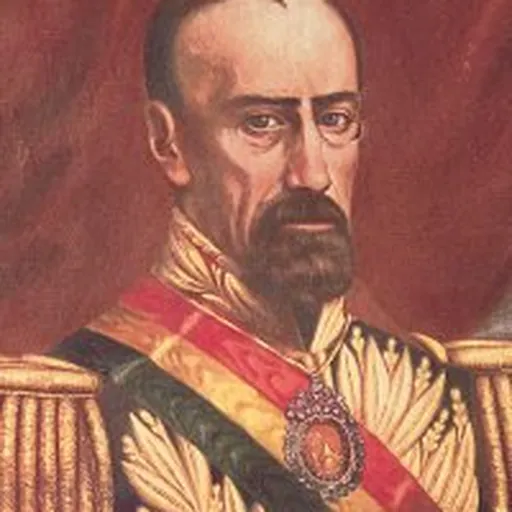
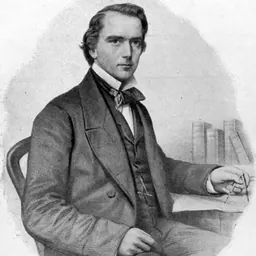
About José María de Achá
Lived 1810 – 1868 (aged 57). José María de Achá was a Bolivian politician.
José María de Achá Valiente (8 July 1810 – 29 January 1868) was a Bolivian general who served as the 14th president of Bolivia from 1861 to 1864. He served in the battles of the Peru-Bolivian Confederation and conspired against longtime dictator Manuel Isidoro Belzu (1848–55). Later, he was appointed Minister of War in the cabinet of another dictator, José María Linares (1857–61). In that capacity, he led the 1861 coup d'état that toppled Linares. Originally he governed as head of Junta, and then as sole leader of the revolutionary government but became constitutional president via elections. He was himself overthrown in the 1864 military coup carried out by General Mariano Melgarejo.
Early military and political activity De Achá was born in the city of Cochabamba on 8 July 1810. He enlisted in the Bolivian army, since a military career was promising at the time. He took part in the War of the Confederation and in the Peru-Bolivia War in 1841. He also fought in the Battle of Ingavi under the command of José Ballivián.
During his political life, de Achá became Minister of War during the presidency of José María Linares, whom he overthrew on 14 January 1861, by means of a coup d'état. After the ousting, a military triumvirate was installed with himself as a member of it. Generals Ruperto Fernández and Manuel Antonio Sánchez were his co-conspirators and fellow triumvirate members. The mission of this triumvirate was to accelerate the process of democratization of the country, convening a constituent assembly. This was installed on 1 May 1861, and on 4 May, the assembly members elected de Achá as provisional President of Bolivia.
Salary increase for ministers and deputies
In addition to appointing democratically minded ministers, de Achá raised their salaries to 5,000 pesos per year (416 pesos per month) the same year former president José María Linares had lowered their salaries, by means of the supreme decree of 11 December 1857.
On 23 May 1861, de Acha also decreed the delivery of per diems and allowances (economic remuneration) to the deputies of the assembly in the amount of about 200 pesos per month that the departmental treasuries should pay.
Among those killed was Francisco Belzú, brother of former President Manuel Isidoro Belzu. In addition to the deaths of Jorge Córdova and Francisco Belzú, several notable personalities in the country were also assassinated that same night.
Once President José María de Achá found out about what had happened, he remained impassive and neutral without carrying out any punishment against Plácido Yáñez. In turn, the people of La Paz, seeing the impunity on the part of the government and irritated by such a crime, took advantage of one of the military uprisings against the government to lynch Plácido Yáñez a month later, on 23 November 1861. Unable to appoint a new Commander-General of La Paz due to the uprising, Achá eventually appointed General Dámaso Bilbao la Vieja in January 1862.
In foreign policy, he signed the Treaty of Peace and Friendship with Peru of 5 November 1863, which ironed out the differences that both Republics had maintained since the Batlle of Ingavi.
The greatest international problem faced by the de Achá government was the one with Chile. The tension between the two countries had started due to the occupation, by Chile, of the Mejillones Bay, in the Litoral department.
Aware of the Chilean threat, he arranged a loan with Great Britain to build a railway to the coast and buy warships to defend the coastline. The processing of this project was entrusted to the industrialist Avelino Aramayo; but when everything was ready, he was frustrated by the refusal of the finance minister, Miguel María de Aguirre. Thus the opportunity was lost for Bolivia to effectively defend its coastal province from Chilean expansionism.
Melgarejo's coup
Despite his military talent and leadership skills, de Achá was unable to successfully confront the uprising of his former collaborator and protégé, Mariano Melgarejo, who overthrew him on 28 December 1864.
Death and legacy At first, de Achá had been quite popular by virtue of having ended the hated Linares dictatorship. He extended a political amnesty, and legitimized his rule by winning the 1862 elections. Soon, however, he was plagued by rebellions, the bane of any Bolivian president during this chaotic period. At that point, de Achá invoked a state of emergency and began to suppress civil liberties. In particular, he became unpopular as a result of the 1862 "Matanzas de Loreto" or "Matanzas de Yáñez" (Yáñez Bloodbath), when his ally, Plácido Yáñez, the military governor of the La Paz Province, massacred dozens of opposition figures Among those murdered was former president Jorge Córdova. Eventually, discontent became widespread, and de Achá found it difficult to govern at all. Indeed, parts of the party were controlled by different caudillos and military warlords. The president was finally overthrown in an 1864 coup d'état led by General Mariano Melgarejo, who would go on to become the most ruthless and brutal dictator of 19th-century Bolivia.
After a couple of years in exile, the broken and unpopular de Achá returned to Bolivia, where his safety was guaranteed by the now consolidated regime of General Melgarejo. Confined to his home city of Cochabamba, the ailing former president died there in 1868, less than 4 years after being overthrown. He was 57 years old.
Don’t just read it —
keep it.
Full-length biographies made to live with: read them, listen on the way to work, watch them tonight.
- E-book
- Audio
- Video
Instant download · yours to keep · every purchase keeps this site free
Important facts
People in José María de Achá's life
Named in this biography and alive at the same time
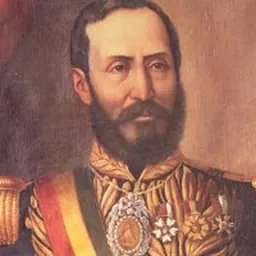
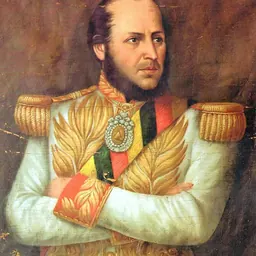

Related people
Same field, nearest in time



Contemporaries
People whose lives overlapped José María de Achá's





Frequently asked questions
Who was José María de Achá?
President of Bolivia (1810-1868)
When was José María de Achá born?
José María de Achá was born on 8 July 1810 in Cochabamba.
When did José María de Achá die?
José María de Achá died on 29 January 1868 in Cochabamba.
What was José María de Achá's occupation?
José María de Achá was a politician.
What nationality was José María de Achá?
José María de Achá was Bolivian.
Sources & further reading
· Wikipedia: José María de Achá
Cite this page
APA: Biography.guide. (2026). José María de Achá. https://biography.guide/jose-maria-de-acha/
MLA: "José María de Achá." Biography.guide, https://biography.guide/jose-maria-de-acha/.
Chicago: "José María de Achá." Biography.guide. https://biography.guide/jose-maria-de-acha/.
Data last updated: 2026-09-20 · Spot an error? Report a correction.
Portrait: Wikimedia Commons · author & licence
Page generated 2026-09-27 04:57 UTC