
José María Calatrava y Peinado
Prime Minister of Spain and Minister of State
About José María Calatrava y Peinado
Lived 1781 – 1847 (aged 65). José María Calatrava y Peinado was a Spanish magistrate, diplomat, politician, lawyer and judge.
José María Calatrava y Peinado (26 February 1781 in Mérida, Spain – 16 January 1846 in Madrid) was a Spanish politician who served as the Prime Minister of Spain and Minister of State between 1836 and 1837.
The main action of Calatrava's administration was proclaiming the constitution of 1837 which granted freedom of religion in Spain while still requiring the state to support the Roman Catholic Church. This was too drastic a change for many in Spain and it caused the downfall of Calatrava's government.
He finished his career as President of the Supreme Court of Spain (1840–1843).
Biography He was studying law in Seville when war broke out against the French. He played a very active role in opposing the military occupation through the Supreme Council of Extremadura, where he was elected deputy in 1810 to represent Badajoz, and he played a significant role in the Cortes of Cádiz. In 1803, he had married María de la Paz Montero de Espinosa in Badajoz.
Following the restoration of absolutism in 1814, he was arrested and imprisoned in Melilla, at the Fort of Victoria Grande, until he was granted amnesty when the liberals came to power in 1820, He was appointed a judge of the Supreme court and, from 1822 to 1823, served as Minister of Justice as one of the leading figures of the so-called Progressive Party (1836–1837) and a founding member of the Constitutional Society, also known as the Society of the Ring.
The end of the Trienio Liberal led to his exile in Portugal, England, and France, alongside his brother, Ramón María de Calatrava. With the death of Ferdinand VII and the arrival of the regency of María Cristina, he returned to Spain, and following the mutiny at La Granja de San Ildefonso, he was appointed President of the Council of Ministers, replacing Francisco Javier de Istúriz, and entrusted the Ministry of Finance to Juan Álvarez Mendizábal so that he could complete the reform of the public finances. In 1837, he stepped down as president in favor of Eusebio Bardají y Azara. A deputy and senator, he served twice as president of Congress for brief periods (from October 9 to November 9, 1820, and from September 10 to October 18, 1839).
During Espartero’s regency, he became president of the Supreme Court, a position from which he was removed—along with other ministers of the High Court—for refusing to recognize the government of Joaquín María López y López, since that government—according to a resolution of the Court’s plenary session—had been formed in violation of the provisions of the 1837 Constitution.
The figure of Calatrava, described by Antonio Alcalá Galiano as “belonging to a faction halfway between the moderates and the radicals,” has recently been reevaluated by Pedro J. Ramírez in La desventura de la libertad. José María Calatrava and the Fall of the Spanish Constitutional Regime in 1823, based on an analysis of Calatrava’s private archives and his notes from the final stage of the Liberal Triennium, which were not intended for public release. From this analysis, in terms of political theory, Calatrava stands out as the first in Spain to propose the introduction of a motion of no confidence into legislation, which would have resolved the operational problem stemming from the Constitution of Cádiz, which made ministers dependent exclusively on the king’s will while requiring them to answer to the Cortes.
Personal life Calatrava y Peinado was an active Freemason, at the “La Templanza” Masonic Lodge and operated under the name of "Brother Tiberio Graco." He was associated with the Grand Orient of the "Moderns" faction, based in Madrid.
Don’t just read it —
keep it.
Full-length biographies made to live with: read them, listen on the way to work, watch them tonight.
- E-book
- Audio
- Video
Instant download · yours to keep · every purchase keeps this site free
Important facts
People in José María Calatrava y Peinado's life
Named in this biography and alive at the same time



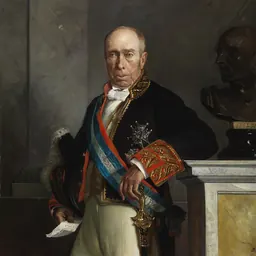
Related people
Same field, nearest in time

Contemporaries
People whose lives overlapped José María Calatrava y Peinado's




Frequently asked questions
Who was José María Calatrava y Peinado?
Prime Minister of Spain and Minister of State
When was José María Calatrava y Peinado born?
José María Calatrava y Peinado was born on 26 February 1781 in Mérida.
When did José María Calatrava y Peinado die?
José María Calatrava y Peinado died on 16 January 1847 in Madrid.
What was José María Calatrava y Peinado's occupation?
José María Calatrava y Peinado was a magistrate, diplomat, politician, lawyer and judge.
What nationality was José María Calatrava y Peinado?
José María Calatrava y Peinado was Spanish.
Sources & further reading
· Wikipedia: José María Calatrava y Peinado
· DBpedia: José María Calatrava
Cite this page
APA: Biography.guide. (2026). José María Calatrava y Peinado. https://biography.guide/jose-maria-calatrava-y-peinado/
MLA: "José María Calatrava y Peinado." Biography.guide, https://biography.guide/jose-maria-calatrava-y-peinado/.
Chicago: "José María Calatrava y Peinado." Biography.guide. https://biography.guide/jose-maria-calatrava-y-peinado/.
Data last updated: 2026-09-20 · Spot an error? Report a correction.
Page generated 2026-09-27 05:20 UTC