
About Jordi Bonet
Lived 1932 – 1979 (aged 47). Jordi Bonet was a Spanish and Canadian sculptor and painter.
The Jordi Bonet Murals in the rotunda of the Charles S. Curtis Memorial Hospital in St. Anthony Newfoundland were created and fabricated in 1967 Jordi Bonet, known professionally as Jordi Bonet (7 May 1932 – 25 December 1979), was a Spanish-born Canadian painter, ceramist, muralist, and sculptor who worked principally in Quebec.
Life and work Born in Barcelona, Spain of Catalan origin, he lost his right arm at the age of 9. His childhood would be marked by the Spanish Civil War. He studied art in Barcelona. He began working in paint and ceramic before expanding his focus to include metal and concrete reliefs.
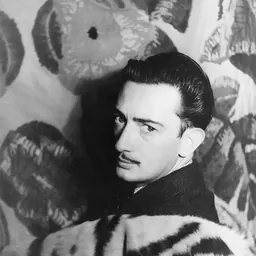
He emigrated to Canada in 1954, establishing himself in Quebec, where he continued his studies. After briefly returning to Spain, he established an atelier in Mont-Saint-Hilaire in 1960. Over the next 20 years, he created more than 100 works in Quebec and abroad, and associated with major art figures such as Salvador Dalí.
In 1964, he was commissioned by the Government of Sierra Leone to deliver the mural which can still be seen at the front of the Bank of Sierra Leone building, in the capital, Freetown. His signature is situated at the bottom right-hand of the mural, with the words "Jordi Bonet '64".
In 1967, Jordi Bonet created The Inuit Family, a rotunda that represents life in northern Newfoundland and Labrador, the work is located inside the main entrance of the Charles S. Curtis Memorial Hospital, Saint Anthony, Canada.
His relief in the Grand Théâtre de Québec created a scandal in 1971 because of the line "Vous êtes pas écœurés de mourir bande de caves? C'est assez !" ("Aren't you sick of dying, you gang of idiots? Enough!") incorporated into it, a quotation from the poet Claude Péloquin. Among his other major works are the relief L'homme devant la science on the west facade of the Pavillon Adrien-Pouliot of Université Laval in Quebec, 'Citius, Altius, Fortius in the Montreal Metro station Pie-IX; Hommage à Gaudí, a cycle of wall sculptures in Place des Arts in Montreal; the Halifax Explosion Memorial Sculpture; and a set of stained-glass windows and sculptures in Our Lady of the Skies Chapel at John F. Kennedy International Airport in New York City. He was particularly interested in sacred works, creating artworks and liturgical objects for churches and convents in Quebec, Ontario, and elsewhere. Galerie L'Art français exhibited his works from the 1950s.
He was one of Quebec's established artists when he died of leukemia at the age of 47.
Honours Royal Canadian Academy of Arts
Photos
Don’t just read it —
keep it.
Full-length biographies made to live with: read them, listen on the way to work, watch them tonight.
- E-book
- Audio
- Video
Instant download · yours to keep · every purchase keeps this site free
Important facts
People in Jordi Bonet's life
Named in this biography and alive at the same time


Related people
Same field, nearest in time



Contemporaries
People whose lives overlapped Jordi Bonet's


Frequently asked questions
Who was Jordi Bonet?
Canadian artist (1932-1979)
When was Jordi Bonet born?
Jordi Bonet was born on 7 May 1932 in Barcelona.
When did Jordi Bonet die?
Jordi Bonet died on 25 December 1979 in Mont-Saint-Hilaire.
What was Jordi Bonet's occupation?
Jordi Bonet was a sculptor and painter.
What nationality was Jordi Bonet?
Jordi Bonet was Spanish and Canadian.
Sources & further reading
Cite this page
APA: Biography.guide. (2026). Jordi Bonet. https://biography.guide/jordi-bonet/
MLA: "Jordi Bonet." Biography.guide, https://biography.guide/jordi-bonet/.
Chicago: "Jordi Bonet." Biography.guide. https://biography.guide/jordi-bonet/.
Data last updated: 2026-09-20 · Spot an error? Report a correction.
Page generated 2026-09-27 05:19 UTC