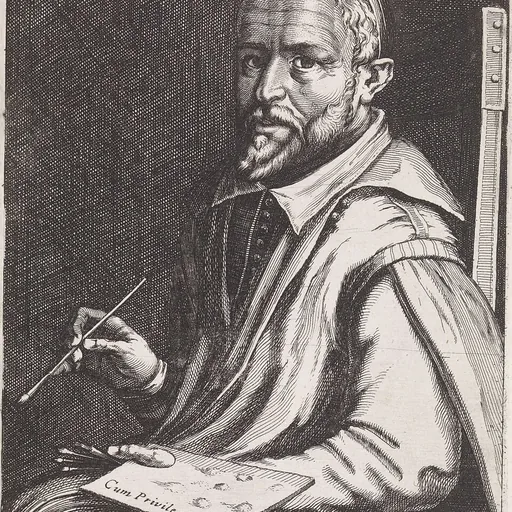
About Joos van Winghe
Lived 1544 – 1603 (aged 58–59). Joos van Winghe was a painter, draftsperson and visual artist.
Joos van Winghe, Jodocus a Winghe or Jodocus van Winghen (1544–1603) was a Flemish painter and print designer. He is known for his history paintings, portraits, allegories and genre scenes, including merry companies. He worked in Brussels as court painter and left Flanders after the Fall of Antwerp in 1584. He then worked in Frankfurt for the remainder of his career. In Germany he enjoyed the patronage of Holy Roman emperor Rudolf II and adopted a more clearly Mannerist style.
Life The principal source on the life of Joos van Winghe is the Flemish contemporary art historian and artist Karel van Mander. Modern art historians treat van Mander's biographies of artists with circumspection. Van Mander recounts that van Winghe was born in Brussels in 1544. There is no independent information which can confirm this birth date.
Van Mander states that van Winghe traveled to Italy to further his studies. In Rome he lived with a cardinal for four years. Van Winghe spent time in Parma where he reportedly painted a fresco of the Last Supper in the refectory of the monastery of the Servites. He worked in the workshop of the Italian Mannerist painter Jacopo Bertoja who also employed the Flemish painter Bartholomaeus Spranger. Bertoja took van Winghe and Spranger to paint in the rooms of the Villa Farnese that he had been commissioned to finish. He also worked in Rome and Parma for Bertoja. A close friendship between Spranger and van Winghe must have developed during their time in Italy. A drawing by Spranger after a painting van Winghe, which has disappeared today, proves that the two artists remained in contact decades later, when Spranger had been court painter to Rudolph II in Prague for many years and van Winghe had settled in Frankfurt.
On his return trip he passed by Paris. He spent time at Fontainebleau where he was exposed to the Mannerist style of the School of Fontainebleau. His period of travel is situated between 1564 and 1568.
After his return to Brussels in 1568 he became court painter to Alexander Farnese, Duke of Parma, then the governor-general of the Spanish Netherlands. He created a number of religious compositions during his stay in Brussels. A painted allegory described by van Mander depicting a chained personification of Belgica, i.e. the Netherlands, supports the view that his emigration was politically motivated. There were also a great number of Flemish printmakers in Frankfurt. Many of the artists were tied together through a network of family relationships established through intermarriage. The exiled artists regularly worked together on projects where each artist would contribute to a painting the portion in which they were specialised. For instance, a figure painter and still life painter would contribute respectively the figures and still life elements in a painting. The artists would also provide designs for the publications engraved by the Flemish printmakers established in Frankfurt. Van Winghe further maintained close relations with the group of Flemish artists in Frankenthal through Hendrik Gijsmans, with whom he was related by marriage, through his younger brother Maximilian van Winghe, who lived in Frankenthal and through his marriage to Catharina van der Borcht, which connected him with the painter family of van der Borcht. Van Winghe likely enjoyed the patronage of Holy Roman emperor Rudolf II thanks to his friend Spranger who was court painter. Spranger may have been instrumental in the purchase of van Winghe's painting Apelles paints Campaspe before Alexander for the imperial collection and a series of twelve apostles designed by him, which was dedicated to Archbishop Berka in Prague. Examples are the Elegant company, playing with torchlight and the Tavern scene in the night recently on the art market that are attributed to him. They show interiors at night lit by torches. Musicians are performing music in both paintings. In the second painting men and women are engaged in card playing, drinking, smoking and kissing. That the venue is a brothel is clear from the surreptitious exchange of a purse of money between one of the men and an old woman. A painting hanging on the back wall shows the scene of the prodigal son eating pig swill. This shows that the painting is likely depicting a scene from the biblical story of the prodigal son during his time of high living. This was a common merry company subject in Netherlandish painting of which Jan Sanders van Hemessen painted one of the first expressions in 1536.
Van Winghe created a few versions on the theme of a Nocturnal feast and masquerade, also referred to as The house of ill repute. The original version is likely the painting in the Royal Museums of Fine Arts of Belgium in Brussels. There is a drawing by van Winghe in the Kupferstich-Kabinett, Dresden. Jan Sadeler made an engraving after the work which is very close to the Brussels painting. Finally there is an anonymous painting in the Rijksmuseum in Amsterdam which differs from the drawing and engraving but is clearly inspired by van Winghe's creation. The Brussels painting shows an elegantly dressed party of people in a magnificent room. At the back of the room are statues in niches. The central niche is larger and contains a large statue of a female nude. In front are men and women engaged in drinking, games and courtship. On the right at the back of the room an old woman holding a purse is leading a young woman by the hand. In the foreground a woman plays an organ and men wearing masks play on lutes and sing. On both sides of the larger niche are two plates with Latin texts from the second Book of Wisdom, which point to the need to enjoy life. The Sadeler engraving carries at the bottom a text from the book of Sirach which warns from the danger of wine, women and prostitutes. The scene depicted in the painting and engraving illustrate the vices that are condemned by Sirach.
Allegories The Mannerist painters had a preference for works with an allegorical meaning. Van Winghe was no exception to this and designed various allegorical works such as the Allegory of Vanity (Dorotheum, Vienna, 17 October 2017, lot 240) and the Fame hovering over the globe (Collection Lingenauber Monaco), which deal with fairly common allegorical themes. Other allegorical works have a political meaning such as the allegory described by van Mander depicting a chained personification of Belgica, i.e. the Netherlands. Hanging, burning and clubbing of Indians by Spanish soldiers from the Narratio regionum ...
Printed work In Frankfurt van Winghe seems to have been mainly active as a draughtsman and designer of prints. He worked with the large community of engravers from his home country who had settled there such as Jan and Raphael Sadeler, Crispijn de Passe and Theodor de Bry.
He designed a series of 12 apostles and Christ for Archbishop Berka in Prague, which were engraved by the Flemish engraver Johan Bara.
Don’t just read it —
keep it.
Full-length biographies made to live with: read them, listen on the way to work, watch them tonight.
- E-book
- Audio
- Video
Instant download · yours to keep · every purchase keeps this site free
Important facts
more
Josse Wingen, Joos van Winghen, Jodocus Winghen, Jost Wingen, Jodocus Winghe, Joos Winghe, Jost Winghen, Josse van Winghen, Jost van Winghe, Jodocus van Winghen, Jodocus van Winghe, Josse Winghe, Jodocus Wingen, Jost van Winghen, Joos van Wingen, Jos. van Winghen, Josse Winghen, Josse van Wingen, Jodocus van Wingen, Josse de Winghen, Jos. Van Winghem, Jdoce von Wingen, Van Wynge, Van WinPeople in Joos van Winghe's life
Named in this biography and alive at the same time



Related people
Same field, nearest in time
Contemporaries
People whose lives overlapped Joos van Winghe's



Frequently asked questions
Who was Joos van Winghe?
Flemish Renaissance painter (1544-1603)
When was Joos van Winghe born?
Joos van Winghe was born in 1544 in Brussels.
When did Joos van Winghe die?
Joos van Winghe died on 18 December 1603 in Frankfurt.
What was Joos van Winghe's occupation?
Joos van Winghe was a painter, draftsperson and visual artist.
What nationality was Joos van Winghe?
Joos van Winghe's recorded nationality: Habsburg Netherlands.
Sources & further reading
Cite this page
APA: Biography.guide. (2026). Joos van Winghe. https://biography.guide/joos-van-winghe/
MLA: "Joos van Winghe." Biography.guide, https://biography.guide/joos-van-winghe/.
Chicago: "Joos van Winghe." Biography.guide. https://biography.guide/joos-van-winghe/.
Data last updated: 2026-09-23 · Spot an error? Report a correction.
Portrait: Wikimedia Commons · author & licence
Page generated 2026-09-27 05:08 UTC