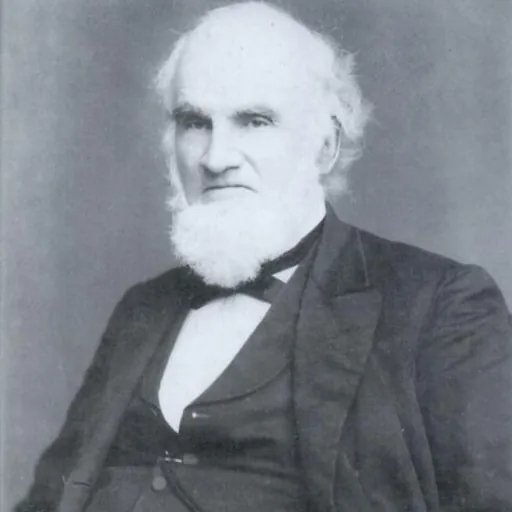
Jonathan Blanchard
American academic and pastor
About Jonathan Blanchard
Lived 1811 – 1892 (aged 80–81). Jonathan Blanchard was an American philosopher, abolitionism in the United States, chancellor (education) and editor.
Jonathan Blanchard (January 19, 1811 – May 14, 1892) was an American pastor, educator, social reformer, and abolitionist. Born in Vermont, Blanchard attended Middlebury College before accepting a teaching position in New York. In 1834, he left to study at Andover Theological Seminary, but departed in 1836 after the college rejected agents from the American Anti-Slavery Society. Blanchard joined the group as one of Theodore Dwight Weld's "seventy" and preached in favor of abolition in southern Pennsylvania.
Blanchard graduated from Lane Seminary in 1838 and was soon ordained to preach at Sixth Presbyterian Church in Cincinnati, Ohio. There, he helped publish abolitionist newspaper The Philanthropist and represented Ohio at the 1843 World Anti-Slavery Convention. In 1845, he was named president of Knox College in Illinois, but was forced out thirteen years later. Blanchard is credited with founding Wheaton College in 1860, where he presided until 1882.
Following the Civil War, Blanchard focused on fighting secret societies through his National Christian Association (NCA). He was a leader in the resurrected Anti-Masonic Party and once campaigned for its Presidential nomination. Along with his son Charles Albert, who succeeded him as Wheaton College president, he is the namesake of the college's Blanchard Hall.
Early life Jonathan Blanchard was born in Rockingham, Vermont on January 19, 1811. He was the eleventh of fifteen children born to Polly (Lovell) and Jonathan Blanchard, Sr. When he was three years old, he heard his brother discuss the recent Battle of Plattsburgh, an engagement of the War of 1812. Blanchard later credited this encounter as an influential moment in the development of his pacifist views. As a child, Blanchard attended public schools and helped on the family farm. When he was fourteen, he took his first job teaching a school. Like his brothers, Blanchard opposed the consumption of alcohol. He published his first article advocating temperance in 1825.
After preparatory studies at Chester Academy in Chester, Vermont, Blanchard matriculated at Middlebury College in 1828. Blanchard first supported abolitionism in 1834, believing slavery to be inconsistent with Biblical teachings. Blanchard was stoned in the streets by citizens in Harrisburg, Pennsylvania, in 1837. Nonetheless, he was considered one of the most effective agents of the AASS and is credited with converting Thaddeus Stevens to the abolitionist cause.
The next year, Blanchard moved to Cincinnati, Ohio, to attend Lane Seminary, where he graduated in 1838. He assisted with the publication of abolitionist newspaper The Philanthropist until it was forced to close in the aftermath of the Cincinnati riots of 1836. Blanchard served as a presidential elector for the Free Soilers in 1848. In 1857, the Knox College board of trust requested that both Blanchard and Gale resign their positions, and both agreed. However, the decision proved controversial, as local civic leaders such as Edward Beecher protested the ruling. A school committee then re-admitted Blanchard as president, who served until the board elected Harvey Curtis the next year. Under Blanchard's leadership, the school was remodeled after Oberlin College, a school that was open to all students and that taught both a classic curriculum and radical social ideals. Blanchard would allow African-American students at Wheaton College to board in his house. His anti-Masonry views prohibited the founding of fraternities or sororities on campus. Blanchard believed that morality and Christian beliefs were innately experienced by man; this put him in line with most Scottish Common Sense Realists. In 1861, Jonathan Blanchard organized College Church in Wheaton. The church first met on the campus of Wheaton College as "The First Church of Christ in Wheaton." Blanchard wanted the church to be known for its opposition to slavery, secret societies, and alcohol use.
After a spell of poor health, Blanchard traveled with his son to the Montana Territory in 1864, ostensibly to explore on behalf of the American Missionary Association. While there, he recommended that the society found the First Congregational Churches of Denver and Salt Lake City.
After the Civil War
After the Civil War, during which the slaves were liberated, Blanchard turned his attention to fighting secret societies like the Freemasons. He co-founded the NCA in 1868 and edited its newspaper, the Christian Cynosure, until his death.
In 1884, Blanchard unsuccessfully sought the candidacy of the American Prohibition Party, the successor of the Anti-Masonic Party, for President of the United States. Blanchard died suddenly at his home in Wheaton on May 14, 1892. He had suffered through influenza the previous week. He was buried in Wheaton Cemetery. Wheaton's most recognizable and oldest building is Blanchard Hall, a limestone tower built as the Central College Building in 1853 and, subsequently, named in honor of the college's first two presidents.
Don’t just read it —
keep it.
Full-length biographies made to live with: read them, listen on the way to work, watch them tonight.
- E-book
- Audio
- Video
Instant download · yours to keep · every purchase keeps this site free
Important facts
Family & relationships
People in Jonathan Blanchard's life
Named in this biography and alive at the same time


Related people
Same field, nearest in time



Contemporaries
People whose lives overlapped Jonathan Blanchard's






Frequently asked questions
Who was Jonathan Blanchard?
American academic and pastor
When was Jonathan Blanchard born?
Jonathan Blanchard was born on 19 January 1811 in Rockingham.
When did Jonathan Blanchard die?
Jonathan Blanchard died in 1892 in Wheaton.
What was Jonathan Blanchard's occupation?
Jonathan Blanchard was a philosopher, abolitionism in the United States, chancellor (education) and editor.
What nationality was Jonathan Blanchard?
Jonathan Blanchard was American.
Sources & further reading
· Wikipedia: Jonathan Blanchard
· DBpedia: Jonathan Blanchard (abolitionist)
Cite this page
APA: Biography.guide. (2026). Jonathan Blanchard. https://biography.guide/jonathan-blanchard-philosopher/
MLA: "Jonathan Blanchard." Biography.guide, https://biography.guide/jonathan-blanchard-philosopher/.
Chicago: "Jonathan Blanchard." Biography.guide. https://biography.guide/jonathan-blanchard-philosopher/.
Data last updated: 2026-09-22 · Spot an error? Report a correction.
Portrait: Wikimedia Commons · author & licence
Page generated 2026-09-27 05:03 UTC