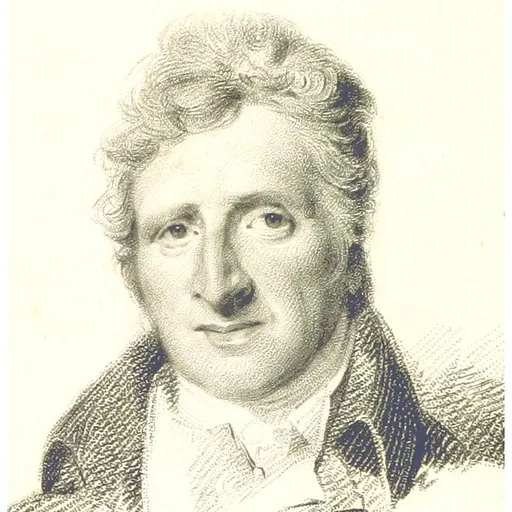
About Jonah Barrington
Lived 1760 – 1834 (aged 73–74). Jonah Barrington was a British politician, judge, barrister and jurist.
Sir Jonah Barrington, K.C. (1756/57 – 8 April 1834), was an Irish lawyer, judge and politician. Jonah Barrington is most notable for his amusing and popular memoirs of life in late 18th-century Ireland; for his opposition to the Act of Union in 1800; and for his removal from the judiciary by both Houses of Parliament in 1830, still a unique event.
Barrington family
Barrington's former home, 14 Harcourt Street, Dublin. The plaque gives his birth year as 1760.
Barrington was the third son, one of thirteen or sixteen children; six at least, and probably seven, were sons; of John Barrington, an impoverished Protestant gentleman landowner in County Laois and his wife Sibella French of Peterswell, County Galway. He was raised and schooled by his grandparents in Dublin and entered Trinity College Dublin in 1773, aged 16 but he left Trinity College without a degree. His father raised and commanded two Corps; the Cullenagh Rangers and the Ballyroan Light Infantry. Barrington's elder brother commanded both the Kilkenny Horse and the Durrow Light Dragoons. Through his correspondence with General Hunt Walsh, Barrington's father secured him a commission in Walsh's regiment. Upon learning that the regiment was to be sent to America to fight in the ongoing conflict, and fearful of dying on some foreign battlefield, Barrington wrote to Walsh asking him to present the commission to another candidate instead, claiming that he himself was too tender to be of any real use. Barrington's fears proved well founded when his replacement, the only child of one of Walsh's friends, was killed in his first engagement.
Career
Law and Parliament
He was called to the Irish bar in 1788 and in 1789 he married Catherine, daughter of Dublin mercer, Edward Grogan. They were to have seven children. Appointed an Admiralty court judge in 1798 he re-entered parliament the same year as member for Clogher and voted against the Act of Union in 1799–1800, rejecting Lord Clare's offer of the solicitor-generalship in 1799. In 1802 he unsuccessfully contested a seat for Dublin in the UK parliament.
Political legacy
Barrington's comments on the Act of Union had a continuing resonance with the Young Ireland, Fenian and Irish Parliamentary Party movements, which hoped to re-establish "Grattan's Parliament" in some way. In particular, his Rise and Fall of the Irish Nation (1833) provided the basis for this romantic idealisation of Grattan's Parliament adopted by the Irish Parliamentary Party from the 1880s.
Admiralty Court
Appointed an Admiralty court judge in 1798 at a salary of £500 he found there was little work to be done and his lack of a degree restricted other opportunities to support extravagant tastes. His award of a knighthood in 1807 brought no increased income. His court ordered the sale of two derelict vessels and he gave instructions that the proceeds were to go to his own bank account. In 1810 or 1811 he took his wife and family to England and from that time on his work in Ireland was carried out by surrogates. Still retaining his judgeship and salary he moved to France in 1814 to escape his creditors and never returned to Ireland. of the Act of Settlement of 1701, which sought to protect the independence of the judiciary, both Houses of the Parliament of the United Kingdom voted for an Address to King William IV praying for his removal, and the King duly dismissed Barrington from office. By then, Barrington's first 1827 volume of memoirs had sold successfully, and they were republished and expanded (see below).
Barrington was the first judge removed from office under the Act of Settlement, and to this day, is the only judge in the United Kingdom to be so removed.
Duel with Richard Daly
According to one of his sometimes spurious personal memoirs, on 20 March 1780. Barrington travelled to Donnybrook to duel with Richard Daly.
Daly had fought 16 duels in three years - three with swords and thirteen with pistols. Remarkably, he, and his opponents, had always escaped serious injury. Barrington had no pistols so he and his second, Richard Crosbie, had spent the previous night constructing a pair 'from old locks, stocks and barrels'. At Donnybrook, Daly's second, Jack Patterson, a nephew of the Chief Justice, approached Crosbie, explained that it was all a mistake and asked that the two shake hands. Barrington was in favour, but Crosbie would have none of it. Taking out a duelling handbook, he pointed to rule No.7 - 'No apology can be received after the parties meet, without a fire.' W. B. Yeats: Mrs French, in the first section of Yeats's poem The Tower, is a character from Barrington's Recollections, where it is used to illustrate mutual attachment between the Irish peasantry and their landlords. James Joyce: Tom Kernan makes reference to Barrington's Reminiscences (recte Recollections) in Ulysses: Must ask Ned Lambert to lend me those reminiscences of sir Jonah Barrington. John Mitchel quoted Barrington in his History of Ireland, concerning the approach to the 1798 rebellion: Mr Pitt counted on the expertness of the Irish Government to effect a premature explosion. Free quarters were now ordered, to irritate the Irish population; slow tortures were inflicted, under the pretence of forcing confessions; the people were goaded and driven to madness (p. 264). A Dictionary of Irish Writers (1985), ed. Brian Cleeve & Ann Brady, lists his Historic Anecdotes and Secret Memoirs of the Legislative Union between Great Britain and Ireland (1809). A book of selections was published for the American market in 1967.
Don’t just read it —
keep it.
Full-length biographies made to live with: read them, listen on the way to work, watch them tonight.
- E-book
- Audio
- Video
Instant download · yours to keep · every purchase keeps this site free
Important facts
People in Jonah Barrington's life
Named in this biography and alive at the same time



Related people
Same field, nearest in time



Contemporaries
People whose lives overlapped Jonah Barrington's




Frequently asked questions
Who was Jonah Barrington?
Irish lawyer, judge and politician
When was Jonah Barrington born?
Jonah Barrington was born in 1760 in Abbeyleix.
When did Jonah Barrington die?
Jonah Barrington died on 8 April 1834 in Versailles.
What was Jonah Barrington's occupation?
Jonah Barrington was a politician, judge, barrister and jurist.
What nationality was Jonah Barrington?
Jonah Barrington was British.
Sources & further reading
· DBpedia: Jonah Barrington (judge)
Cite this page
APA: Biography.guide. (2026). Jonah Barrington. https://biography.guide/jonah-barrington-politician/
MLA: "Jonah Barrington." Biography.guide, https://biography.guide/jonah-barrington-politician/.
Chicago: "Jonah Barrington." Biography.guide. https://biography.guide/jonah-barrington-politician/.
Data last updated: 2026-09-20 · Spot an error? Report a correction.
Portrait: Wikimedia Commons · author & licence
Page generated 2026-09-27 04:58 UTC