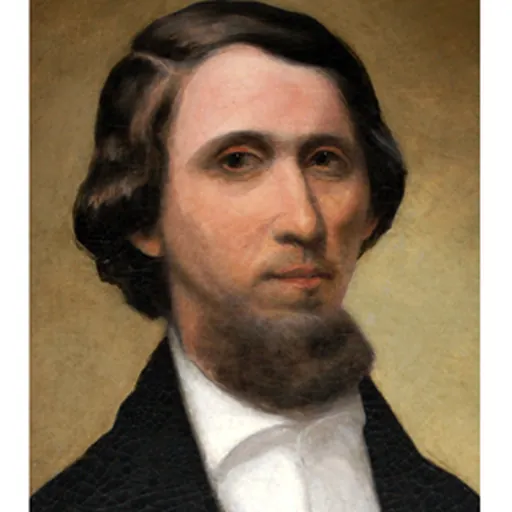
Johnson J. Hooper
American humorist; author of "The Widow Rugby's Husband"
About Johnson J. Hooper
Lived 1815 – 1862 (aged 46). Johnson J. Hooper was a writer and humorist.
Johnson Jones Hooper (June 9, 1815 – June 7, 1862) was an American lawyer and writer from Alabama known for his humorist works set in what was then known as the Southwest of America, particularly the collection of stories published as Adventures of Captain Simon Suggs. Hooper was known for pushing political agendas through his characters, as he satirizes everyday people's views, giving him the title as a realist author. This gained him a national reputation. A secessionist, he was appointed in 1861 as secretary of the Provisional Confederate Congress and moved to Richmond, Virginia with it before his death from tuberculosis.
Biography Early life Hooper was born in Wilmington, North Carolina, as the youngest of six children to Archibald Maclaine Hooper and Charlotte (de Bernier) Hooper. Hooper’s father was the son of a prominent Episcopalian pastor and rector who began an early career in law, but then later moved to editorship, working Wilmington’s only newspaper at the time, The Cape Fear Recorder. Johnson’s mother, Charlotte DeBerniere, was the great-granddaughter of French Huguenot Jean Antoine D’Averhoult, who fled France after the Revocation of the Edict of Nantes. Archibald and Charlotte Hooper had six kids together: George, Maclaine, John, Louisa, Mary, and Johnson. Two of his older brothers, George and John, are the most notable within the resources that reference his family. At the age of 20, he moved to Dadeville, Alabama. There he edited a newspaper and practiced law, having been admitted to the bar after "reading the law". In 1838, Hooper passed the bar exam and began working in his brother’s practice. He then continued to take on the role as a census taker for Tallapoosa County. From this experience, and his observations of the rural Alabama population, he took much of the inspiration for his most notable works.
Education Hooper had very little formal education and spent most of his time working with his father as a printer at his newspaper. His familial background was in the printing and editorial business. The Hooper family’s early prosperity allowed Johnson’s older brothers, George and John, to attend West Point and the University of North Carolina respectively. When Hooper was aged 11 to 17, he worked with his father as a printer's devil for a magazine titled Cape Fear Recorder. Annie died at age two, while the two boys lived into adulthood. Hooper joined the Catholic Church in 1861, the year before his death, caused by the effects of tuberculosis in 1862 This story launched his personal career as a humorist, a theme and genre that is seen throughout each one of his works. By September 9, 1843, a journalist from New York, William T. Porter, a known writer, read and reprinted “Taking the Census in Alabama” in his Spirit of the Times newspaper, leading Hooper to his first taste of recognition as a writer. Separated into two parts, this story introduces Kit Kuncker, his second-most developed character, next to Simon Suggs.
In 1844 he began publishing short stories about a character known as Simon Suggs, which he collected and published in 1845 as the Adventures of Captain Simon Suggs. It was broadly, cruelly, and uncouthly humorous, yet one of the raciest books of its time, descriptive of a gambling sharp of what was then referred to as the Southwest in the "flush times." The work made him nationally known, and may have inspired one or more characters by Mark Twain. While working as an editor for Carey & Hart on The Big Bear of Arkansas, Hooper was able to get himself signed to a contract that would print the first edition of 3,000 copies of what would become his most notable work. The collection of stories was combined under one title: Some Adventures of Captain Simon Suggs, Late of the Tallapoosa Volunteers: Together with “Taking the Census” and Other Alabama Sketches, which was published on July 30th 1845. In 1849 Hooper released another collection of short stories titled A Ride With Old Kit Kuncker, and Other Sketches, many of which also surrounded his beloved “Suggs” character. Hooper's Widow Rugby's Husband and Other Tales of Alabama in 1851 was less successful. For unknown reasons, during the summer of 1845, Hooper resigned from this position and moved to Wetumpka to accept a job as editor for The Wetumpka Whig. Just one year later, he moves to Montgomery to be an associate editor and co-owner of Alabama Journal. In 1849, he left Montgomery, Alabama to move to LaFayette to reopen his law practice while also taking an editorship role at the Chambers County Tribune. In 1854 Hooper returned to Alabama and co-founded The Montgomery Mail, considered an "independent paper." There and in Dadeville, he began to practice law before being asked to take the census of Tallapoosa County in 1840, influencing his first real successful literary work as mentioned in the section above. Also in Dadeville, Hooper opens a law practice in 1841 and goes into partnership with his brother George by the next year. However, this partnership only last for a short amount of time.
Political career Intensely political, Hooper supported secession of Alabama and other slave states. He aligned with the Whig party in the government, and reflected his political views directly and satirically in all of his literature. all of this through his most famous character, Captain Simon Suggs. His humorist tone inspired other writers to follow in similar styles.
Thomas A. Burke dedicated his book of humorous tales, Polly Peablossom's Wedding (1854), to Hooper.
David Handlin ranked Some Adventures of Captain Simon Suggs as number 9 in his article "One Hundred Best American Novels, 1770 to 1985" (2014).
Political Hooper's prevalent interest in politics allowed his works to be influenced by the political views and characterizations of the Southwest. As a result, his literary works set a precedent within politics as well. The military campaign biography was then utilized as an element of "Jacksonian machine politics". This type of biography allowed voters to define the characteristics and values of the running candidates for the voting public. This is one of the first examples of propaganda for the Confederate States of America. Johnson Hooper became known as the "Champion of the Creeks" because of his overwhelming empathy to the Creek Indians, whose land had been overrun by settlers on the frontier of western Alabama. He often spoke out against the speculators who had threatened the natives and cheated them of their rightful land.
Works Anthony Milan’s Launch. Wilmington, North Carolina: Cape Fear Recorder, 1830. (Rpt. as Anthony Milan’s Launch. Chapel Hill: University of North Carolina Press, 1969; Tuscaloosa: University of Alabama Press, 1993). Taking the Census in Alabama. Philadelphia: Carey & Hart, 1845 (Rpt. as Taking the Census in Alabama. Chapel Hill: University of North Carolina Press, 1969; Tuscaloosa: University of Alabama Press, 1993). Some Adventures of Captain Simon Suggs, Late of the Tallapoosa Volunteers. Philadelphia: Carey & Hart, 1845 (Rpt. as Adventures of Captain Simon Suggs, Late of the Tallapoosa Volunteers. Chapel Hill: University of North Carolina Press, 1969; Tuscaloosa, University of Alabama Press, 1993). A Ride with Old Kit Kuncker, and Other Sketches, and Scenes of Alabama. Tuscaloosa: M. D. J. Slade, 1849 (Rpt. as The Widow Rugby's Husband. Philadelphia: A. Hart, 1851). Dog and Gun: A Few Loose Chapters on Shooting, Among Which Will Be Found Some Anecdotes and Incidents. New York: Orange Judd & Company, 1856 (Rpt. Tuscaloosa: University of Alabama Press, 1992).
Don’t just read it —
keep it.
Full-length biographies made to live with: read them, listen on the way to work, watch them tonight.
- E-book
- Audio
- Video
Instant download · yours to keep · every purchase keeps this site free
Important facts
People in Johnson J. Hooper's life
Named in this biography and alive at the same time

Related people
Same field, nearest in time


Contemporaries
People whose lives overlapped Johnson J. Hooper's



Frequently asked questions
Who was Johnson J. Hooper?
American humorist; author of "The Widow Rugby's Husband"
When was Johnson J. Hooper born?
Johnson J. Hooper was born on 9 July 1815.
When did Johnson J. Hooper die?
Johnson J. Hooper died on 7 June 1862.
What was Johnson J. Hooper's occupation?
Johnson J. Hooper was a writer and humorist.
Sources & further reading
· Wikipedia: Johnson J. Hooper
Cite this page
APA: Biography.guide. (2026). Johnson J. Hooper. https://biography.guide/johnson-j-hooper/
MLA: "Johnson J. Hooper." Biography.guide, https://biography.guide/johnson-j-hooper/.
Chicago: "Johnson J. Hooper." Biography.guide. https://biography.guide/johnson-j-hooper/.
Data last updated: 2026-09-22 · Spot an error? Report a correction.
Portrait: Wikimedia Commons · author & licence
Page generated 2026-09-27 05:04 UTC