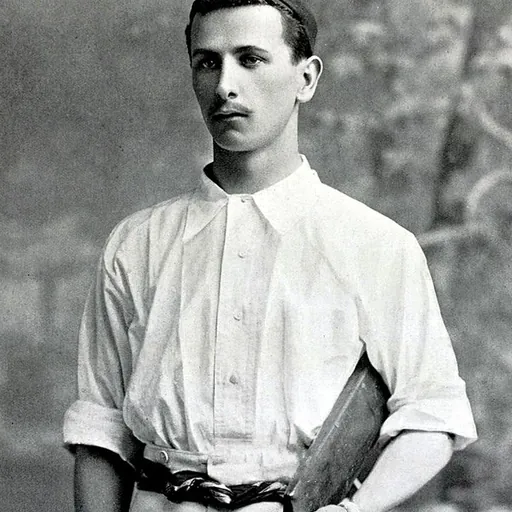
About Johnny Tyldesley
Lived 1873 – 1930 (aged 57). Johnny Tyldesley was a British cricketer.
John Thomas Tyldesley (22 November 1873 – 27 November 1930) was an English cricketer who played first-class cricket for Lancashire and Test cricket for England. He was a specialist professional batsman, usually third in the batting order, who rarely bowled and generally fielded in outfield positions.
Born at Worsley, Lancashire, Tyldesley began his first-class career with Lancashire in 1895, and was a regular player until the First World War began in August 1914. Tyldesley was part of the Lancashire side when they won their first County Championship title in 1897. He played 31 Tests for England between 1899 and 1909, and was part of England teams who won the Ashes in 1903–04, and 1905. Tyldesley served in the British Army during the war, attaining the rank of corporal, and then recommenced his Lancashire career in 1919. He effectively retired from first-class cricket at the end of that season but did make one further appearance in 1923. Through the 1920s, Tyldesley ran a sports goods shop on Deansgate in Manchester. He played for Lancashire Second XI for some years until the end of the 1926 season when he concentrated on coaching, remaining with Lancashire and running his business until he died, aged 57, at his home in Monton, Eccles, Lancashire.
Early years Johnny Tyldesley was born at Roe Green, Worsley on 22 November 1873 and received his early training in Lancashire club cricket, described by Wisden Cricketers' Almanack as "a very stiff school". He played for the Worsley Cricket Club in 1892 and 1893 before joining the Lancashire Second XI in 1894. Wisden considered him "a well equipped batsman" when he made his first-class debut for Lancashire in 1895.
First-class career Lancashire : 1895 to 1898 Tyldesley made his first-class debut, also his County Championship debut, on 22 July 1895, playing for Lancashire against Gloucestershire in a drawn match at Old Trafford. Batting in the middle order, he scored 13 and 33 not out. In his second match for Lancashire, Tyldesley scored 152 not out with 17 fours and 1 six against Warwickshire on a rain-affected pitch at Edgbaston, enabling Lancashire to win by an innings and 54 runs. He played in ten first-class matches in 1895 and 17 in 1896. His innings at Edgbaston remained his only century in that period, though he scored six half-centuries in 1896 with a top score of 68.
Having been runners-up five times in the previous six seasons, Lancashire won their first official County Championship title in 1897. Tyldesley began the season with a run of indifferent scores and did not make a half-century until his fourteenth match, starting on 1 July at Old Trafford, when he scored 54 and 53 against Essex. He followed up with three successive centuries, scoring 106 and 100 not out in the same match against Warwickshire at Edgbaston and then 174, his highest score to date, against Sussex at Old Trafford. After that, his form lapsed again and, apart from one innings of 68 against Somerset at Old Trafford, he made low scores only, including four ducks, in the remainder of the season. He generally batted at number five for Lancashire in 1897. His season tally was 1,017 runs in 26 matches at the average of 30.81. He scored three centuries, three half-centuries and held 13 catches. He surpassed 1,000 runs in a season for the first time, going on to achieve the feat in each of nineteen successive seasons.
England tour of Australia : 1901–02 Tyldesley was not at his Lancashire best but still had a highscore of 66 in the second Test.
Lancashire and England: 1902 to 1903 In the 1902 Ashes J.T. Tyldesley scored 245 runs including a "superb" 138 in four and a half hours at Edgbaston was critical in placing England in a winning position. Almost twenty years later, Jessop remarked on the accuracy of his cutting.
England tour of Australia : 1903–04 Tyldesley toured Australia in 1903–04 and, despite again not making a Test hundred, he played an outstanding innings on a "sticky wicket" in the second Test at the Melbourne Cricket Ground. He was dismissed for 97 in England's first innings when they totalled 315 over the first two days of the match. Rain caused the pitch to deteriorate badly on the third day and Australia were all out for 122, of which Victor Trumper scored 74. England struggled to 74/5 at the close with Tyldesley 48 not out. On the morning of the fourth day, he reached 62 before being dismissed with the England score at 90/8. England were all out for 103 and then dismissed Australia for 111 to win the match by 185 runs. England's captain Pelham Warner said of Tyldesley's 62 that "surely a better innings has never been played on a bad wicket". Cardus agreed with Wisden that Tyldesley was exceptionally quick on his feet and therefore always seemed to have plenty of time in which to play his strokes. Tyldesley was very strong, despite his small size, with quick reflexes and great flexibility in his wrists which assisted both his strokeplay and, when fielding, his throwing.
Tyldesley was an outstanding fielder who specialised in deep positions, mostly at third man or deep long on, and was noted for his speed and ability to quickly gather and accurately return the ball. Kent won the match by an innings and 195 runs, Tyldesley scoring 19 and 4.
Coaching At the end of the 1919 season, Tyldesley retired to concentrate on his business but also took a coaching post with Lancashire. He played one match as Lancashire's first professional captain in 1923 but by then his health was declining.Lancashire won the County Championship twice (1897 and 1904) during Tyldesley's playing career, As cricket coach he played a major role in Lancashire's County Championship successes in the late 1920s. While he was coaching, they won the title four times in five seasons from 1926 to 1930, finishing second in 1929. In all he was part of the first 6 County Championship titles 1897, 1904, (as player) 1926, 1927, 1928, 1930 (as coach).
Family and business A. A. Thomson described Tyldesley as a "skilled, intelligent, well-mannered artisan" who was kindly, studious and without malice. He had been granted a benefit match by Lancashire, against Yorkshire at Old Trafford in 1906, which realised a profit of £3,105.
His younger brother Ernest Tyldesley (1889–1962), who was a top-class batsman for Lancashire and played in 14 Tests for England, remains Lancashire's most prolific run-getter of all time – he himself is second. His great-great-nephew is the former Yorkshire and England captain turned Cricket Commentator Michael Vaughan.
Don’t just read it —
keep it.
Full-length biographies made to live with: read them, listen on the way to work, watch them tonight.
- E-book
- Audio
- Video
Instant download · yours to keep · every purchase keeps this site free
Important facts
People in Johnny Tyldesley's life
Named in this biography and alive at the same time



Related people
Same field, nearest in time




Contemporaries
People whose lives overlapped Johnny Tyldesley's


Frequently asked questions
Who was Johnny Tyldesley?
Cricket player of England. (1873-1930)
When was Johnny Tyldesley born?
Johnny Tyldesley was born on 22 November 1873 in Worsley.
When did Johnny Tyldesley die?
Johnny Tyldesley died on 27 November 1930 in Monton.
What was Johnny Tyldesley's occupation?
Johnny Tyldesley was a cricketer.
What nationality was Johnny Tyldesley?
Johnny Tyldesley was British.
Sources & further reading
Cite this page
APA: Biography.guide. (2026). Johnny Tyldesley. https://biography.guide/johnny-tyldesley/
MLA: "Johnny Tyldesley." Biography.guide, https://biography.guide/johnny-tyldesley/.
Chicago: "Johnny Tyldesley." Biography.guide. https://biography.guide/johnny-tyldesley/.
Data last updated: 2026-09-20 · Spot an error? Report a correction.
Page generated 2026-09-27 05:09 UTC