
John White
English artist, and an early pioneer of English efforts to settle the New World
About John White
Lived 1540 – 1593 (aged 52–53). John White was a British painter, scientific illustrator, cartographer, world traveler, artist and map maker.
John White (–) was an English colonial governor, explorer, artist, and cartographer. White was among those who sailed with Richard Grenville in the first attempt to colonise Roanoke Island in 1585, acting as artist and mapmaker to the expedition. He would most famously briefly serve as the governor of the second attempt to found Roanoke Colony on the same island in 1587 and discover the colonists had mysteriously vanished.
During his time at Roanoke Island, he made several watercolour sketches of the surrounding landscape and the native Algonquian peoples. These works are significant as they are the most informative illustrations of a Native American society of the Eastern seaboard; all of the surviving original watercolours are now preserved in the print room of the British Museum.
In 1587, White became governor of Sir Walter Raleigh's failed attempt at a permanent settlement on Roanoke Island, known to history as the "Lost Colony". This was the earliest effort to establish a permanent English colony in the New World. White's granddaughter Virginia Dare was the first English child born in North America. In late 1587, White returned to England for supplies. The return expedition was delayed due to various reasons, including the Spanish Armada. Governor White finally returned to Roanoke Island in August 1590, but found the colony had been long deserted.
After the failure of the colony, White retired to Raleigh's estates in Ireland, reflecting upon the "evils and unfortunate events" which had ruined his hopes in the New World, though never giving up hope that his daughter and granddaughter were still alive.
Early life John White's exact date of birth is unknown but it seems likely he was born sometime in the 1530s–1540s. In 1587, the arms granted to him were those of the White family of Truro, Cornwall. Despite this, White was not mentioned by name. His drawings from this period were of the lands and people encountered on the voyage.
Gentleman artist In 1585, White had been commissioned to "draw to life" the inhabitants of the New World and their surroundings. During White's time at Roanoke Island, he completed numerous watercolour drawings of the surrounding landscape and native peoples. These works are significant as they are the most informative illustrations of a Native American society of the Eastern Seaboard, and predate the first body of "discovery voyage art" created in the late 18th century by the artists who sailed with Captain James Cook. They represent the sole-surviving visual record of the Native American inhabitants encountered by England's first settlers. White's watercolours would soon become a sensation in Europe; it was not long before the watercolours were engraved by the Flemish master engraver Theodor de Bry. Through the medium of print, the illustrations became widely known and distributed; they were published in 1590 under the title America. His efforts did not go unrewarded; on 7 January 1587, Raleigh named "John White of London Gentleman, to be the chief Governor" of the new colony.
Arrival at Roanoke
In May 1587, White's colonists sailed for Virginia in the Lion. They were guided by the Portuguese navigator Simon Fernandes, the same pilot who had led the 1585 expedition and who was given by his fellow sailors the unhappy nickname of "the swine." The settlers' chosen destination was not Roanoke but the Chesapeake Bay. But, upon reaching Roanoke in late July, Faced with what amounted to a mutiny by his navigator, White appears to have backed down and acquiesced in this sudden change of plan.
This second colony at Roanoke set about repairing the structures left behind in 1585. From an early stage there were tensions with the local Algonquian Indians, choosing a time and place of attack "of great advantage to the savages."
On 8 August 1587, White led a dawn attack on the Dasamongueponkes that went disastrously wrong. White and his soldiers entered the Dasamongueponke village in the morning "so early that it was yet dark," but mistakenly attacked a group of hitherto friendly Indians, killing one and wounding many. "We were deceived," wrote White in his journal, "for the savages were our friends." Henceforth, relations with the local tribes would steadily deteriorate.
Virginia Dare
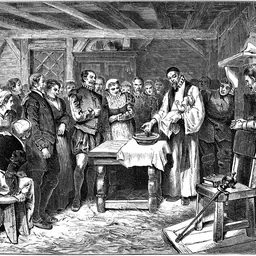
On 18 August 1587, there was happier news – White became a grandfather. "Eleanor, daughter to the governor and wife to Ananias Dare, one of the assistants, was delivered of a daughter in Roanoke." The child was healthy and "was christened there the Sunday following, and because this child was the first Christian born in Virginia, she was named Virginia." Because the colony had been deposited in Roanoke rather than the Chesapeake area, supply ships from England ignorant of Fernandez's change of plan would most likely not land in Roanoke at all, and the settlement might not survive the coming winter. White was reluctant to abandon his colony, anxious that his enemies in England "would not spare to slander [him] falsely" should he leave, and worried that his "stuff and goods might be spoiled and most of it pilfered away."
Misfortune struck White's return to England from the beginning. The anchor of the flyboat on which White was quartered could not be raised, and many crew members were severely injured during the attempt. Worse, their journey home was delayed by "scarce and variable winds" followed by "a storm at the north-east," and many sailors starved or died of scurvy. On 16 October 1587 the desperate crew, at last, landed in Smerwicke, in the west of Ireland, and White was finally able to make his way back to Southampton.
Spanish Armada
Further bad news awaited White on his return to England. Just two weeks previously Queen Elizabeth I had issued a general "stay of shipping," preventing any ships from leaving English shores. The reason was the "invincible fleetes made by the King of Spain, joined with the power of the Pope, for the invading of England" – the Spanish Armada.
Brave and the Roe
In early 1588, White was able to scrape together a pair of small pinnaces, the Brave and the Roe, which were unsuitable for military service and could be spared for the expedition to Roanoke. Unluckily for White, they were barely suited for the Atlantic crossing and the governor endured further bad luck as the ships were intercepted by French pirates, who "playd extreemely upon us with their shot," hitting White (to his great embarrassment) "in the side of the buttoke." White and his crew escaped to England with their lives, but "they robbed us of all our victuals, powder, weapons and provision," and the journey to Virginia had to be abandoned. By this stage White appears to have formed the view that he was born under "an unlucky star." The return journey was prolonged by extensive privateering and several sea battles, and White's eventual landing at the Outer Banks was further imperilled by poor weather. The landing was hazardous and was beset by bad conditions and adverse currents. During the landing on Roanoke, of the mariners who accompanied White, "seven of the chiefest were drowned."
Governor White finally reached Roanoke Island on 18 August 1590, his granddaughter's (Virginia Dare) third birthday, but he found his colony had been long deserted. The buildings had collapsed and "the houses [were] taken downe." The few clues about the colonists' whereabouts included the letters "CRO" carved into a tree, and the word "CROATOAN" carved on a post of the fort.
True to their word, the colonists had looked after White's belongings, which had been carefully buried and hidden. However, local Indians had looted the hiding place, and White found "about the place many of my things spoyled and broken, and my books torne from the covers, the frames of some of my pictures and mappes rotten and spoyled with rayne, and my armour almost eaten through with rust."
Due to the weather, which "grew to be fouler and fouler," White had to abandon the search of adjacent islands for the colonists. The ship's captain had already lost three anchors and could not afford the loss of another. and also owned a house at Newtown, Kylmore (Kilmore, County Cork), Ireland. He appears to have been in Ireland living on the estates of Sir Walter Raleigh, making maps of land for Raleigh's tenants, and reflecting upon the "evils and unfortunate events" which had ruined his hopes in the New World, though never giving up hope that his daughter and granddaughter were still alive.
White's year of death is unclear and not widely known. The last surviving document related to White is a letter he wrote from Ireland in 1593 to the publisher of the prints of his Roanoke drawings. However, a record from May 1606 that Bridget White, who was appointed estate administrator for her brother "John White", may refer to him. Furthermore, another two documents give his year of death as 1606.
Legacy White is chiefly remembered today for his watercolours, which represent a unique record of 16th-century Algonquian society. All of White's surviving works are now in the print room of the British Museum.
In 2007, the British Museum placed the entire group of John White's watercolours on public display under the collection, "A New World: England's First View of America." There are more than seventy watercolours in the travelling exhibit. There were plans to show the collection at the North Carolina Museum of History.
The World War II Liberty ship was named in his honor.
In popular culture In the sixth season of American Horror Story, White is mentioned in the third episode. Kathy Bates portrays Tomasyn "The Butcher" White, his fictional wife and regent-governor while he is away getting supplies from England. Wes Bentley portrays John and Tomasyn's son, Ambrose.
Gallery
Don’t just read it —
keep it.
Full-length biographies made to live with: read them, listen on the way to work, watch them tonight.
- E-book
- Audio
- Video
Instant download · yours to keep · every purchase keeps this site free
Important facts
People in John White's life
Named in this biography and alive at the same time




Related people
Same field, nearest in time

Contemporaries
People whose lives overlapped John White's




Frequently asked questions
Who was John White?
English artist, and an early pioneer of English efforts to settle the New World (1540-1593)
When was John White born?
John White was born in 1540 in London.
When did John White die?
John White died in 1593 in County Cork.
What was John White's occupation?
John White was a painter, scientific illustrator, cartographer, world traveler, artist and map maker.
What nationality was John White?
John White was British.
Sources & further reading
· DBpedia: John White (colonist and artist)
Cite this page
APA: Biography.guide. (2026). John White. https://biography.guide/john-white-painter-1540/
MLA: "John White." Biography.guide, https://biography.guide/john-white-painter-1540/.
Chicago: "John White." Biography.guide. https://biography.guide/john-white-painter-1540/.
Data last updated: 2026-09-26 · Spot an error? Report a correction.
Page generated 2026-09-27 05:14 UTC