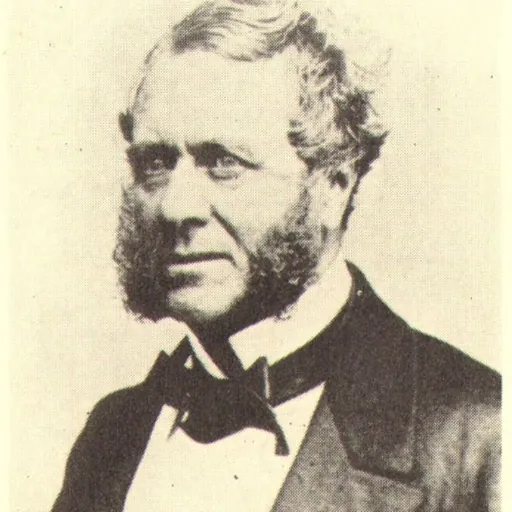
John Washington
British Royal Navy officer and hydrographer
About John Washington
Lived 1800 – 1863 (aged 63). John Washington was a naval officer, geographer, cartographer and hydrographer.
John Washington (1 January 1800 – 16 September 1863) was an officer of the Royal Navy, Hydrographer of the Navy, and a founding member of the Royal Geographical Society of London.
Early career Washington joined the Royal Navy in May 1812, and served aboard with Sir George Cockburn's fleet in Chesapeake Bay, seeing much action in the War of 1812. From October 1813, he was aboard , which was sent to cruise off Greenland in 1814. On this voyage, he learnt much about astronomical and magnetic observations from the Master of the ship, William Bain (Later Sir William). He joined the Royal Naval Academy in November 1814, and graduated in May 1816. He then served for three years aboard on the North American Station, and afterwards as midshipman aboard and on the South American Station.
He was appointed to in February 1823, serving in the West Indies, after which he spent two years on half-pay. He spent this time travelling in France, Spain, and Italy, and improving his knowledge of the languages of these countries. In May 1827, he was appointed to serve on in the Mediterranean, and in December, was moved to , returning to Britain in early 1828. During the winter of 1829-1830 he was exploring and making astronomical observations in Morocco, publishing an account of his travels in 1831. From 1830 to 1833, he was flag lieutenant to Sir John Beresford, Commander-in-Chief, The Nore, and on 14 August 1833, Washington was promoted to the rank of commander. He was one of the original members of the Royal Geographical Society and served as its secretary from 1836 to 1841. In 1838 he published an account of Mohammedu-Siseï, a Mandingo from The Gambia, who had been enslaved, freed, and served as a soldier in the West Indian Regiment. Washington met him in London, and his account describes aspects of Islamic religion and culture in the West Indies.
Surveying
Washington's surveying career began in March 1841 with his first command, the paddle steamer . He took over the North Sea survey after the death of William Hewett, whose ship HMS Fairy was lost with all hands in a storm in 1840. In January 1842, he was temporarily lent to the yacht , which was appointed to bring Frederick William IV of Prussia to England. Washington was made captain on 16 March 1842. In January 1843, he was moved to another paddler, , in which he continued the survey of the east coast of England until 1847. An important part of Washington's work in the North Sea was confirming Hewett's observation of a point with neither rise nor fall of the tide. This had been predicted by William Whewell, and is now known as an amphidromic point. The east coast of England is characterised by many shifting channels in shallow waters. An example is The New Stanford Channel near Lowestoft, a new channel useful for navigation, which Washington documented in 1843.
Harbours and safety at sea Washington's surveying on the east coast included work on harbours. In 1844 he published an account of the changes that had occurred at Harwich, including accelerating encroachment of the sea on the western side of the harbour entrance, with resulting changes in currents and silting up of useful approach channels. He attributed this to the quarrying of cement stone from the cliffs, estimating that at least a million tons had been removeds since 1812. He recommended remedies including abolition of quarrying and the construction of a breakwater. He was one of the commissioners appointed to investigate the subject of harbours of refuge, and in January 1845 he was appointed a commissioner for inquiring into the state of the rivers, shores, and harbours of the United Kingdom. In February of the same year he was elected a Fellow of the Royal Society. After completing his work in the North Sea, he was employed in the railway and harbour department of the admiralty. Following the report, the use of decked vessels was encouraged, and became generally accepted by the late 1860s.
In 1850, supported by the Duke of Northumberland, Washington launched a competition for the design of a new life-boat, with a prize of 100 guineas (£105). A committee was set up to judge the entries, with Washington as chairman, and produced a report the following year, which included illustrations of the most promising designs, and also a chart marking the wrecks round the coasts of Britain and Ireland in 1850. The winning design, with modifications after testing, was adopted by the National Life-Boat Institution.
Commercial hydrographer
After the war with Russia was over, Washington turned his attention to the production and sale of charts. Beaufort had insisted on personally inspecting every chart before it was published, and this had led to delays and a backlog of unpublished charts. Washington accepted the need for careful review, but delegated this work to naval assistants, initially to Captain A.B. Becher, then increasingly to more junior assistants. Chart production and distribution were also re-organised, printing being outsourced to Messrs. Malby and Sons, and the sale of charts by agents and the updating and correction of stock regularised. In the 1864 catalogue, 2,500 charts were listed, a 20 percent increase since 1855. Sales revenue also increased. Surveying activity was also increased, with more surveys ongoing than at any time before or since. A new initiative during this period was deep-sea sounding in preparation for the laying of long-distance telegraph cables. The first submarine communications cable had been laid between Dover and Calais in 1850, but cables beyond the continental shelf presented much greater difficulties. Several possible routes for transatlantic telegraph cable were surveyed by Lieutenant Dayman, though the first successful cable was not laid until after Washington's death.
Naval organisation Washington pioneered a major change in naval organisation concerning the role of Masters. These trained specialists were responsible for the navigation of all but the smallest ships, but although they had great responsibility, and were sometimes in command of ships, they were not of officer rank. Although a few masters did become officers, there was no accepted promotion path. The reforms advocated by Washington led to the creation of a new officer rank of Navigating Lieutenant, and over a period all masters were transferred to this rank or became staff commanders.
Zambezi expedition Washington gave considerable assistance to David Livingstone's Zambezi expedition of 1858-1864, providing personnel and craft, and there was frequent correspondence between him and Livingstone during the expedition.
Death and funeral Washington was promoted to the rank of rear-admiral on 12 April 1862. In the following year he became ill, and travelled to Le Havre, then to Switzerland. He returned to Le Havre and died there. Many at the time believed that his illness and death were the result of overwork and worry about accusations in the press that failings in the hydrographic office had led to the loss of in New Zealand. His funeral in Le Havre, on 19 September was attended by French civil, and military representatives as well as by British seamen and townspeople.
Don’t just read it —
keep it.
Full-length biographies made to live with: read them, listen on the way to work, watch them tonight.
- E-book
- Audio
- Video
Instant download · yours to keep · every purchase keeps this site free
Important facts
People in John Washington's life
Named in this biography and alive at the same time

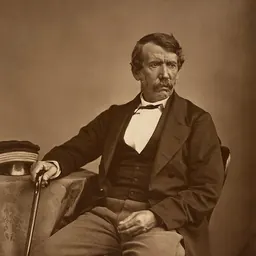
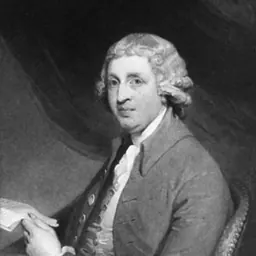
Related people
Same field, nearest in time



Contemporaries
People whose lives overlapped John Washington's





Frequently asked questions
Who was John Washington?
British Royal Navy officer and hydrographer (1800-1863)
When was John Washington born?
John Washington was born on 1 January 1800 in Crondall.
When did John Washington die?
John Washington died on 16 September 1863 in Le Havre.
What was John Washington's occupation?
John Washington was a naval officer, geographer, cartographer and hydrographer.
Sources & further reading
· DBpedia: John Washington (Royal Navy officer)
Cite this page
APA: Biography.guide. (2026). John Washington. https://biography.guide/john-washington-naval-officer/
MLA: "John Washington." Biography.guide, https://biography.guide/john-washington-naval-officer/.
Chicago: "John Washington." Biography.guide. https://biography.guide/john-washington-naval-officer/.
Data last updated: 2026-09-22 · Spot an error? Report a correction.
Portrait: Wikimedia Commons · author & licence
Page generated 2026-09-27 05:01 UTC