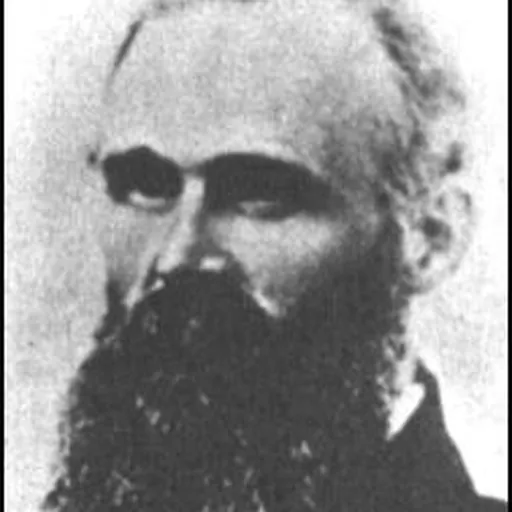
About John W. Phelps
Lived 1813 – 1885 (aged 71). John W. Phelps was an American military officer.
John Wolcott Phelps (November 13, 1813 – February 1, 1885) was a general in the Union Army during the American Civil War, an author, an ardent abolitionist and presidential candidate.
Soldier and abolitionist Phelps was born in Guilford, Vermont, the son of Judge John and Lucy (Lovell) Phelps. He was appointed to the United States Military Academy on July 1, 1832, and graduated on July 1, 1836, with the brevet rank of Second Lieutenant, and was assigned to the 4th U.S. Artillery. He was promoted to Second Lieutenant on July 28, 1836. He fought in the Creek and Seminole War in 1838, and participated in the Trail of Tears that same year.
Organizing of black troops General Phelps was afterward stationed at Camp Parapet in Carrollton, seven miles from New Orleans. Many fugitive slaves arrived at the camp seeking refuge. General Phelps organized the black men of military age into companies. He then formally asked his commanding officer, General Butler, for arms for the blacks. General Phelps thought he could organize three regiments of Africans to help defend his camp. General Butler ordered Phelps to put the Negros to work cutting down trees around the camp, and instead of furnishing guns, ordered his quartermaster to send axes and tents for the fugitive slaves. General Phelps was unwilling to employ the Africans as mere laborers, becoming what he viewed as their slave-driver, "having no qualification that way," and offered his resignation on August 21, 1862. General Butler refused to accept it. Later that August, General Phelps returned his commission to President Abraham Lincoln.
After Lincoln issued the Emancipation Proclamation on January 1, 1863, the federal administration adopted a policy of organizing United States Colored Troops. The President offered General Phelps a Major General's commission. General Phelps wanted the commission backdated to the day of his resignation the prior year. The President could not allow the implied contravention of General Butler's original orders, which were in good standing for that time, and would not agree to General Phelps' terms.
At New Orleans, Phelps had organized a few squads of Negroes and drilled them daily. . . . Not knowing what to do with so many Negroes, Butler at first returned the runaway slaves to their masters. But still the contrabands came. Some of them were employed as cooks, nurses, washwomen, and laborers. . . . [Finally] Butler ordered . . . the exclusion of all unemployed Negroes and whites from his lines.
For his organization of and attempt to arm escaped slaves, Confederate President Jefferson Davis issued an order on August 21, 1862, declaring Phelps an outlaw, for having "organized and armed negro slaves for military service against their masters, citizens of the Confederacy." Black Federal soldiers were condemned by the Confederacy as robbers and criminals, punishable by death. Many were warned by their officers before going into battle that they would be executed if captured. His running mate was Samuel C. Pomeroy of Kansas who four years later in 1884 would seek the White House as the presidential candidate of the American Prohibition National Party. In the 1880 race, the Phelps/Pomeroy ticket garnered only 1,045 votes nationwide. They ran on an eleven-point platform calling for such things as the prohibition of alcoholic beverages, the prohibition of all secret lodges, justice for Indians, demanding the Bible be a required text in all educational institutions; and the abolition of the electoral college.
He was vice president of the Vermont Historical Society from 1863 to 1885, and reported on the discovery of mammoth remains in Brattleboro and Richmond.
Phelps died in Guilford on February 1, 1885.
Don’t just read it —
keep it.
Full-length biographies made to live with: read them, listen on the way to work, watch them tonight.
- E-book
- Audio
- Video
Instant download · yours to keep · every purchase keeps this site free
Important facts
People in John W. Phelps's life
Named in this biography and alive at the same time

Related people
Same field, nearest in time

Contemporaries
People whose lives overlapped John W. Phelps's






Frequently asked questions
Who was John W. Phelps?
Union Army general from Vermont (1813-1885)
When was John W. Phelps born?
John W. Phelps was born on 13 November 1813 in Guilford.
When did John W. Phelps die?
John W. Phelps died on 2 February 1885 in Guilford.
What was John W. Phelps's occupation?
John W. Phelps was a military officer.
What nationality was John W. Phelps?
John W. Phelps was American.
Sources & further reading
Cite this page
APA: Biography.guide. (2026). John W. Phelps. https://biography.guide/john-w-phelps/
MLA: "John W. Phelps." Biography.guide, https://biography.guide/john-w-phelps/.
Chicago: "John W. Phelps." Biography.guide. https://biography.guide/john-w-phelps/.
Data last updated: 2026-09-23 · Spot an error? Report a correction.
Portrait: Wikimedia Commons · author & licence
Page generated 2026-09-27 05:05 UTC