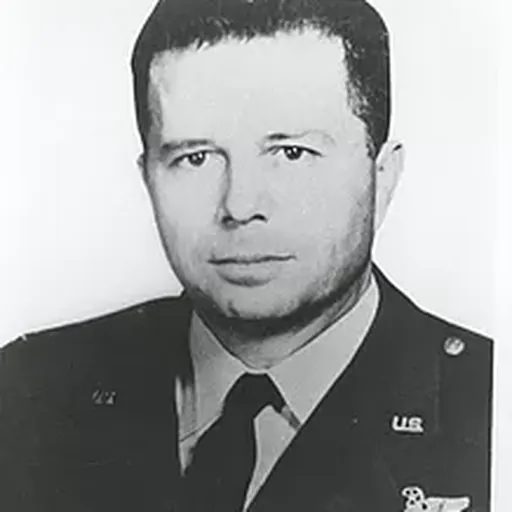
About John W. Mitchell
Lived 1915 – 1995 (aged 80). John W. Mitchell was an American military personnel and aircraft pilot.
John William Mitchell (June 14, 1914 – November 15, 1995) was an officer of the United States Air Force, a flying ace and the leader of Operation Vengeance, the mission to shoot down Admiral Isoroku Yamamoto. He served in World War II and the Korean War.
Early life Mitchell was born in Enid, Mississippi to Noah Boothe Mitchell (1881–1967) and Lillian Dickinson Mitchell (1880–1921) on June 14, 1914. Mitchell was a valedictorian of his high school class. He graduated at Columbia University with a degree in Economics on 1934 and continued at the University of Chicago, where he obtained his diploma on 1939.
Members of the 339th Fighter Squadron; Mitchell is fifth from the left, in the front row. Overnight at Henderson Field, ground crews fitted large new fuel tanks under the wings of the P-38Gs. By dawn on April 18, 18 aircraft were ready. Mitchell's last instructions before the 07:00 take-off were to maintain radio silence. The flight proceeded northwest at wave-top level to avoid Japanese spotters, sweeping widely away from New Georgia. Mitchell tried to hold the planes at thirty feet; with only the ocean below, depth perception was almost non-existent. By 08:00, the P-38s were 285 miles from the planned interception. At that minute, Admiral Yamamoto's G4M Betty bomber took off from Rabaul, on time for his scheduled 10:00 arrival at Bougainville. His entourage, including his chief of staff, Admiral Matome Ugaki, was aboard two other G4M Betty bombers, and the bomber flight was escorted by six A6M Zeros.
At 08:20, the P-38s changed their heading for the first time, swinging slightly to the north. Half an hour later, when abreast of Vella Lavella, they made their second planned course change, again shifting a little more to the north. At 09:00, Mitchell made their last change, heading northeast, directly toward the coast of Bougainville, only 40 miles away. He also began the slow climb for altitude at this point. At 09:34 Doug Canning called out "Bogeys, eleven o'clock high." The P-38 pilots jettisoned their drop tanks and attacked. Holmes and Hine had trouble with their tanks; Lanphier, at least initially, headed for the escort flight, while Barber engaged the Japanese bombers. All the other P-38Gs followed their instructions to fly cover against the Zero fighters.
Both Thomas G. Lanphier and Rex Barber claimed one bomber shot down over the jungles of Bougainville. Besby Holmes claimed another shot down over the water a few minutes later. From Japanese records and survivors, among them Admiral Ugaki, the following facts are certain: only two G4M Betty bombers were attacked; Yamamoto's was shot down over Bougainville with no survivors; the second went into the ocean and Admiral Ugaki was among the three survivors. The day following the attack, a Japanese search party located the wreckage, including Yamamoto's body, which they ceremonially cremated.
Post mission
After the mission, Mitchell served a tour with Headquarters Army Air Forces from June to December 1943. His total score in Guadalcanal was eight enemy planes destroyed. Then he was assigned to the 412th Fighter Group, where he served from December 1943 to April 1945. Mitchell flew Supermarine Spitfires and Hawker Hurricanes as an observer in England in April and May 1945.
Mitchell was credited with destroying a total of 11 enemy aircraft in aerial combat during World War II.
Post war After United States Army Air Forces became United States Air Force, Mitchell was assigned as director of training and operations at Keesler Field, Mississippi, from February 1946 to August 1947. He attended Air Command and Staff College at Maxwell Air Force Base, Alabama from August 1947 to June 1948, and then served as base commander at Godman Air Force Base, Kentucky, from June 1948 to July 1949. Mitchell served with the 63d Fighter Wing at Brooks Air Force Base, Texas, from July 1949 to November 1950, and then served as commander of the 57th Fighter Interceptor Group at Eielson Air Force Base, Alaska, from November 1950 to June 1952.
"Mitchell was madder than any colonel the pilot had ever seen"
Mitchell and Lt Gen. Glenn O. Barcus, the commanding general of Fifth Air Force, made a lot of personnel changes and even attempted to strip one pilot, Capt. Dolphin Overton, of his flying ace status.
Later life Mitchell died on November 15, 1995, at the age of 81. He was buried at the Golden Gate National Cemetery on November 30.
Aerial victory credits SOURCES: Air Force Historical Study 85: USAF Credits for the Destruction of Enemy Aircraft, World War II and Air Force Historical Study 81: USAF Credits for the Destruction of Enemy Aircraft, Korean War, Freeman 1993
Awards and decorations Mitchell's decorations include:
USAF Command PilotDistinguished Service CrossNavy CrossLegion of MeritDistinguished Flying Crosswith 2 bronze oak leaf clustersBronze StarAir Medalwith 1 silver and 3 bronze oak leaf clustersAir Medal(second ribbon required for accouterment spacing)Army Commendation MedalAir Force Presidential Unit CitationNavy Presidential Unit Citationwith 1 service starAmerican Defense Service MedalAmerican Campaign MedalAsiatic-Pacific Campaign Medalwith 4 bronze campaign starsWorld War II Victory MedalArmy of Occupation Medalwith 'Japan' claspNational Defense Service MedalKorean Service Medalwith 3 bronze campaign starsAir Force Longevity Service Awardwith 1 silver oak leaf clusterArmed Forces Reserve Medal Republic of Korea Presidential Unit CitationUnited Nations Korea MedalRepublic of Korea War Service Medal
Distinguished Service Cross
Citation:
"The President of the United States of America, authorized by Act of Congress, July 9, 1918, takes pleasure in presenting the Distinguished Service Cross to Major (Air Corps), {then Captain} John W. Mitchell, United States Army Air Forces, for extraordinary heroism in air actions against the enemy while serving as a Pilot with the 67th Fighter Squadron and later as Commander of the 339th Fighter Squadron, 347th Fighter Group, 13th Air Force, during the periods 4 October 1942 to 10 November 1942 and from 22 December 1942 to 4 February 1943. On 4 October, Major Mitchell led a flight of eleven P-39 airplanes to Guadalcanal, arriving there on 7 October. On 9 October, he led a flight of P-39 airplanes on two escort missions for SBD airplanes against an enemy naval force 150 miles off Guadalcanal; part of the second mission being accomplished after dark and being extremely hazardous due to the very low ceiling and no landing lights. He destroyed one enemy float bi-plane; others of the flight probably destroyed two others, all returning safely to base. On 23 October, he shot down one enemy Zero while leading a flight of P-39 airplanes on patrol over Guadalcanal, and returning and landing safely after dark in heavy rain. On 7 November, he led a flight of eight P-39's loaded with 500-pound bombs on a dive-bombing mission against an enemy naval force of one cruiser and fourteen destroyers. Intercepted by five enemy float "Zeroes" he destroyed one, and the flight shot down the balance, all returning safely. On 5 January, while with six P-38 airplanes on an escort mission for five B-17 bombers, some twenty-five enemy planes attacked. Outnumbered four-to-one, the fighters destroyed three of the enemy and probable three others, Major Mitchell accounting for one float Zero. On 27 January, he led a flight of six P-38's against a superior force of about thirty "Zeroes" over Guadalcanal and destroyed two of them himself. On 29 January, he took off alone from Henderson Field, Guadalcanal, before daylight in a P-38 to intercept enemy bombers that had been harassing the troops by bombing each night and shot down an enemy type 97 medium bomber making a low-level bombing and strafing run on the field. On 2 February, he led a flight of four P-38's as a bomber escort and shot down one float "Zero" of the three enemy planes accounted for by the flight. Major Mitchell has destroyed more than five enemy airplanes, having shot down a total of eight confirmed, destroyed an undetermined number on the ground and water during strafing strikes at Rekata Bay and Munda Point, and led numerous other missions in addition to those specifically mentioned, in over 150 hours of combat flying time as Flight Commander."
Navy Cross
Citation:
"The President of the United States of America takes pleasure in presenting the Navy Cross to Major (Air Corps) John W. Mitchell, United States Army Air Forces, for extraordinary heroism while serving with the 339th Fighter Squadron, 347th Fighter Group, 13th Air Force, attached to a Marine Fighter Command in action against enemy Japanese forces in the Solomon Islands on 18 April 1943. Leading a flight of sixteen fighter planes at dangerously low altitude in the longest planned interception mission ever attempted, Major Mitchell contacted the assigned objective, consisting of two enemy bombers and six escort fighters, with complete tactical surprise and launched a fierce, determined attack. In the ensuing engagement he directed the operations of his group with such outstanding professional skill and daring courage that they shot down both bombers in flames, three of the hostile escort aircraft and another bomber, not in company, which was sighted approaching the nearby enemy base at Kahili. With full appreciation of the technical accuracy required for the achievement of this vital mission, Major Mitchell completed the difficult assignment with remarkable success. His brilliant leadership and valiant devotion to duty under extremely adverse conditions contributed greatly to the efforts of our forces in the Solomon Islands and were in keeping with the highest traditions of the United States Armed Services."
Don’t just read it —
keep it.
Full-length biographies made to live with: read them, listen on the way to work, watch them tonight.
- E-book
- Audio
- Video
Instant download · yours to keep · every purchase keeps this site free
Important facts
People in John W. Mitchell's life
Named in this biography and alive at the same time






Related people
Same field, nearest in time


Contemporaries
People whose lives overlapped John W. Mitchell's



Frequently asked questions
Who was John W. Mitchell?
officer of the US Air Force (1914-1995)
When was John W. Mitchell born?
John W. Mitchell was born on 14 July 1915 in Enid.
When did John W. Mitchell die?
John W. Mitchell died on 15 November 1995 in Enid.
What was John W. Mitchell's occupation?
John W. Mitchell was a military personnel and aircraft pilot.
What nationality was John W. Mitchell?
John W. Mitchell was American.
Sources & further reading
· DBpedia: John W. Mitchell (United States Air Force)
Cite this page
APA: Biography.guide. (2026). John W. Mitchell. https://biography.guide/john-w-mitchell/
MLA: "John W. Mitchell." Biography.guide, https://biography.guide/john-w-mitchell/.
Chicago: "John W. Mitchell." Biography.guide. https://biography.guide/john-w-mitchell/.
Data last updated: 2026-09-20 · Spot an error? Report a correction.
Page generated 2026-09-27 05:10 UTC