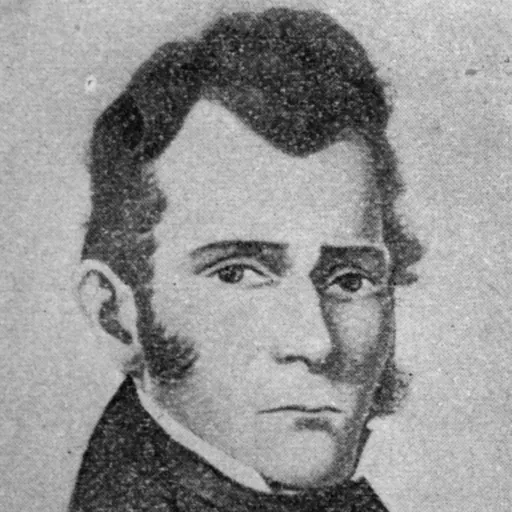
About John Tipton
Lived 1786 – 1839 (aged 52). John Tipton was an American politician and writer.
John Shields Tipton (August 14, 1786 – April 5, 1839) was from Tennessee and became a farmer in Indiana; an officer in the 1811 Battle of Tippecanoe, and veteran officer of the War of 1812, in which he reached the rank of Brigadier General; and politician. He was elected to the Indiana General Assembly in 1819, and in 1831 as US Senator from the state of Indiana, serving until 1838. He was appointed as US Indian Agent and was selected to lead the militia in removing Menominee's band of Potawatomie in 1838; they were relocated to Kansas, Indian Territory.
Early life Tipton, a son of Joshua and Janet Shields Tipton, was born in what is now Sevier County, Tennessee. When Tipton was only 6 years old his father was killed by Native Americans. His great uncle, also named John Tipton, was a prominent man in the area. When Tipton was an infant, his uncle's house was besieged by supporters of an effort to create the 14th state in Northeastern Tennessee called the State of Franklin.At the age of 17, Tipton moved to Harrison County, Indiana. In 1806 he married his 1st cousin Martha Shields, a daughter of John Shields of Lewis and Clark fame. He became a farmer. Fighting various Native American tribes in the area, he commanded a militia unit of the Yellow Jackets in the Battle of Tippecanoe campaign in 1811.
War of 1812
Serving at Fort Vallonia He served as Major in command of two companies of Indiana Rangers at Fort Vallonia during the War of 1812 with Great Britain.
Battle of Stoney Creek On the 6th of June 1813, he fought at the Battle of Stoney Creek, Ontario, Canada.
Promotion at the end of the War When peace was declared, Tipton was promoted to Brigadier-General. He entered politics, being elected as a member of the Indiana State House of Representatives and serving two terms, from 1819 to 1823. During this time, he founded the town of Columbus, Indiana originally known as Tiptonia. Tipton was later appointed as the highway commissioner for the State of Indiana and was assigned to building a highway from Indianapolis, Indiana to Louisville, Kentucky. When the road approached Columbus, Tipton constructed the first bypass road ever built; it detoured south around the west side of Columbus en route to Seymour. He also participated in commissions to establish a new state capital for Indiana and to set the boundaries between Indiana and Illinois. In 1823, he was appointed as the United States Indian agent for the Potawatomi and Miami tribes.
In 1825, he married again, this time to Matilda Spencer, the daughter of the late Captain Spier Spencer. Her father died at the Battle of Tippecanoe in 1811.
The towns of Tipton, Indiana, and Iowa, and Tipton County, Indiana are named after him.
Don’t just read it —
keep it.
Full-length biographies made to live with: read them, listen on the way to work, watch them tonight.
- E-book
- Audio
- Video
Instant download · yours to keep · every purchase keeps this site free
Important facts
People in John Tipton's life
Named in this biography and alive at the same time


Related people
Same field, nearest in time


Contemporaries
People whose lives overlapped John Tipton's

Frequently asked questions
Who was John Tipton?
American politician (1786-1839)
When was John Tipton born?
John Tipton was born on 14 August 1786 in Sevier County.
When did John Tipton die?
John Tipton died on 5 April 1839 in Logansport.
What was John Tipton's occupation?
John Tipton was a politician and writer.
What nationality was John Tipton?
John Tipton was American.
Sources & further reading
Cite this page
APA: Biography.guide. (2026). John Tipton. https://biography.guide/john-tipton-politician-1786/
MLA: "John Tipton." Biography.guide, https://biography.guide/john-tipton-politician-1786/.
Chicago: "John Tipton." Biography.guide. https://biography.guide/john-tipton-politician-1786/.
Data last updated: 2026-09-21 · Spot an error? Report a correction.
Portrait: Wikimedia Commons · author & licence
Page generated 2026-09-27 04:59 UTC