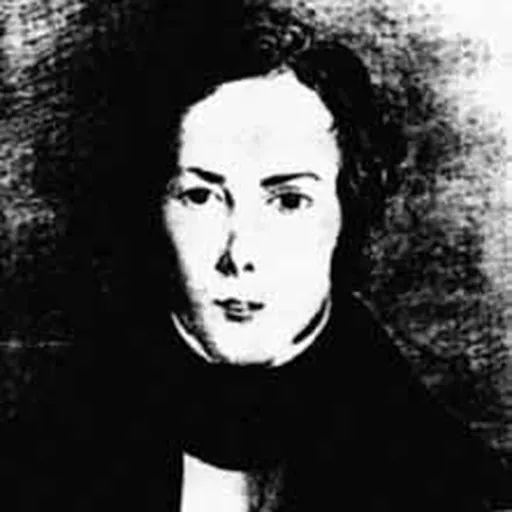
About John T. Graves
Lived 1806 – 1870 (aged 63). John T. Graves was an Irish and British mathematician, university teacher, lawyer and local government officer.
John Thomas Graves (4 December 1806 29 March 1870) was an Irish jurist and mathematician. He was a friend of William Rowan Hamilton, and is credited both with inspiring Hamilton to discover the quaternions in October 1843 and then discovering their generalization the octonions himself (he called them octaves) later that same year. He was the brother of both the mathematician and bishop Charles Graves and the writer and clergyman Robert Perceval Graves.
Life Born in Dublin 4 December 1806, he was son of John Crosbie Graves, barrister, grandnephew of Richard Graves, D.D., and cousin of Robert James Graves, M.D. He was sent to school in England, in the parish of Westbury-on-Trym, then a village outside Bristol, under the Rev. Samuel Feild (Field in the Oxford Dictionary of National Biography), later vicar of Hatherleigh. Feild has been described as a "prominent second generation evangelical Anglican"; he was one of two curates in the parish, under Richard Carrow, the parish priest, as perpetual curate.
Graves was an undergraduate at Trinity College Dublin, where he distinguished himself in both science and classics, and was a class-fellow and friend of William Rowan Hamilton, graduating B.A. in 1827. He then moved to Oxford, where he became an incorporated member of Oriel College, 11 November 1830. Graves proceeded M.A. at Oxford in 1831, and at Dublin in 1832.
Having in 1830 entered the King's Inns, Dublin, Graves was called to the English bar in 1831, as a member of the Inner Temple. and died without issue on 29 March 1870 at Cheltenham.
In the same report is a supporting paper by Hamilton, On Conjugate Functions or Algebraic Couples, as tending to illustrate generally the Doctrine of Imaginary Quantities, and as confirming the Results of Mr. Graves respecting the existence of Two independent Integers in the complete expression of an Imaginary Logarithm. It was an anticipation, as far as publication was concerned, of an extended memoir, which had been read by Hamilton before the Royal Irish Academy on 24 November 1833, On Conjugate Functions or Algebraic Couples, and subsequently published in the seventeenth volume of the Transactions of the Royal Irish Academy. To this memoir were prefixed A Preliminary and Elementary Essay on Algebra as the Science of Pure Time, and some General Introductory Remarks. In the concluding paragraphs of each of these three papers Hamilton acknowledges that it was "in reflecting on the important symbolical results of Mr. Graves respecting imaginary logarithms, and in attempting to explain to himself the theoretical meaning of those remarkable symbolisms", that he was conducted to "the theory of conjugate functions, which, leading on to a theory of triplets and sets of moments, steps, and numbers" were foundational for his own work, culminating in the discovery of quaternions. Shortly before the discovery, Graves wrote in a letter addressed to Hamilton on 26 October 1843, "If with your alchemy you can make three pounds of gold, why should you stop there?"
Graves devised also a pure-triplet system founded on the roots of positive unity, simultaneously with his brother Charles Graves, the bishop of Limerick. He afterwards stimulated Hamilton to the study of polyhedra, and was told of the discovery of the icosian calculus. The library, which is believed to be the largest collection of mathematical works in the UK, contains a first edition of Sir Issac Newton's Philosophiæ Naturalis Principia Mathematica.
UCL also holds notes for jurisprudence lectures given by Graves between 18391843 and documents relating to Graves' career.
Don’t just read it —
keep it.
Full-length biographies made to live with: read them, listen on the way to work, watch them tonight.
- E-book
- Audio
- Video
Instant download · yours to keep · every purchase keeps this site free
Important facts
People in John T. Graves's life
Named in this biography and alive at the same time

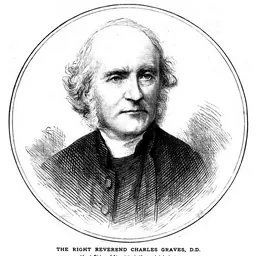

Related people
Same field, nearest in time




Contemporaries
People whose lives overlapped John T. Graves's





Frequently asked questions
Who was John T. Graves?
Irish mathematician (1806–1870)
When was John T. Graves born?
John T. Graves was born on 4 December 1806 in Dublin.
When did John T. Graves die?
John T. Graves died on 29 March 1870 in Cheltenham.
What was John T. Graves's occupation?
John T. Graves was a mathematician, university teacher, lawyer and local government officer.
What nationality was John T. Graves?
John T. Graves was Irish and British.
Sources & further reading
Cite this page
APA: Biography.guide. (2026). John T. Graves. https://biography.guide/john-t-graves/
MLA: "John T. Graves." Biography.guide, https://biography.guide/john-t-graves/.
Chicago: "John T. Graves." Biography.guide. https://biography.guide/john-t-graves/.
Data last updated: 2026-09-22 · Spot an error? Report a correction.
Portrait: Wikimedia Commons · author & licence
Page generated 2026-09-27 05:04 UTC