
John Scandrett Harford
British banker, benefactor and abolitionist, died 1866
About John Scandrett Harford
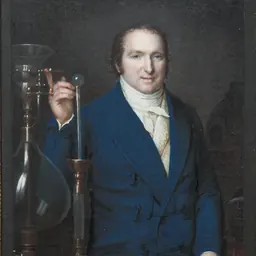
Lived 1785 – 1866 (aged 80). John Scandrett Harford was a British painter, politician, businessperson and abolitionist.
John Scandrett Harford, FRS (8 October 1785 – 16 April 1866) was a British banker, benefactor and abolitionist.
Early life and background Harford was the son of John Scandrett Harford, a prominent banker in Bristol. By the end of the 18th century the elder John Scandrett Harford was a wealthy landowner, and a staunch Quaker. He married Mary Gray, daughter of Abraham Gray of Tottenham.
John Scandrett Harford the younger had a Quaker upbringing, but in 1809 was baptised in the Church of England, at Chelwood. He had schooling under Charles Lloyd at Peterley House, Great Missenden.
Property The Harford properties included the Blaise Castle Estate at Henbury. This had belonged to Thomas Farr, who went bankrupt in 1778 following outbreak of the American Revolutionary War. The estate then changed hands a number of times before John Harford the elder purchased the land and buildings. Diamond Cottage is an example of the extremely picturesque style of the cottages.
In 1819, Harford also acquired the Peterwell estate at Lampeter, making the purchase jointly with his younger brothers. It was previously owned by his father-in-law, Richard Hart Davis, who had built c.1812 a house within its bounds. The estate descended to his nephew John Battersby Harford, who remodelled the house in the Italianate style in 1859 as Falcondale.
Educational interests John Harford the Elder was a patron of Hannah More's schools in Somerset in the 1790s. Maria Edgeworth claimed that the main character in More's popular novel Coelebs in Search of a Wife was modeled on the younger Harford.
In spring 1820, Harford met Thomas Burgess, the bishop of St Davids, at the home of Henry Ryder, the bishop of Gloucester. Burgess mentioned his 'projected college for clerical education in South Wales,' although at this time 'he did not appear to be sanguine in the hope of speedily realising the plan.' Harford knew that a college at Lampeter 'would tend to civilise and improve the vicinity.' In the autumn of 1820, Harford offered to donate to Burgess the site of Lampeter Castle, 'Castle Field' or 'Cae Castell' in Welsh, which, as Lords of the Manor of Lampeter, he and his brothers now owned. As such, it is on land donated by Harford that the Lampeter campus of the University of Wales Trinity Saint David (formerly St David's College) now stands. A bust of Harford is in the collection of the University. Two halls of residence at the university, Harford I and Harford II, are also named after him.
Later life Harford was appointed High Sheriff of Cardiganshire for 1825–26.
Macugnaga, M. Rosa/ Cima di Jagi (1846) by John Scandrett Harford
He was also a moderately successful artist, and his oil paintings can often be found at auctions in the UK. He was elected a Fellow of the Royal Society in 1823, and was the founding President of what is now the Royal West of England Academy (then the Bristol Academy of Fine Arts) from its inception in 1844 until 1859. In later life he went blind, and he died at Blaise Castle in 1866.
Family Harford in 1812 married Louisa, the daughter of Richard Hart Davis. He died without children at Blaise Castle, his heir being John Battersby Harford, a nephew. There also records of the Peterwell and Falcondale estates of the Harford family at the National Library of Wales.
Published works Some account of the life of Thomas Paine, Bristol, 1819 Aeschylus : Agamemnon....Translated from Greek by J. S. Harford, London : Murray, 1831 Life of Thomas Burgess, London: Eyre & Spottiswood, 1840. 2nd ed. London : Eyre, 1841 Life of Michaelangelo Buonarroti, Longman & Roberts, 1857; Spottiswoode & Co., 1858 Recollections of William Wilberforce, 1st ed., Longman, Green, Longman, Roberts, & Green, London, 1864
Don’t just read it —
keep it.
Full-length biographies made to live with: read them, listen on the way to work, watch them tonight.
- E-book
- Audio
- Video
Instant download · yours to keep · every purchase keeps this site free
Important facts
People in John Scandrett Harford's life
Named in this biography and alive at the same time





Related people
Same field, nearest in time



Contemporaries
People whose lives overlapped John Scandrett Harford's


Frequently asked questions
Who was John Scandrett Harford?
British banker, benefactor and abolitionist, died 1866
When was John Scandrett Harford born?
John Scandrett Harford was born on 8 October 1785 in Bristol.
When did John Scandrett Harford die?
John Scandrett Harford died on 16 April 1866 in Blaise Castle House.
What was John Scandrett Harford's occupation?
John Scandrett Harford was a painter, politician, businessperson and abolitionist.
What nationality was John Scandrett Harford?
John Scandrett Harford was British.
Sources & further reading
· Wikipedia: John Scandrett Harford
· DBpedia: John Scandrett Harford
Cite this page
APA: Biography.guide. (2026). John Scandrett Harford. https://biography.guide/john-scandrett-harford/
MLA: "John Scandrett Harford." Biography.guide, https://biography.guide/john-scandrett-harford/.
Chicago: "John Scandrett Harford." Biography.guide. https://biography.guide/john-scandrett-harford/.
Data last updated: 2026-09-20 · Spot an error? Report a correction.
Page generated 2026-09-27 05:22 UTC