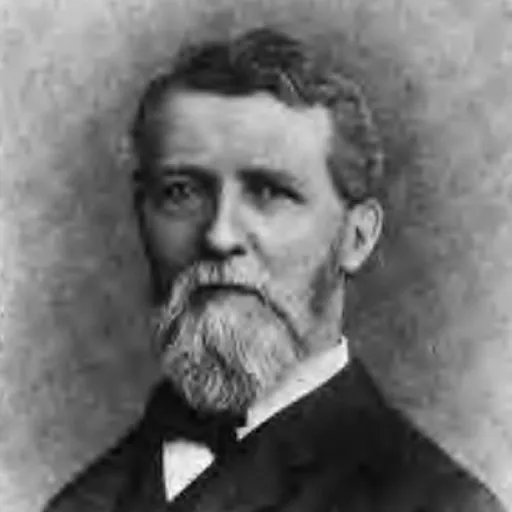
About John Rogers
Lived 1829 – 1904 (aged 74). John Rogers was an American sculptor.
John Rogers (October 30, 1829 – July 26, 1904) was an American sculptor who produced very popular, relatively inexpensive figurines in the latter 19th century.
He became famous for his small genre sculptures, popularly termed "Rogers Groups", which were mass-produced in cast plaster. A total of 80,000 copies of almost 80 Rogers Groups were sold across the United States and abroad.
At the height of their popularity, Rogers' figurines graced the parlors of homes in the United States and were found as far away as Chile and Australia. The English novelist Charles Reade furnished his home with all the Rogers figurines available to him, and in the Dakota Territory, Lt. Col. George Custer and his wife had one. Often selling for $15 apiece, the figurines were affordable to the middle class. Rogers was inspired by popular novels, poems and prints as well as the scenes he saw around him.
Recognition
John Rogers's statuettes celebrated the lives of ordinary people, urban and rural alike, in portraits that conveyed and endorsed shared American values. Through his Rogers Groups, he offered an unrivaled transcript of the manners, sports, amusements, social customs, domestic interests, costumes, and even modes of furnishing of the period. John Rogers made statues of Civil War soldiers, family groups, literary topics, theater scenes and heroic historical figures. His statues ranged from eight to forty-six inches tall.
Between 1860 and 1893 Rogers sculpted approximately 85 different, mostly patented groups of statuary. During that period, some 25 workman in his New York factory turned out thousands of plaster castings of his works. Some subjects he executed were only reproduced in a few copies. Of others, thousands were sold. Over Rogers' 30-year career, the artist sold over a million dollars of sculpture (about $30,000,000 in 2015, adjusted for inflation). It is estimated that a total of 80,000–100,000 plaster castings of his groups were produced during John Rogers’ lifetime. By the 1880s, it seemed that families who did not have a John Rogers Group were not conforming to the times. Even Abraham Lincoln had a John Rogers Group.
John Rogers statuary were moderately priced, averaging $14.00 a piece (about $425 in 2015 dollars). Rogers' sculptures became a nationwide vogue, and were seen in virtually every art and bookstore window. The appearance of a new John Rogers statue was a major event covered by reporters from the nation's newspapers.
John Rogers’ sculpture of "The Slave Auction," exhibited in New York in 1860, brought him to the notice of the general public. This was the forerunner of the well-known war series of Civil War statuettes which included, among others, the "Picket Guard" (1862), "One more Shot" (1864), "Union Refugees” (1864), "Taking the Oath and drawing Rations" (1866), "Wounded Scout" (1864), and "Council of War" (1868).
Rogers’ works on social subjects, most of which were sculpted following the Civil War, were also very popular. Among the most commonly found John Rogers Groups today are "Coming to the Parson" (1870), " We Boys" (1872), "The Favored Scholar" (1873), "Going for the Cows" (1873) and "Checkers up at the Farm" (1875).
Rogers also sculpted several statues illustrating passages from literature, including a series of three groups illustrating Washington Irving's Rip Van Winkle (1871) as well as "Why don't You speak for Yourself?" (1885) from Henry Wadsworth Longfellow's The Courtship of Miles Standish. In addition, John Rogers frequently used subjects from Shakespeare, including “The Wrestlers” (1881) from As You Like It, "Is it so nominated in the Bond?" (1880) from The Merchant of Venice, "Ha! I like Not That" (1882) from Othello, and others.
Rogers was also commissioned to execute a number of monumental sculptures, including the sculpture of General John F. Reynolds (1881–1883), which stands before the Philadelphia City Hall, and in 1887 he exhibited "Ichabod Crane and the Headless Horseman," a huge bronze group.
While Rogers produced plaster castings of his groups in the United States, during his lifetime, seven of his groups were copied in England in Parian ware, which is an unpolished porcelain, by at least two companies, Robert Cooke and Robinson & Leadbeater. There may have been other makers of these Parian-ware Rogers Groups. While not definitive, it is assumed these copies were unauthorized, as there is no record of Rogers having made arrangements for their manufacture. The groups that were produced in Parian ware include "One More Shot", The Wounded Scout", "Checker Players", "Camp Life, The Card Players", "Taking the Oath and Drawing the Rations" and "Union Refugees." In addition, some of these English copies were produced in majolica (a glazed porcelain). While the Parians are always white, the majolica versions have been found in white, red, green, beige and brown. These Parian and majolica versions were essentially "knock offs" since while the subject and compositions were extremely similar to the Rogers originals, these Parian manufacturers actually "resculpted' the pieces using their own staff artists. So, there are numerous variations in the details between the original plasters and the Parian copies. However, Rogers himself did sculpt "The Fisher Girl" of which 11 copies were cast in England by Copeland in Parian ware, as a lottery winning for subscribers/members of the Cosmopolitan Art Association in 1861.
In 1878 Rogers opened his small studio in New Canaan, Connecticut. The popularity of Rogers' figurines was already declining when poor health forced his retirement in 1893 and had significantly diminished by the time of his death in 1904. 13 Oenoke Ridge, New Canaan Connecticut, now known as the John Rogers Studio, was designated a U.S. National Historic Landmark in 1965.
Don’t just read it —
keep it.
Full-length biographies made to live with: read them, listen on the way to work, watch them tonight.
- E-book
- Audio
- Video
Instant download · yours to keep · every purchase keeps this site free
Important facts
People in John Rogers's life
Named in this biography and alive at the same time




Related people
Same field, nearest in time




Contemporaries
People whose lives overlapped John Rogers's



Frequently asked questions
Who was John Rogers?
sculptor from the United States (1829–1904)
When was John Rogers born?
John Rogers was born on 3 October 1829 in Salem.
When did John Rogers die?
John Rogers died on 27 July 1904.
What was John Rogers's occupation?
John Rogers was a sculptor.
What nationality was John Rogers?
John Rogers was American.
Sources & further reading
· DBpedia: John Rogers (sculptor)
Cite this page
APA: Biography.guide. (2026). John Rogers. https://biography.guide/john-rogers-sculptor/
MLA: "John Rogers." Biography.guide, https://biography.guide/john-rogers-sculptor/.
Chicago: "John Rogers." Biography.guide. https://biography.guide/john-rogers-sculptor/.
Data last updated: 2026-09-22 · Spot an error? Report a correction.
Portrait: Wikimedia Commons · author & licence
Page generated 2026-09-27 05:03 UTC