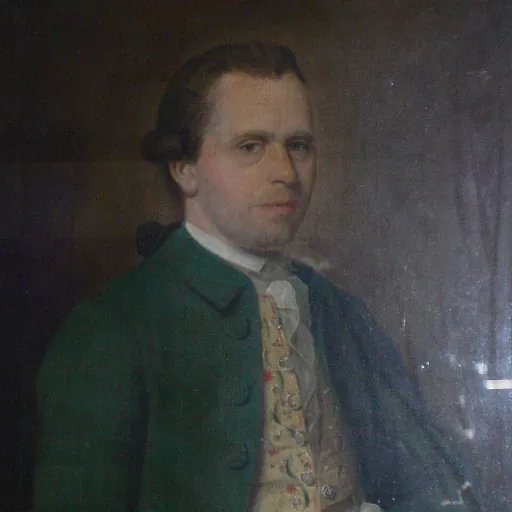
John Pretor Pinney
British merchant and slave trader
About John Pretor Pinney
Lived 1740 – 1818 (aged 77–78). John Pretor Pinney was a British merchant, slave trader and plantation owner.
John Pretor Pinney (1740 – 23 January 1818) was a plantation and slave owner on the island of Nevis in the West Indies and was a sugar merchant in Bristol. He made his fortune from England’s demand for sugar. His Bristol residence is now the city's Georgian House Museum.
Early life Born John Pretor in Chard, Somerset in 1740, his parents were Michael Pretor (d.1744) and Alicia Clarke (d.1759). His mother had a distant cousin, John Frederick Pinney, who had no children, so in 1762 at the age of 22 John Pretor was the key beneficiary of John Frederick’s will, inheriting land in Dorset and several plantations worked by enslaved people on Nevis. His inheritance was on the condition that he took the surname Pinney, which he did. John Pretor Pinney left England for Nevis in 1764 where he remained until 1783. The plantations which he inherited had been built up by his great-great-uncle, Azariah Pinney (1661–1720) and his family. Azariah Pinney had been granted a pardon by James II for his part in the Monmouth Rebellion on the condition that he spent 10 years in the West Indies; he arrived in Nevis in 1682. However, by the time John Pretor Pinney inherited the estates, they were run down and in debt.
Later, he owned between 170 and 210 people on his 394 acre plantation 'Mountravers', producing sugar and rum to be shipped to Bristol and London. In 1772 Pinney married a white Creole, Jane Weekes, with whom he had seven children. During his time back in England Pinney increased his wealth 5 times from that which he brought back from Nevis. When he died in 1818 his fortune was worth about £340,000 (the equivalent of about £24.5 million as of 2019, based on the percentage increase in the Retail Price Index from 1818 to 2019). and Pinney’s manservant Pero Jones (1753–1798) who was never freed. Pero's Bridge in Bristol is named after him. Unusually, Pinney was not a member of the Society of Merchant Venturers, but was a member of the West India Association in Bristol which in the late 1780s lobbied to defend the slave trade. His son Charles Pinney took over much of his father’s business, although John Pretor Pinney's main estate of Mountravers had been sold in 1808.
Death and legacy
Pinney died in Bristol on 23 January 1818, and was buried in the family vault in the parish church at Somerton in Somerset.
His house at 7 Great George Street is now a museum owned and run by Bristol City Council. In the Georgian House Museum is a list of the names of over 900 enslaved people owned by the Pinney family, many of whose biographies have been researched by Christine Eickelmann.
Don’t just read it —
keep it.
Full-length biographies made to live with: read them, listen on the way to work, watch them tonight.
- E-book
- Audio
- Video
Instant download · yours to keep · every purchase keeps this site free
Important facts
People in John Pretor Pinney's life
Named in this biography and alive at the same time


Related people
Same field, nearest in time
Contemporaries
People whose lives overlapped John Pretor Pinney's




Frequently asked questions
Who was John Pretor Pinney?
British merchant and slave trader (1740–1818)
When was John Pretor Pinney born?
John Pretor Pinney was born in 1740.
When did John Pretor Pinney die?
John Pretor Pinney died in 1818.
What was John Pretor Pinney's occupation?
John Pretor Pinney was a merchant, slave trader and plantation owner.
What nationality was John Pretor Pinney?
John Pretor Pinney was British.
Sources & further reading
· Wikipedia: John Pretor Pinney
Cite this page
APA: Biography.guide. (2026). John Pretor Pinney. https://biography.guide/john-pretor-pinney/
MLA: "John Pretor Pinney." Biography.guide, https://biography.guide/john-pretor-pinney/.
Chicago: "John Pretor Pinney." Biography.guide. https://biography.guide/john-pretor-pinney/.
Data last updated: 2026-09-20 · Spot an error? Report a correction.
Page generated 2026-09-27 05:09 UTC