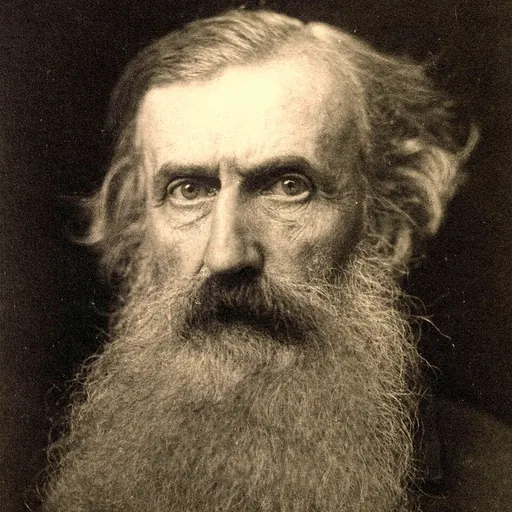
About John O'Leary
Lived 1830 – 1907 (aged 76). John O'Leary was a British journalist, poet, writer and irish Republican.
John O'Leary (23 July 1830 – 16 March 1907 ) was an Irish separatist and a leading Fenian. He studied both law and medicine but did not take a degree and for his involvement in the Irish Republican Brotherhood, he was imprisoned for five years in England during the nineteenth century.
Early life Born in the town of Tipperary, County Tipperary, the Catholic O'Leary was educated at the local Protestant Grammar School, The Abbey School, and later the Catholic Carlow College. He identified with the views advocated by Thomas Davis and met James Stephens in 1846.
Irish Republican Brotherhood O'Leary abandoned his study of law at Trinity College because he was unwilling to take the oath of allegiance required of a barrister. He enrolled at Queen's College, Cork in 1850, to study medicine, later moved to Queen's College, Galway, then on to further studies at Meath Hospital, Dublin, in Paris and in London. In 1855, he visited Paris, where he became acquainted with Kevin Izod O'Doherty, John Martin and the American painter, James Abbott McNeill Whistler. O'Leary subsequently became financial manager of the newly formed Irish Republican Brotherhood (IRB), and was joint editor of the IRB paper The Irish People.
Arrest and trial On 16 September 1865, O'Leary was arrested, and later tried on charges of high treason, reduced to 'treason felony'. He was sentenced to twenty years' penal servitude, of which five years were spent in English prisons, prior to his release and exile in January 1871. During his exile, he lived mainly in Paris, also visiting the United States, remained active in the IRB and its associated organisations, and wrote many letters to newspapers and journals.
Later life in Dublin On the expiry of his 20-year prison term and therefore of the conditions associated with his release in 1885, he returned to Ireland. He and his sister, the poet Ellen O'Leary, both became important figures within Dublin cultural and nationalist circles, which included W. B. Yeats, Maud Gonne, Rose Kavanagh, Rosa Mulholland, George Sigerson, and Katharine Tynan. He also functioned as an elder statesman of the separatist movement, being active in the Young Ireland Society, and acted as president of the Irish Transvaal Committee, which supported the Boer side in the Boer War.
Political outlook
O'Leary was a separatist, believing in complete Irish independence from Britain. However, he was not a republican but a constitutional monarchist. He believed in physical force, but was opposed to individual acts of violence such as those promoted by O'Donovan Rossa with his Skirmishing Fund, believing that revolutionary action should be thoroughly prepared. He was strongly opposed to the land agitation promoted by Michael Davitt and Parnell. For most of his life, he was opposed to any form of parliamentary action, being particularly hostile to the former Fenian M.P. John O'Connor Power. However, he supported Parnell during the early days of the Split of 1890–91. He was a secularist, believing that the Church should stay out of politics. In an article published in the Dublin University Review in 1886, he showed some awareness that Protestants would require guarantees of their liberties within an independent Ireland. Like most intellectuals of his generation, he was not interested in the Irish language, although sympathetic to organisations of the Gaelic revival of the 1880s onwards.
Personal life
O'Leary never married, although he had an early love affair with a young woman, who is thought to have later entered a convent. He acted as best man for James Stephens, in 1864. He was brought up Catholic, but abandoned the religion for all of his life, until close to his death, when he was reconciled to the church, around Christmas 1906. He inherited property from his family in the town of Tipperary. For most of his life, this provided a reasonably comfortable income, so that he did not have to earn money and was able to assist fellow separatists financially. However, he did become a victim of agitation during the Plan of Campaign in 1889–91, when rental payments to him largely ceased. He was remembered in the town of Tipperary as a 'hard landlord'. He was succeeded as IRB leader by Neal O'Boyle from Antrim.
Yeats' Tribute
"Romantic Ireland's dead and gone; It's with O'Leary in the grave."
He also mentions O'Leary in his poem "Beautiful Lofty Things":
"Beautiful lofty things: O'Leary's noble head;"
Works
Young Ireland: The Old and the New (1885) Recollections of Fenians and Fenianism, 2 vols, London, 1896
Don’t just read it —
keep it.
Full-length biographies made to live with: read them, listen on the way to work, watch them tonight.
- E-book
- Audio
- Video
Instant download · yours to keep · every purchase keeps this site free
Important facts
People in John O'Leary's life
Named in this biography and alive at the same time



Related people
Same field, nearest in time


Contemporaries
People whose lives overlapped John O'Leary's




Frequently asked questions
Who was John O'Leary?
Irish separatist and a leading Fenian (1830-1907)
When was John O'Leary born?
John O'Leary was born on 23 July 1830 in Tipperary.
When did John O'Leary die?
John O'Leary died on 16 March 1907 in Dublin.
What was John O'Leary's occupation?
John O'Leary was a journalist, poet, writer and irish Republican.
What nationality was John O'Leary?
John O'Leary was British.
Sources & further reading
· DBpedia: John O'Leary (Fenian)
Cite this page
APA: Biography.guide. (2026). John O'Leary. https://biography.guide/john-o-leary-journalist-1830/
MLA: "John O'Leary." Biography.guide, https://biography.guide/john-o-leary-journalist-1830/.
Chicago: "John O'Leary." Biography.guide. https://biography.guide/john-o-leary-journalist-1830/.
Data last updated: 2026-09-21 · Spot an error? Report a correction.
Portrait: Wikimedia Commons · author & licence
Page generated 2026-09-27 05:01 UTC