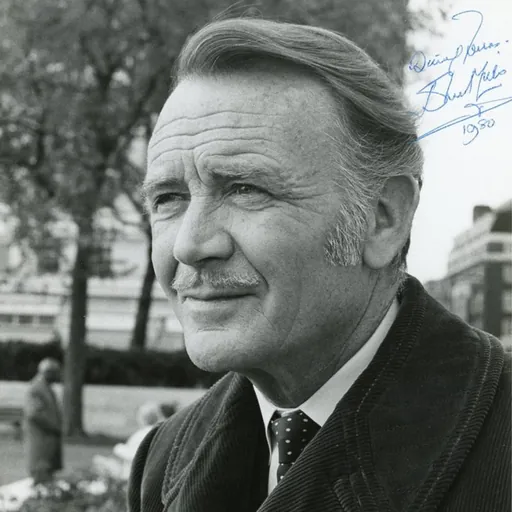
About John Mills
Lived 1908 – 2005 (aged 97). John Mills was a British autobiographer, character actor, stage actor, film actor, film director and film producer, known for Ryan's Daughter, Swiss Family Robinson (1960 film) and Tunes of Glory.
Sir John Mills (born Lewis Ernest Watts Mills; 22 February 190823 April 2005) Mills was born at Watts Naval School, where his father was a master. He spent his early years in the village of Belton where his father was the headmaster of the village school. He first felt the thrill of performing at a concert in the school hall when he was six years old. He then lived in a modest house on Gainsborough Road, Felixstowe, Suffolk, until 1929. His elder sister was Annette Mills, remembered as presenter of BBC Television's Muffin the Mule (1946–55).
He was educated at Balham Grammar School in London, Sir John Leman High School in Beccles and Norwich High School for Boys, where it is said that his initials can still be seen carved into the brickwork on the side of the building in Upper St Giles Street. Upon leaving school he worked as a clerk
Career
Early career Mills took an early interest in acting, making his professional début at the London Hippodrome in The Five O'Clock Girl in 1929. He followed this with a cabaret act.
Mills then got a job with a theatrical company that toured India, China and the Far East performing a number of plays. Noël Coward saw him appear in a production of Journey's End in Singapore and wrote Mills a letter of introduction to use back in London.
On his return, Mills starred in The 1931 Revue, Coward's Cavalcade (1931) and the Coward revue Words and Music (1932).
He made his film debut in The Midshipmaid (1932). He also appeared in The Ghost Camera (1933) with Ida Lupino and Britannia of Billingsgate (1934).
Mills was promoted to leading roles in A Political Party (1934), a comedy. He was in a series of quota quickies: The River Wolves (1934); Those Were the Days (1934), the first film of Will Hay; The Lash (1934); Blind Justice (1934); Doctor's Orders (1934); and Car of Dreams (1935). He did Jill Darling (1934) on stage and was one of many names in Royal Cavalcade (1935).
"A" movies Mills had the star role in an A film, Brown on Resolution (1935). It was back to quota quickies for Charing Cross Road (1935) and The First Offence (1936). He had another excellent part in an "A", playing Lord Guildford Dudley in Tudor Rose (1936). He did Aren't Men Beasts? (1936) on stage and worked for Hollywood director Raoul Walsh in O.H.M.S. (1937).
Mills starred in The Green Cockatoo (1937) directed by William Cameron Menzies. He appeared as Colley in the hugely popular 1939 film version of Goodbye, Mr Chips, opposite Robert Donat.
World War II At the Old Vic he was in A Midsummer Night's Dream (1939), She Stoops to Conquer (1939) and Of Mice and Men (1939–40). He joined the army in 1939 but occasionally made films on leave. He went back to movies with Old Bill and Son (1940) and made Cottage to Let (1941), a war film for Anthony Asquith. Mills went back to supporting Will Hay in The Black Sheep of Whitehall (1942) and he was one of many names in the war film, The Big Blockade (1942).
He was in Men in Shadow (1942) on stage, written by his wife. He achieved acclaim for his performance as an able seaman in Noël Coward's In Which We Serve (1942), a huge hit. Mills had another good support role in The Young Mr. Pitt (1942) playing William Wilberforce opposite Robert Donat. He was invalided out of the army in 1942.
Stardom Mills's climb to stardom began when he had the lead role in We Dive at Dawn (1943), a film directed by Asquith about submariners. He was top billed in This Happy Breed (1944), directed by David Lean and adapted from a Noël Coward play.
Also popular was Waterloo Road (1945), from Sidney Gilliat, in which Mills played a man who goes AWOL to retrieve his wife from a draft-dodger (played by Stewart Granger). Mills played a pilot in The Way to the Stars (1945), directed by Asquith from a script by Terence Rattigan, and another big hit in Britain. He did Duet for Two Hands (1945) on stage.
Mills had his greatest success to date as Pip in Great Expectations (1946), directed by David Lean. It was the third biggest hit at the British box office that year and Mills was voted the sixth most popular star.
Less successful critically and financially was So Well Remembered (1947) which used American writers and directors. The October Man (1947) was a mildly popular thriller from Roy Ward Baker.
Mills played the title role in Scott of the Antarctic (1948), a biopic of Captain Scott. It was the fourth-most-watched film of the year in Britain and Mills was voted the eighth-biggest star in an exhibitors' poll.
Producer Mills turned producer with The History of Mr Polly (1949) from the novel by H. G. Wells. It was directed by Anthony Pelissier and Mills said it was his favourite film. Pelissier also made The Rocking Horse Winner (1949) which Mills produced; he also played a small role. More liked at the box office was a submarine drama, Morning Departure (1950), directed by Baker. By this stage his fee was a reported £20,000 a film.
Career slump After Morning Departure Mills took almost two years off. The films he made on his return were not popular: a thriller, Mr Denning Drives North (1951); The Gentle Gunman (1952), where he and Dirk Bogarde played IRA gunmen for Basil Dearden; and The Long Memory (1953), a thriller from Robert Hamer.
Popularity revival
Mills had his first hit in a number of years with Hobson's Choice (1954), directed by Lean. He appeared in the war film The Colditz Story (1955).
Mills played a supporting role in a movie for MGM, The End of the Affair (1955), with Deborah Kerr and Van Johnson. More liked in Britain was another war story, Above Us the Waves (1955); this was the sixth-most-popular film at the British box office that year, and it helped Mills become the fifth-most-popular star in the country.
After Escapade (1955), Mills made the popular military comedy The Baby and the Battleship (1956), one of the biggest hits of 1956. Also on that list was another Mills comedy, It's Great to Be Young (1956).
Mills had a key support role as a peasant in War and Peace (1956) and made a cameo in Around the World in 80 Days (1956).
Mills appeared in the thrillers: Town on Trial (1957) directed by John Guillermin and The Vicious Circle (1957). More popular with the public were the war films: Dunkirk (1958), the second-most-popular film of the year in Britain; Ice Cold in Alex (1958), directed by J. Lee Thompson; and I Was Monty's Double'''(1958), directed by Guillermin.
In the 1959 crime drama Tiger Bay, directed by Thompson, Mills played a police detective investigating a murder that a young girl has witnessed. His daughter Hayley was cast, and earned excellent reviews.
Mills went to Australia to play a cane cutter in the Hollywood financed Summer of the Seventeenth Doll (1959). The movie was poorly received critically and commercially.
Better received was Tunes of Glory (1960), a military drama directed by Ronald Neame co-starring Alec Guinness. Mills's performance earned him a Best Actor Award at the Venice Film Festival.
Walt Disney saw Tiger Bay and offered Hayley Mills the lead role in Pollyanna (1960). Disney also offered John Mills the lead in the adventure film Swiss Family Robinson (1960), which was a huge hit. He did Ross (1960–61) on stage.
The Rank Organisation insisted Mills play the role of the priest in The Singer Not the Song (1961) opposite Dirk Bogarde. Mills and Baker reteamed on an interracial drama, Flame in the Streets (1961), and an Italian-British war film, The Valiant (1962).
Mills did a comedy with James Mason, Tiara Tahiti (1962). He had a support role in The Chalk Garden (1964) starring Hayley.
After a cameo on the war film Operation Crossbow (1965), Mills made a third film with his daughter, The Truth About Spring (1965). He had a cameo in King Rat (1965) for Bryan Forbes, who then directed Mills in The Wrong Box (1966). Mills played Hayley's father-in-law on screen in The Family Way (1966). He then directed her in Sky West and Crooked (1966) from a script written by his wife.
He was the subject of This Is Your Life on two occasions, firstly in 1960 when he was surprised by Eamonn Andrews outside Pinewood Studios, and again in 1983 when Andrews surprised him on the stage of London's Wyndham's Theatre at the curtain call of the play Little Lies.
Character actor Mills began to move into character roles, supporting Hugh O'Brian in Africa Texas Style (1967) and Rod Taylor in Chuka (1967). He went to Italy for a giallo, A Black Veil for Lisa (1968) and played William Hamilton in Emma Hamilton (1968).
Mills had a cameo in Oh! What a Lovely War (1969) for director Richard Attenborough and supported Mark Lester (though he was top billed) in Run Wild, Run Free (1969). He went to Australia to star in a convict drama, Adam's Woman (1970).
For his role as the village idiot in Ryan's Daughter (1970)—a complete departure from his usual style—Mills won a Best Supporting Actor Oscar.
He was in Dulcima (1971), then had support roles in Young Winston (1972) for Attenborough, Lady Caroline Lamb (1972) and Oklahoma Crude (1973). On stage he did Veterans at the Royal Court, At the End of the Day (1973), The Good Companions (1974), Great Expectations (1975) and Separate Tables (1977).
Also on the small screen, in 1974 he starred as Captain Tommy "The Elephant" Devon in the six-part television drama series The Zoo Gang, about a group of former underground freedom fighters from the Second World War, alongside Brian Keith, Lilli Palmer and Barry Morse.
In the late 1970s Mills could still get lead roles in films, as shown by The "Human" Factor (1975), Trial by Combat (1976) and The Devil's Advocate (1977). He had filmed supporting roles in The Big Sleep and The Thirty Nine Steps (both 1978).
His most famous television role was probably as the title character in Quatermass for ITV in 1979. He followed this with a sitcom in Young at Heart (1980–82).
On the big screen he was now mainly playing upper-crust types as in Zulu Dawn (1979), Gandhi (1982) and Sahara (1983). He performed Goodbye Mr Chips on stage (1982) followed by Little Lies (1983).
Later career
In 1986 he did The Petition at the National and the following year did Pygmalion on Broadway. He provided a voice for When the Wind Blows (1986) and supported Madonna in Who's That Girl (1987). His best roles were on TV in Harnessing Peacocks (1993) and Martin Chuzzlewit (1994). Mills also starred as Gus: The Theatre Cat in the filmed version of the musical Cats in 1998.
In 2000, Mills released his extensive home cine-film footage in a documentary film entitled Sir John Mills's Moving Memories, with interviews with Mills, his children Hayley, Juliet and Jonathan and Richard Attenborough. The film was produced and written by Jonathan Mills, directed and edited by Marcus Dillistone, and features behind the scenes footage and stories from films such as Ice Cold in Alex and Dunkirk. In addition the film also includes home footage of many of Mills's friends and fellow cast members including Laurence Olivier, Harry Andrews, Walt Disney, David Niven, Dirk Bogarde, Rex Harrison and Tyrone Power. He portrayed a charming old gent as head of an art museum in 1997's Bean. Mills's last cinema appearance was playing a tramp in Lights 2 (directed by Marcus Dillistone); the cinematographer was Jack Cardiff. They had last worked together on Scott of the Antarctic in 1948.
Personal life and death The Wick on Richmond Hill in Richmond, Greater London, was the family home for many years.
His first wife was the actress Aileen Raymond, They were married in 1932 and divorced in 1940. Raymond later became the mother of actor Ian Ogilvy.
His second wife was the dramatist Mary Hayley Bell. Their marriage, on 16 January 1941, lasted for 64 years until his death in 2005. They were married in a rushed civil ceremony, because of the war; it was not until sixty years later that they were married in a church. They lived in The Wick, Richmond, London, for many years. They sold the house to musician Ronnie Wood in 1971 and in 1975, moved to Hills House, Denham, Buckinghamshire.
Mills and Bell had two daughters, Juliet, star of television's Nanny and the Professor and Hayley, a Disney child star who appeared in Pollyanna, The Parent Trap and Whistle Down the Wind. They had one son, a screenwriter.
In 2002, he received a Fellowship of the British Academy of Film and Television Arts (BAFTA), their highest award, and was named a Disney Legend by the Walt Disney Company.
Filmography
Film
Television
Year Title Role Notes 1967 Dundee and the Culhane Dundee 13 episodes 1974 The Zoo Gang Thomas 'The Elephant' Devon 6 episodes 1978 Dr. Strange Thomas Lindmer TV movie 1979 Quatermass Professor Bernard Quatermass4 episodes 1980–1982 Tales of the Unexpected William Perkins/The Umbrella Man/Sam Morrissey 3 episodes Young at Heart Albert Collyer 18 episodes 1982 The Adventures of Little Lord Fauntleroy The Earl of Dorincort TV movie 1984 The Masks of Death Dr Watson 1985 A Woman of Substance Henry Rossiter 3 episodes Murder with Mirrors Lewis Serrocold TV movie Edge of the Wind General Blair TV play 1987 The Dame Edna Experience Season 1, Episode 6 (as himself) 1989 A Tale of Two Cities Jarvis Lorry 2 episodes 1993 Harnessing Peacocks Bernard Quigley TV movie 1994 Martin Chuzzlewit Mr Chuffey 3 episodes, TV Mini-series
Stage appearances
Year Title Theatre 1929 The Five O'Clock Girl London Hippodrome 1930 Charley's Aunt New Theatre 1931 The 1931 Revue London Pavilion London Wall Duke of York's Theatre Cavalcade Theatre Royal Drury Lane 1932 Words and Music Adelphi Theatre 1933 Give Me a Ring London Hippodrome 1934 Jill Darling Saville Theatre 1936 Red Night Queen's Theatre Aren't Men Beasts! Strand Theatre 1937 Floodlight Saville Theatre Talk of the Devil Piccadilly Theatre 1938 Pelissier's Follies of 1938 Saville Theatre A Midsummer Night's Dream The Old Vic She Stoops to Conquer 1939 We at the Crossroads Globe Theatre Of Mice and Men Gate Theatre/Apollo Theatre 1942 Men in Shadow Lyric Theatre 1945 Duet for Two Hands Vaudeville Theatre 1950 The Damascus Blade UK Tour Top of the Ladder St James's Theatre 1951 Figure of Fun Aldwych Theatre 1953 The Uninvited Guest St James's Theatre 1954 Charley's Aunt New Theatre/Strand Theatre 1961 Ross Eugene O'Neill Theatre/Hudson Theatre, New York City 1963 Powers of Persuasion Garrick Theatre 1972 Veterans Royal Court Theatre 1973 At the End of the Day Savoy Theatre 1974 The Good Companions Her Majesty's Theatre 1975 Great Expectations UK Tour/O'Keefe Centre, Toronto 1977 Separate Tables Apollo Theatre 1982 Goodbye, Mr Chips Chichester Festival Theatre 1983 Little Lies Wyndham's Theatre 1986 The Petition National Theatre/Wyndham's Theatre 1987 Pygmalion Plymouth Theatre, New York City From 1992 One-man show Various venues
Box office ranking For a number of years, British film exhibitors voted him among the top ten British stars at the box office via an annual poll in the Motion Picture Herald''. 1945 – 4th 1946 – 8th 1947 – 4th (6th most popular overall) 1948 – 3rd (4th most popular overall) 1949 – 3rd (8th most popular overall) 1950 – 4th (6th most popular overall) 1954 – 10th 1955 – 2nd (5th most popular overall) 1956 – 10th 1957 – 6th 1958 – 6th 1961 – 5th
Don’t just read it —
keep it.
Full-length biographies made to live with: read them, listen on the way to work, watch them tonight.
- E-book
- Audio
- Video
Instant download · yours to keep · every purchase keeps this site free
Important facts
Family & relationships
People in John Mills's life
Named in this biography and alive at the same time




Related people
Same field, nearest in time



Contemporaries
People whose lives overlapped John Mills's


Frequently asked questions
Who was John Mills?
British actor (1908–2005)
When was John Mills born?
John Mills was born on 22 February 1908 in Felixstowe, Watts Naval School.
When did John Mills die?
John Mills died on 23 April 2005 in Denham.
What was John Mills's occupation?
John Mills was an autobiographer, character actor, stage actor, film actor, film director and film producer.
What was John Mills known for?
John Mills was known for Ryan's Daughter, Swiss Family Robinson (1960 film) and Tunes of Glory.
What nationality was John Mills?
John Mills was British.
Sources & further reading
Cite this page
APA: Biography.guide. (2026). John Mills. https://biography.guide/john-mills-autobiographer/
MLA: "John Mills." Biography.guide, https://biography.guide/john-mills-autobiographer/.
Chicago: "John Mills." Biography.guide. https://biography.guide/john-mills-autobiographer/.
Data last updated: 2026-09-22 · Spot an error? Report a correction.
Portrait: Wikimedia Commons · author & licence
Page generated 2026-09-27 05:03 UTC