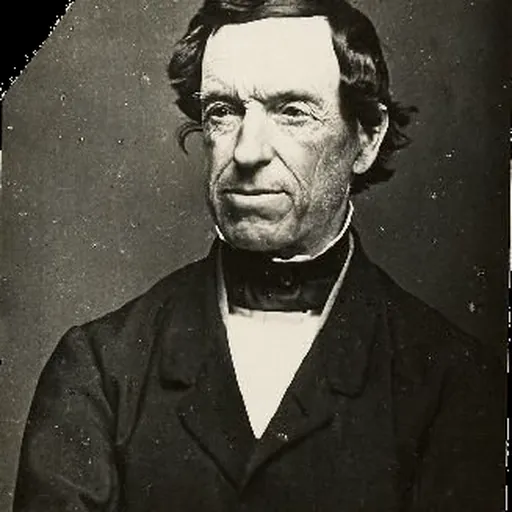
About John McLean
Lived 1799 – 1890 (aged 90–91). John McLean was a British writer, explorer, manager, founder, trapper and fur trader, known for Churchill Falls, Hudson's Bay Company and Labrador Peninsula.
John McLean (–1890) was a Scotsman who emigrated to British North America, where he became a fur-trapper, trader, explorer, grocer, banker, newspaperman, clerk, and author. He travelled by foot and canoe from the Atlantic to the Pacific and back, becoming one of the chief traders of the Hudson's Bay Company. He is remembered as the first person of European descent to discover Churchill Falls on Canada's Churchill River and sometimes mistakenly credited as the first to cross the Labrador Peninsula. Long overlooked, his first-person accounts of early 19th-century fur trading in Canada are now valued by historians. Under the pen name Viator (Latin for "Traveller"), his letters to newspapers around Canada also helped shift public opinion away from yielding the western territories to the United States during the Alabama Claims dispute over damages for British involvement in the American Civil War.
Life Early life
John McLean was born in Dervaig or beside the Loch Bà on 24 July 1798, in 1799,
Ottawa River John McLean entered the service of the Hudson's Bay Company at a most interesting and critical time in its history, during the strife between the Hudson's Bay and North West Companies. He worked on the Ottawa Riverthe present-day border between Quebec and Ontariountil 1833. During his apprenticeship, he moved progressively further upcountry, from Lake of Two Mountains, to Chats Falls in April 1822, to Fort Coulonge in June 1823. He then directed a post at Lac de Sable on the Lièvre in the wilderness north of Ottawa and Montreal. He spent nine years fending off company rivals, cultivating relations with indigenous trappers, and improving the post's profitability only to be removed to a new territory once things had become easy.
New Caledonia Ordered to the Western Department on the Pacific, he travelledmostly by canoefrom Montreal up the Ottawa, crossed Lake Nipissing to the French River and the sheltered northern bays of Lake Huron, passed Sault Ste Marie into Lake Superior and Fort William on Thunder Bay, stopped on the north shore of Lake Winnipeg at Norway House in Rupert's Land (now Manitoba) for further orders, and finally followed thempast Cumberland House in present-day Saskatchewan and Athabasca and Fort Dunvegan in present-day Alberta and down the Peace Riverto New Caledonia (present-day British Columbia), where he expected "to fare like a dog". Reaching Fort St James on Stuart Lake on 28 October 1833, however, he had nothing but praise"I do not know that I have seen anything to compare with this charming prospect in any other part of the country; its beauties struck me even at this season of the year, when nature having partially assumed her hybernal dress, everything appeared to so much greater advantage." He also complemented Fort Alexandria on the Fraser, his post from March to May the next year, for its scenery, friendly indigenous neighbours, and good food. once a year. "Surrounded by a country that presents as complete a picture of desolation as can be imagined", he avoided lingering there and instead personally led expeditions southeast across the Labrador Peninsula in an attempt to establish overland contact with Fort Smith (present-day North West River, Labrador) at the mouth of the Naskaupi River on Lake Melville, the furthest extent of Esquimaux Bay (now Hamilton Inlet). He expected discovering such a route would lead to his promotion within the company, and his predecessor Erlandson had already accidentally demonstrated its feasibility in 1834 when his attempt to reach Mingan on the St Lawrence had been redirected to Lake Melville by his five Innu guides. (McLean is sometimes credited as the first European to have crossed the entire peninsula.) He himself credited Erlandson's earlier trek, which had lasted from 6 April to 22 June 1834. (W.H.A.) Davies, in Bryant. to take a route up the Koksoak from Erlandson's maps and reports, He sent a team under Erlandson to Indian Head Lake to establish Fort Trial as a waystation and depot for the supply route to for outposts further south. McLean travelled up Ungava Bay to the George River, which they followed despite its low water to find a route up the George, through a series of lakes around the falls, and along the Naskaupi The forts he had established were abandoned. Gov. Simpson denied his request for a pension.
Later life
He had married Clarissa Eugenia Evans, daughter of the missionary and linguist James Evans, While there, he managed a grocery store on Market Square for four years, He became an important member of the town and in 1856 laid the cornerstone for the Norfolk Street Wesleyan Methodist Church (the present Lakeside Hope House).
By then, however, his financial position had been ruined when he was obliged to repay £1300 stolen from the bank in two incidents in September 1855. (McLean's wife and historians have tended to finger Erlandson for the theft as he left an unexpectedly large estate at his death, but at the time McLean supported his friend and employee and accepted responsibility for the loss.) With what he had left, he moved to nearby Elora, where he served as court clerk for the next 25 years. His wife died 6 May 1858, at the age of 32. For some years his mother-in-law, Mrs. Evans, lived with him, and cared for his children.
Following the American Civil War, when Britain had assisted the Confederacy with blockade running and commerce raiding because of its textile mills' reliance on American cotton, the victorious United States had cancelled its Canadian free trade agreement and demanded enormous reparations. For a time, American expansionists, Canadian separatists, and British anti-imperialists all seemed to support the transfer of the western wilderness of British North America rather than resolving the issue monetarily. It was largely unpopulated and the Hudson's Bay Company had long portrayed it as frozen wastes useless for settlement, mostly to dissuade competitors and the encroachment of farmers and civilization into its trapping grounds. Alarmed by this possibility and unwilling to accept the territories' loss to the Americans (inter alia, he considered the War of 1812 to have been an act of unprovoked aggression), he wrote to newspapers across Canada under the name "Viator", vividly detailing the beauty and resources of the Canadian west and advocating the purchase of Rupert's Land from the Hudson's Bay Company. His letters to his hometown Elora Lightning Express were reworked into a short book under the name Remarks on the Great Nor'-West. His accounts have been credited with shifting Canadian public opinion against the land transfer, increasing political pressure to find a separate resolution to the dispute.
Works , considered a major source on Canada's fur trade. 2nd ed. in 1932 edited by W.S. Wallace as John McLean's Notes of a Twenty-Five Years' Service in the Hudson's Bay Territory, Toronto: Champlain Society. volume I & volume II , first published as articles for the Elora Lightning Express.
Legacy
McLean was the inspiration for one of the characters in R.M. Ballantyne's Ungava, a fictionalized retelling of that station's establishment and operation. He was briefly the namesake of what is now Churchill Falls. After fitful returns and abandonments, the fort he established at the mouth of the George River in 1838 a plaque commemorating McLeanincluding the mistaken belief that he was the first to cross the Labrador Peninsula
Don’t just read it —
keep it.
Full-length biographies made to live with: read them, listen on the way to work, watch them tonight.
- E-book
- Audio
- Video
Instant download · yours to keep · every purchase keeps this site free
Important facts
People in John McLean's life
Named in this biography and alive at the same time

Related people
Same field, nearest in time




Contemporaries
People whose lives overlapped John McLean's





Frequently asked questions
Who was John McLean?
Scottish explorer of Canada
When was John McLean born?
John McLean was born in 1799 in Isle of Mull.
When did John McLean die?
John McLean died on 8 September 1890 in British Columbia, Victoria, British Columbia.
What was John McLean's occupation?
John McLean was a writer, explorer, manager, founder, trapper and fur trader.
What was John McLean known for?
John McLean was known for Churchill Falls, Hudson's Bay Company and Labrador Peninsula.
What nationality was John McLean?
John McLean was British.
Sources & further reading
· DBpedia: John McLean (explorer)
Cite this page
APA: Biography.guide. (2026). John McLean. https://biography.guide/john-mclean-writer/
MLA: "John McLean." Biography.guide, https://biography.guide/john-mclean-writer/.
Chicago: "John McLean." Biography.guide. https://biography.guide/john-mclean-writer/.
Data last updated: 2026-09-23 · Spot an error? Report a correction.
Portrait: Wikimedia Commons · author & licence
Page generated 2026-09-27 05:05 UTC