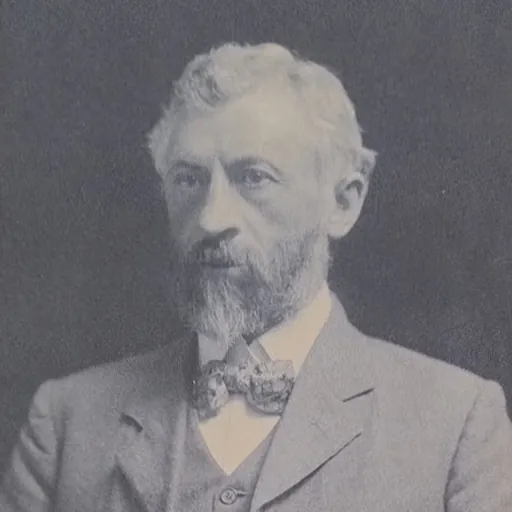
About John Mather
Lived 1848 – 1916 (aged 67–68). John Mather was an Australian painter and printmaker.
John Mather (1848 – 18 February 1916) was a Scottish-Australian plein-air painter and etcher.
Mather was a Scottish artist who emigrated to Melbourne in 1878.
Mather was one of the early practitioners of painting en plein air in Victoria and his work predates that of other better-known plein air artists. Mather practised the Scottish plein-air tradition and the close study of nature. After emigrating to Melbourne, he sought to analyse and faithfully represent the light and colour of the Australian landscape. Modifying earlier European tones, his paintings came closer to visual truth than any Australian landscapes produced before the later widespread adoption of plein-air methods. Through his desire to realistically reproduce picturesque scenes, he developed a distinctive and independent artistic style. which was described as "a distinctively Australian school of landscape painters ... who look at colonial scenery with their own eyes, and not through European spectacles."
Mather worked towards bringing the Academy and Association together to form the Victorian Artists Society in 1888 and served as its president for many years. and was a celebrated teacher. However a little more than decade after his death he was almost forgotten. Mather died on 18 February 1916 and lay in a grave with no memorial until 2023 when a plaque was added to his grave simply stating: Mr John Mather 1848 – 1916 The beauty of his Art endures. The words, his Art endures, refers to his painting and etching but also the art he nurtured as a mentor, teacher and one of the founding fathers of art in Victoria.
Early life, art education and exhibited works John Mather was born in Hamilton, South Lanarkshire, Scotland, son of John Mather, a surveyor, and his wife Margaret, née Allan. He had access to the art collection of the Duke of Hamilton and was familiar with all the works. When about 15 years old he had his first art lessons with Thomas Fairbairn (1820-1884) From Glasgow, Mather went to Edinburgh, where he studied at the school of the National Gallery and "painted 'bits' of the old part of the city, which sold rapidly." There he exhibited works as painter in annual exhibitions of the Royal Scottish Academy in 1873.
In 1873 – 74, Mather went to Paris and remarked: "I saw the miles of pictures that are to be seen in Paris, and studied them as well as I could." His other known works of the Cadzow Forest, all predating his arrival in Melbourne, include:
Cadzow Forest (circa 1871-76) Water colour Cadzow Forest and white cattle (Title unknown) 1876 Water colour Cadzow Forest and white cattle (Title unknown) 1877 Oil Cadzow Forest is an ancient woodland about 2 kilometres south-east of Hamilton. Famous for its centuries-old oaks and herd of white cattle. In the mid-19th century, the Cadzow Forest became a major destination for Scottish landscape painters, comparable to the Forest of Fontainebleau for the painters of the Barbizon School.
Thomas Fairbairn, Mather's first teacher, was an art teacher and prominent water colourist who moved to Hamilton in 1853, possibly to be near the oak tree forest of Cadzow. Fairbairn was celebrated as a literal reproducer of nature. He meticulously captured the textures of the ancient oaks, mosses, and woodland streams without romanticising or altering them. Fairbairn was widely regarded as a watercolourist, bringing a soft, precise touch to paintings of the forest landscape.
Other artists that painted in the Cadzow Forest included:
Samuel Bough (1822–1878), Alexander Fraser the Younger (1827–1899), and Horatio McCulloch (1805–1867). In 1913 Mather remarked that he had recently built a studio named Cadzow in memory of the forest and his first painting. John Mather listed his occupation as Painter using the nomenclature of the Royal Glasgow Institute and the Royal Scottish Academy at that time.
In April 1879 he exhibited 11 works at the Annual Exhibition of the Victorian Academy of Arts and was noted as a large exhibitor. He exhibited two oils, Yarra Flats and Evening on the Yarra, and nine watercolours, A Woodland Path Scotland; Sketch near Essendon; Spring-time Scotland; Sketch on Brighton Beach; Lagoon, Yarra Flats; On the Tamar, Tasmania; Old Cottage, Argyllshire Scotland; Old Huts, Isle of Mull, Scotland and A Grey Day, Glen Falloch, Scotland. On 19 December 1879, Mather's tender of £4700 for the internal decorations of the Exhibition Buildings was accepted by the Building Committee of the International Exhibition after providing "other evidence of the possession of special ability."
Mather exhibited again in 1880 and 1881. On 27 October 1881 he was elected to the Council of the Victorian Academy of Arts. In April 1882 he exhibited a number of oil paintings and water colours at the annual exhibition of the Academy, Later that year he exhibited another six works in the First Black and White Exhibition of the Academy.
He was married on 16 October 1882 to Miss Jessie Pines Best, a daughter of Captain James Best, a pilot of Hobson's Bay. Together they had one daughter and three sons; Margaret Playfair, John Allan, Louis Melville (died in infancy), and Leslie Frank Strand (died in 1919).
John Mather's 'plein air' work John Mather was one of the early practitioners of painting en plein air in Victoria.
Mather had an early interest in the landscape around Heidelberg, demonstrated by Wattles at Heidelberg and Leaving off Work, Heidelberg Road, both exhibited with the Victorian Academy of Arts in 1881. He exhibited the following year, Near the Yarra, Heidelberg and Stubble Field, Heidelberg. Another example is a water colour of bushland and river, The Yarra at Heidelberg, signed and dated 1882. On the Upper Yarra 1885 J. Mather Between 1882 and 1885, Mather painted oil and watercolour landscapes around Sunbury and Riddell's Creek, displaying them at exhibitions of the Art Society of New South Wales, the Victorian Academy of Arts, the 1884 Ballarat Fine Art Exhibition, and in his studio at 93 Collins Street East.
In autumn 1885, he made two trips to the Upper Yarra valley, which was described as an artist’s paradise with richly varied and delightfully picturesque scenery. In April 1885, he displayed the results of his first trip to the Upper Yarra valley in his studio.
In 1885, Mather was also noted as amongst the artists travelling to Heidelberg, the first organised effort in Melbourne to form a group for landscape painting. The participants included Arthur Streeton, Walter Withers, John Longstaff, Fredrick McCubbin, E. Phillips Fox, Louis Abrahams, Jane Sutherland, Tudor St George Tucker, John Llewellyn Jones, Tom Humphries, and Fredrick Williams.
These Sunday painting excursions predated the artist's camps of Tom Roberts, Arthur Streeton, Walter Withers, Frederick McCubbin, Charles Condor and others at Box Hill, Mentone, and Heidelberg, and elsewhere. where he is also recorded as addressing a large gathering of eighty artists, students and their friends.
Around this time, Streeton, then about twenty-two, 'sketched' with Paterson and Mather, regarding himself as a student in their company. He later wrote: “We three painters met at Flinders Street Station, Melbourne … They were my seniors by about fifteen years, and it was kind of them to invite me to join in their painting trip to the ocean shore at Kilcunda.” A Glimpse of Brighton Beach 1896 John Mather, "A very small painting ... remarkable for charm of composition and good suggestion of wind in the strain of ti-trees" Mather's affinity with en plein air is revealed when discussing a broad range of his favourite paintings in the National Gallery of Victoria. Commenting on Peter Graham's Autumnal Showers he states; "he was in intimate converse with nature, when every new effect was an unspeakable joy, a new delight and a fresh discovery...[the work] ... must have been a labour of love."
When completing a painting of Mt Feathertop, Mather undertook a daily walk of 12 miles for a fortnight to complete the work "... leaving the picture on the spot where he was painting it, and frequently returning to find it so buried in snow that he had to actually dig it out ..."
Whilst some of Mather's larger pictures were painted indoors from sketches; Alexander Colquhoun, painter and art critic, believed that "it was when seated out in the open with a small block or pochade before him that he was at his happiest and came nearest to the realisation of his ideals as an artist."
Career
Later he joined the bohemian Buonarotti Club, camping with other members on plein-air painting expeditions, and served, with Frederick McCubbin, Louis Abrahams, Jane Sutherland, and Tom Roberts on the club's exhibition selection committee. As a painter, Mather was also involved in the bohemian Artists' Camps of Sydney.
In 1886, together with other professional artists, he was a founding member of the Australian Artists' Association, serving on the Executive Committee, as well its Exhibition Selection and Hanging Committees.
A Sunny Bank 1882 has appeared at auction under various generic titles, however the landscape is identifiable as that near Riddell's Creek. The composition's distinctive rocky outcrops, creek-side vegetation, and distant sunlit hillside with farmhouse also resemble the landscape and features in other illustrated works by Mather that are titled or otherwise identified as views of Riddell's Creek.
The work is an oil on canvas, signed and dated 1882. It is housed in a large, elaborate John Thallon frame, suggesting that it was intended for exhibition. The canvas measures 53.5 × 36.0 cm (sight size 52.5 × 34.5 cm) within a 77.5 × 59.5 cm frame.
Mather generally gave his works descriptive titles reflecting their principal subject. Most were named after a locality or geographical feature. Others a prominent aspect of the composition such as Passing Showers or Moonlight. More poetic titles, such as The Weary Sun hath made a Golden Set were comparatively uncommon, although larger exhibition works occasionally received titles such as Reflections and The Golden West.
The exhibition records indicate at least eight distinct titles possibly associated with Mather's work around Riddell's Creek:
• A Study of Rocks
• A Sunny Bank
• An Australian Creek
• Riddell's Creek
• A Summer Morning
• A Study (possibly later exhibited as Waterfall on Riddell's Creek)
• A Weedy Bank
• Waterfall on Riddell's Creek
Illustrated surviving works include the watercolour Riddell's Creek (1883), the watercolour A Study of Rocks, Riddell's Creek (1884) and the oil painting Summer Morning.
The titles of the various works, their dates (when noted), media references, exhibition details, descriptions, and images (when available), indicate two plausible candidates for the 1882 work: A Sunny Bank and the later Riddell's Creek.
The Sydney Morning Herald described, A Sunny Bank, exhibited in March 1883, as "one of the most charming landscapes in the exhibition, the sky being especially admirable." The oil painting carried a substantially higher catalogue price (£26 5s) than the later paintings titled Riddell's Creek.
The paintings exhibited as Riddell's Creek in 1884 and 1885 also received favourable reviews. In 1884, The Age described a painting as "a delicious bit of nature, skillfully put together and remarkably just in colour." Reviewing the 1885 exhibition, the newspaper wrote that another painting "stands out brilliantly from its surroundings as a genuine work of art", praising its purity and truth of colour, composition, and natural feeling.
Whilst Riddell's Creek describes the location, A Sunny Bank more accurately describes the brightly illuminated hillside beyond the darker foreground rocks and aligns with Mather's practice of naming a work after an aspect of the composition.
Together, the early 1882 date, the work's size and quality, its elaborate John Thallon frame, and the exhibition prices of comparable works suggest that A Sunny Bank is the more likely exhibition title.
A Sunny Bank, was among the works exhibited in the 1883-1884 Calcutta International Exhibition including another work by John Mather A Morning Walk (1883). A Morning Walk subsequently returned to Australia and entered the collection of the Ballarat Fine Art Gallery through the James Oddie Bequest.
The apparent absence of A Sunny Bank from Victorian exhibition records following the Calcutta International Exhibition suggests that it may have remained overseas. The earliest documented provenance places this present work in London, where it was illustrated and sold at Sotheby's in October 1991. The auction date is also written in chalk on the reverse of the frame. Following a period in private ownership, the painting reappeared at auction in Melbourne Australia in 2026 before entering another private collection.
Identifying A Sunny Bank as a landscape of Riddell's Creek places the painting within Mather's series of paintings of the district and suggests that it was among the works exhibited at the 1883-1884 Calcutta International Exhibition.
Prior to emigrating to Australia he exhibited at:
Royal Glasgow Institute of the Fine Arts in 1871 and 1876. The Victorian Academy of Arts Black and White Exhibitions of 1882 and 1883. Ballarat Fine Art Exhibition 1884. The Australian Artists Association Exhibitions of 1886 and the Summer and Winter Exhibitions of 1887. The Victorian Society of Artists Exhibitions of Spring 1888, Autumn 1888, Winter 1889, 1895, Autumn 1900, 1904, 1905 and 1909. The Victorian Society of Artists Exhibition of Water Colour and Black and White Drawings 1890. The Victorian Society of Artists Annual Exhibitions from 1890 to 1911, (other than in 1902 and 1903). The Australian Art Association exhibitions from 1913 to 1916.
In the other Australian states, he exhibited in the:
Annual Exhibitions of the Royal Art Society of New South Wales from 1883 to 1888 as well as in 1892, 1893, 1895, 1899, and 1900. Exhibition of John Mather’s Water Colours, 1911 Trowbridge Bros, Elizabeth Street, Hobart. South Australian Society of Arts, September 1913 Mr. J. Mathers Exhibition of paintings and etchings.
Some of his works were part of a New South Wales provincial exhibition of a loan collection of pictures undertaken by the National Art Gallery and Art Association of New South Wales exhibited in: 1895 at the Bathurst Technological Museum. 1896 at the Goulburn Technological Museum. 1897 at the Newcastle Technological Museum.
His works were exhibited in colonial and international exhibitions held in Victoria including the:
1888 Melbourne Centennial Exhibition at the Melbourne Exhibition Building Picture Galleries. 1890 Exhibition of Works of Victorian Artists and a Loan Collection of Pictures at the Art Gallery of the Exhibition Building. 1893 Exhibition of Australian Art, Past and Present at the National Gallery, Swanston Street. 1901 Victorian Gold Jubilee Exhibition, Bendigo.
His works were exhibited internationally in:
1883-1884 Calcutta International Exhibition which included A Morning Walk by the Yarra now in the collection of the Ballarat Art Gallery. 1886 at the Colonial and Indian Exhibition London. 1898 at the Grafton Galleries Exhibition of Australian Art in London. 1899 at the Earls Court, London Greater Britain Exhibition.
As well as exhibitions at his studios, he held larger solo exhibitions including his:
1904 Exhibition of Australian Landscapes by John Mather at the Athenaeum Melbourne. 1911 Exhibition of Mr J. Mather’s Paintings, at the Athenaeum Melbourne. 1912 Exhibition of Mr J. Mather’s Paintings, at the Athenaeum Melbourne. In 1916 after his death his wife organised the Memorial Exhibition of Pictures by the late John Mather, at the Athenaeum, Melbourne.
John Mather's studio John Mather in his studio before a partially completed painting. Painting en plein air has been overemphasised and the role of studio work understated in Australian art history. Whilst periodically undertaking outdoor painting, many Australian artists maintained studios in the cities.
John Mather had a number of studios throughout his career and used them for his art, both painting and etching; as well as art lessons, exhibitions of his work and meetings with fellow artists.
Mather painted both en plein air and in his studio. His often very large water colours were painted indoors from sketches made in the field. A magic lantern slide of unknown date shows John Mather in his studio posed before a large partially complete watercolour. Likewise in 1898 he is noted as; "expanding his fascinating scrap, "Evening," into a water colour, "The Golden West," of large size and characteristic completeness." thumb
As early as 1881 Mather had a studio at 95 Collins Street Melbourne, and by 1888, a studio at Healesville which he maintained until about 1894. thumb The Model 1897 by John Mather. "They call him old Tom Bowling, after one of his songs. Besides picking up a living as a street musician, he gets a few shillings as an artist’s model."
In March 1891, he opened a studio at the Austral Buildings Collins Street Melbourne giving classes for the study of oil and water-color painting. The morning classes were held from ten o'clock until one, and the afternoon from two until five. The studio was filled with landscape sketches and studies for the free use of his pupils.
Described in 1891; "The studio is large and well lit and attractively furnished, while it is not overladen with the heterogenous collection so dear to the heart of the average artist. Mr. Mather’s room is made to appear what it is - a place to work and study, and the number of sketches in oil and water color that adorn the walls, proclaim the busy life of the painter."
He also had studios at his various residences. His last studio at his South Yarra residence was described as a "large low room with polished floor contained a grand piano and a few art treasures and beautiful hangings. The artist's own pictures took up most of the wall space, and the dark polished floor was shining perfection. ... Mather’s own little grandson was sometimes an interested spectator when the artist was at work. Once the child asked 'Why is that cow white, grandpa?' In reply the artist explained the colour scheme of his picture it some length, concluding with the exact reason why, to complete the colour scheme, that cow in the foreground was white. To all of which the five-year-old child listened patiently, then contradicted him briefly with, 'Tis not. It's because it's full of milk'"
Students John Mather is reported to have "had a wide celebrity as a teacher, and ... there are artists of repute in Melbourne now who commenced their careers in his Austral School in Collins Street."
John Mather's Artist Camp c.1903-4 Cape Woolamai ... "wherever Mr. Mather has pitched his artistic tent he has made himself thoroughly familiar with land and sea scape, and has reproduced these with fidelity to nature and the true artist's gift for seizing beautiful effects."
His students include:
Jessie Traill Ida Rentoul Outhwaite Jessie Laver Evans Janet Cumbrae-Stewart M. J. MacNally Ellis Rowan Miss Robertson Lady Downer Margaret Forrest or Lady Forrest Lady Williams Alexander McClintock Polly Hurry Dora Wilson Janie Wilkinson Whyte James Fawcett of Fawcett and Ashworth Arthur Jerome Salmon
Etchings John Mather was among the earliest practitioners of etching in Victoria, producing his first known print, a portrait of Louis Abrahams, around 1886. The previous year John Mather, Tom Roberts and Louis Abrahams had begun teaching themselves etching techniques.
By the early 1890s Mather had produced a number of landscape etchings and was printing his own plates. By 1894 he had imported a professional printing press and equipment from London, strengthening the technical foundations of etching practice in Melbourne.
Mather first exhibited an etching, Bathing-place on the Watts, at the Victorian Artists’ Society Annual Exhibition in September 1895, where it was noted as; "conspicuous as the only bit of nude work in the collection."
Alongside his figurative and landscape prints, Mather produced numerous etchings of windswept tea-trees along Brighton Beach, before shifting after 1900 toward larger architectural and urban compositions.
In the late 1890s he was the only artist in Australia formally teaching etching, and in 1900 he was described as a master of the medium.
Mather was later associated with other notable etchers including John Shirlow, Victor Cobb and Lionel Lindsay. Shirlow was frequently described as the pioneer of Victorian etching, he himself disclaimed the title, pointing to the work of earlier practitioners including Mather.
Similarly Cobb stated, "John Mather ... commenced to etch in Victoria in the early eighties. To him, and no one else, belongs the credit as the first to pioneer of the art in Victoria. He imported an expensive press and equipment from London, conducted classes, and did much for the progress of the art, and was an enthusiastic exponent on the copper plate, up to the time of his death, a few years ago."
Death John Mather's grave with no memorial. In 2023 a small plaque was added with the words: Mr John Mather 1848 – 1916 The beauty of his Art endures. John Mather died of diabetes at his home, Cadzow, South Yarra, Victoria on 18 February 1916; he was buried in the Cheltenham Pioneer Cemetery
In July 2023 a small plaque was placed on the grave simply stating:
Mr John Mather 1848 – 1916 The beauty of his Art endures.
The words, his Art endures, refers to his painting and etching but also the art he nurtured as a mentor, teacher and one of the founding fathers of art in Victoria. Nearly 100 works of the 135 catalogued were sold, realising about £900.
Shortly after the auction, his widow Jessie Mather departed Melbourne for Europe, travelling via London and Nice before continuing to New York. While in Wakefield, Rhode Island, she became ill and died there in August 1920. Her 1920 will and probate indicate that she still retained almost £340 of furniture and paintings. left Late Afternoon (1906) by John Mather gifted to the Museum of Fine Arts, St. Petersburg, Florida in memory of Margaret Mather, the daughter of the artist, by her husband, George Bond Works from Mather’s collection next reappeared in the 1960s. At that time, a large number of his works were in the possession of his daughter, Margaret Mather, who had emigrated to the United States in 1919 and ultimately settled in Florida in 1956. The collection contained more than 90 of her father's oils, watercolours, and etchings, including some of his most notable works. These works were subsequently exhibited in June 1967. One work nominally titled Late Afternoon was later deaccessioned and is now in a private collection. In 2023, twenty-six oils and watercolours by Mather remained in the museum’s collection.
Following George Bond’s death in 1971, the remaining Mather collection formed part of his estate, and the executors offered it for sale to a friend and associate of George Bond residing in Florida. Following the death of the collection's last owner, the collection was auctioned and sold.
The Mather collection, together with additional works, was auctioned during 2021–23 in Florida. Several works returned to Melbourne, among them a large water colour Brighton Beach (1896), which was acquired by a Melbourne-based collector and subsequently entered the collection of the Bayside City Council Gallery.
Legacy In 1932, Mather was described as "a landscape painter of considerable reputation during his lifetime". His extensive art collection was subsequently auctioned on 25 June 1919. Critics, historians, and curators focused narrowly on a few selected artists and images of Australian impressionism. The work of art historians of the 1930s, later transcribed in subsequent art histories, provided little information about his activities. Other than occasional individual works loaned or sold by private owners, there were few significant exhibitions of his work.
Similarly, many of the titles of his works have been forgotten, with nominal or generic titles sometimes applied at art auctions. Nevertheless, because Mather depicted scenes accurately as he observed them, it is often possible to identify the locations of his paintings using historical sources.
Mather's art, widely appreciated during his lifetime but largely forgotten in the decades after his death, has since been rediscovered.
Collections Three of Mather's own paintings, Autumn in the Fitzroy Gardens in oil, and Morning, Lake Omeo and Wintry Weather, Yarra Glen, both watercolours, were purchased by the National Gallery of Victoria. National Library of New Zealand National Gallery of Victoria Art Gallery of New South Wales State Library of Victoria Geelong Art Gallery Launceston Art Gallery Latrobe Regional Gallery New England Regional Art Museum Mornington Peninsula Regional Gallery Bayside Gallery, Bayside City Council Victorian Artists Society Collection Museum of Fine Arts, St. Petersburg, Florida
Notes and references
Don’t just read it —
keep it.
Full-length biographies made to live with: read them, listen on the way to work, watch them tonight.
- E-book
- Audio
- Video
Instant download · yours to keep · every purchase keeps this site free
Important facts
People in John Mather's life
Named in this biography and alive at the same time






Related people
Same field, nearest in time
Contemporaries
People whose lives overlapped John Mather's




Frequently asked questions
Who was John Mather?
Australian artist (1848-1916)
When was John Mather born?
John Mather was born in 1848 in Hamilton.
When did John Mather die?
John Mather died on 18 February 1916 in South Yarra.
What was John Mather's occupation?
John Mather was a painter and printmaker.
What nationality was John Mather?
John Mather was Australian.
Sources & further reading
· DBpedia: John Mather (artist)
Cite this page
APA: Biography.guide. (2026). John Mather. https://biography.guide/john-mather-painter/
MLA: "John Mather." Biography.guide, https://biography.guide/john-mather-painter/.
Chicago: "John Mather." Biography.guide. https://biography.guide/john-mather-painter/.
Data last updated: 2026-09-23 · Spot an error? Report a correction.
Portrait: Wikimedia Commons · author & licence
Page generated 2026-09-27 05:07 UTC