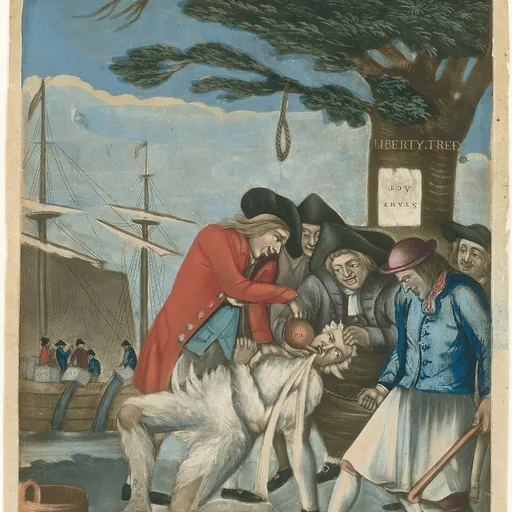
John Malcolm
British loyalist in the American Revolution
About John Malcolm
Lived 1701 – 1788 (aged 86–87). John Malcolm was a captain (nautical).
Incident in Boston A confrontation with the Patriot shoemaker George Hewes thrust Malcolm into the spotlight. On January 25, 1774, according to the account in the Massachusetts Gazette, Hewes saw Malcolm threatening to strike a boy with his cane. When Hewes intervened to stop Malcolm, both men began arguing, and Malcolm insisted that Hewes should not interfere in the business of a gentleman. When Hewes replied that at least he had never been tarred and feathered himself, Malcolm struck Hewes hard on the forehead with the cane and knocked him unconscious.
That night, a crowd seized Malcolm in his house and dragged him into King Street to punish him for the attack on Hewes and the boy. Some Patriot leaders who believed mob violence hurt their cause tried to dissuade the crowd by arguing that Malcolm should be turned over to the justice system. These pleas fell on deaf ears, however, as the relentless crowd justified the attack by citing Ebenezer Richardson amongst other grievances. Richardson was a customs official who had killed an 11-year-old Bostonian named Christopher Seider, but escaped punishment by receiving a royal pardon.
Malcolm was stripped to the waist and covered with burning hot tar and feathers before he was forced into a waiting cart. The crowd took him to the Liberty Tree and told him to apologize for his behavior, renounce his customs commission, and curse King George III. When Malcolm refused, the crowd put a rope around his neck and threatened to hang him. That did not break him, but when they threatened to cut off his ears, Malcolm relented. The crowd then forced him to consume copious amounts of tea and sarcastically toasted the King and the royal family. By this time Hewes (who had recovered) was so appalled by Malcolm's treatment that he attempted to cover him with his jacket. Malcolm was finally freed and was sent home, but continued to endure physical beatings as he returned.
Later life On May 2, 1774, Malcolm moved to England where he hoped to secure compensation from the suffering he had endured in Boston. Having received no reply through a messenger about his petition, on January 12, 1775, Malcolm himself "attended the levee at St. James’s, knelt before the King, and gave his petition into His Majesty's own hands." Despite writing in his petition that he wanted to return to Boston and resume his duties as a customs official, and that being tarred and feathered was now a badge of honor for him, the king was not impressed. Malcolm never returned to Boston for the remainder of his life due to the outbreak of the American Revolution. He was later given a commission as an ensign in 1780, for "an Independent Company of Invalids" at Plymouth, England. Malcolm died on November 23, 1788, leaving his widow in Boston to file a pension 2 years later.
Don’t just read it —
keep it.
Full-length biographies made to live with: read them, listen on the way to work, watch them tonight.
- E-book
- Audio
- Video
Instant download · yours to keep · every purchase keeps this site free
Important facts
People in John Malcolm's life
Named in this biography and alive at the same time

Contemporaries
People whose lives overlapped John Malcolm's




Frequently asked questions
Who was John Malcolm?
British loyalist in the American Revolution
When was John Malcolm born?
John Malcolm was born in 1701 in England.
When did John Malcolm die?
John Malcolm died in 1788 in England.
What was John Malcolm's occupation?
John Malcolm was a captain (nautical).
Sources & further reading
· DBpedia: John Malcolm (Loyalist)
Cite this page
APA: Biography.guide. (2026). John Malcolm. https://biography.guide/john-malcolm-captain-nautical/
MLA: "John Malcolm." Biography.guide, https://biography.guide/john-malcolm-captain-nautical/.
Chicago: "John Malcolm." Biography.guide. https://biography.guide/john-malcolm-captain-nautical/.
Data last updated: 2026-09-22 · Spot an error? Report a correction.
Portrait: Wikimedia Commons · author & licence
Page generated 2026-09-27 04:59 UTC