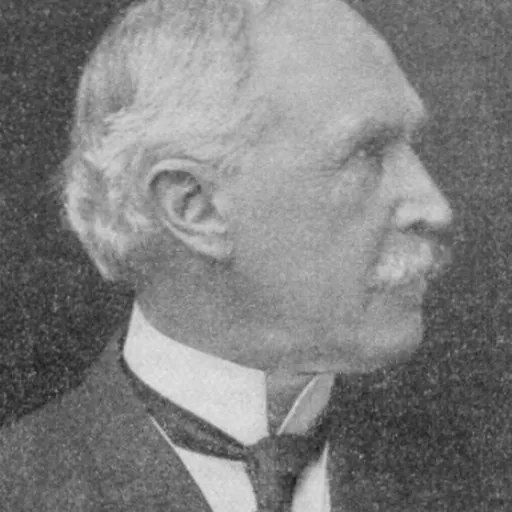
About John Lee Webster
Lived 1847 – 1929 (aged 82). John Lee Webster was an American politician.
John Lee Webster was a prominent Nebraska lawyer who, with Andrew Jackson Poppleton, freed Ponca Chief Standing Bear from Army custody in a landmark decision that held the American Indian is a "person" within the meaning of the U.S. Constitution, entitled to its guarantee of due process of law. He has been described as one of Nebraska's greatest lawyers.
Early years John Lee Webster was born in New Rumley, Harrison County, Ohio, March 18, 1847. At age 17, he enlisted in the Union army during the Civil War. Serving with the 107th Ohio Infantry in the Shenandoah Valley and Washington DC areas, he was a member of a gun crew in the heavy artillery at Fort Simpson, Virginia, across the Potomac River from Washington, when it was feared that Confederate General Robert E. Lee would capture the city. Webster also saw service at Harper's Ferry and near Richmond. After the war, Webster enrolled at Mount Union College, Ohio, and graduated in law from Washington College, Pennsylvania.
Webster was made Omaha city attorney in 1887-1888.
Webster was famous for his lectures on Alexander Hamilton and on the U.S. Constitution. He spoke before the bar associations of Nebraska, Iowa, Colorado, and Minnesota. The most significant aspect of the ruling, according to some historians, concerned the legality of the Army's detention of Standing Bear. Judge Dundy concluded that no such authority existed in an act of Congress or in a treaty with the Ponca tribe, either to detain him, to remove him by force, or to force him back to the Indian Territory.
Star Route cases Webster was appointed a special assistant United States attorney in the prosecution of the "Star Route" cases, a series of federal prosecutions in the early 1880s involving high-level corruption in the U.S. Post Office Department and fraudulent contracts for delivering mail in remote western territories.
Supreme Court cases Over a quarter century, Webster appeared before the Supreme Court of the United States in a number of cases having significant legal impact.
The earliest among them, Marsh v. McPherson was a seminal case that explored critical issues related to contract law, including the delivery of possession, breach of warranties, and the appropriate measure of damages resulting from such breaches. Frost v. Spitley clarified the limited effect of quitclaim deeds in U.S. property law. Boyd v. Thayer and Elk v. Wilkins contributed to the development of legal principles of U.S. citizenship. Webster successfully defended a Chinese national against deportation in Liu Hop Fong v. U.S., and represented the government in Sloan v. U.S., which clarified the Supreme Court's appellate jurisdiction in a case involving a treaty. He brought before the court a controversy involving the purchase of private waterworks, in City of Omaha v. Omaha Water Co. In Shallenberger v. First State Bank of Holstein, Webster represented banks that challenged the Nebraska bank deposit guaranty law. Civic life In 1888, Governor John Milton Thayer appointed Webster to represent Nebraska at the celebration in New York City of the centennial of George Washington's inauguration as president of the United States, held April 29-May 1, 1889.
In 1898, Webster addressed the opening of the Trans-Mississippi and International Exposition, held in Omaha.
In 1916, Webster was named the 22nd king of Ak-Sar-Ben, prominent Omaha civic and philanthropic organization. The celebration would include a historical pageant symbolizing the development of Nebraska and the relationship of the state to the opening and settlement of the West. The pageant took place in Omaha in October 1916, at which President and Mrs. Woodrow Wilson were present. More than 100,000 persons witnessed the Omaha celebrations. The ceremonies in Lincoln took place at the University of Nebraska commencement in June 1917, at which former President Theodore Roosevelt gave an address.
Until a few months before his death in 1929, Webster headed a committee seeking to create a World War I memorial in Omaha. Webster Street in Omaha is named in his honor.
Political life In 1889, Webster was said to have been highly endorsed and recommended for appointment to U.S. Supreme Court following the death of Associate Justice Stanley Matthews.
Webster was named chairman of the Nebraska delegation to the 1892 Republican National Convention,
In 1904, the Nebraska State Republican Convention declared for the nomination of Theodore Roosevelt for president of the United States and endorsed Webster for vice-president.
Personal life In 1868, Webster married Josephine Leah Watson, whom he met in college. They had one daughter, Flora, born in 1875.
Webster died on September 2, 1929, at age 82, after a long illness.
Don’t just read it —
keep it.
Full-length biographies made to live with: read them, listen on the way to work, watch them tonight.
- E-book
- Audio
- Video
Instant download · yours to keep · every purchase keeps this site free
Important facts
People in John Lee Webster's life
Named in this biography and alive at the same time





Related people
Same field, nearest in time




Contemporaries
People whose lives overlapped John Lee Webster's




Frequently asked questions
Who was John Lee Webster?
American lawyer
When was John Lee Webster born?
John Lee Webster was born on 18 March 1847 in Harrison County.
When did John Lee Webster die?
John Lee Webster died on 2 September 1929.
What was John Lee Webster's occupation?
John Lee Webster was a politician.
What nationality was John Lee Webster?
John Lee Webster was American.
Sources & further reading
Cite this page
APA: Biography.guide. (2026). John Lee Webster. https://biography.guide/john-lee-webster/
MLA: "John Lee Webster." Biography.guide, https://biography.guide/john-lee-webster/.
Chicago: "John Lee Webster." Biography.guide. https://biography.guide/john-lee-webster/.
Data last updated: 2026-09-24 · Spot an error? Report a correction.
Portrait: Wikimedia Commons · author & licence
Page generated 2026-09-27 05:08 UTC