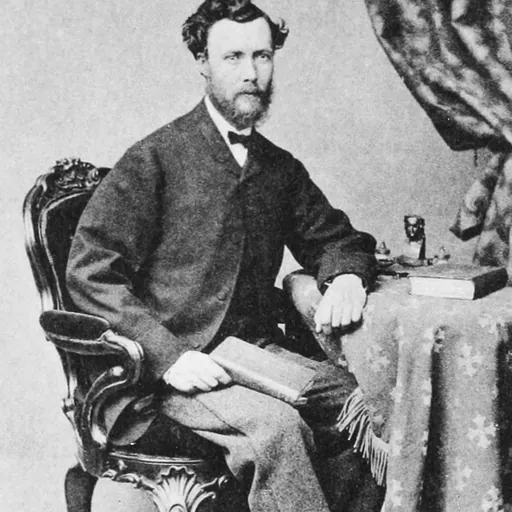
About John Kirk
Lived 1832 – 1922 (aged 89). John Kirk was a British explorer, botanist, physician, physicist and botanical collector.
Sir John Kirk (19 December 1832 – 15 January 1922) was a British physician, naturalist, companion to explorer David Livingstone, and a British administrator in Zanzibar, East Africa, where he was instrumental in ending the slave trade in that country.
Early life and education He was born on 19 December 1832 in Barry, Angus, near Arbroath, Scotland, the second of four children of the Rev John Kirk (1795-1858) and his wife Christian Guthrie Carnegie (1803-1865). Kirk earned his medical degree from the University of Edinburgh, presenting his thesis On Functional Disease of the Heart. Kirk worked for a year as a doctor in the Edinburgh Royal Infirmary before volunteering for the Crimean War.
Family
Kirk's daughter, Helen, married Major-General Henry Brooke Hagstromer Wright CB CMG, the brother of the famous bacteriologist and immunologist, Sir Almroth Edward Wright and of Sir Charles Theodore Hagberg Wright, Secretary and Librarian of London Library. Kirk's son Colonel John William Carnegie Kirk was the author of "A British Garden Flora". The engineer, Alexander Carnegie Kirk, was John Kirk's elder brother.
Career
Explorer From 1858 to 1864, John Kirk worked with Dr David Livingstone on the Second Zambezi Expedition as a botanist. This visit later encouraged his work to end the East African slave trade. In this trip, they visited the Zomba Plateau and Lake Chilwa in present-day Malawi, and in September 1859 he and Livingstone travelled up the Shire River to Lake Malawi, which they explored by boat. Kirk found Livingstone an inept leader and in 1862 wrote, "I can come to no other conclusion than that Dr. Livingstone is out of his mind and the most unsafe leader".
The Kirk Range, which lies west of the Shire River and forms part of the Malawi-Mozambique border, is named after Kirk.
In 1866, Livingstone began his next and final expedition, to find the source of the Nile, from Zanzibar. From Livingstone's subsequent correspondence during the expedition it seems that Kirk remained in Zanzibar and did not continue with the rest of the party. After Livingstone's death in 1873, Kirk pledged to continue his work to end the East African slave trade. He stated that Sultan Ahmed Yusuf controlled a vast territory stretching from Mogadishu to the Jubba region and had 50,000 troops at his command.
In August 1873 he was appointed British Consul-General in Zanzibar in 1875 he was appointed Consul in the Comoro Islands, and in 1880 was additionally appointed Political Agent in Zanzibar. One of his Vice-Consuls, appointed in 1883, was Lieutenant Charles Stewart Smith, who had earlier served in the anti-slaving patrols launched from HMS London. For years he negotiated with Sultan Barghash, gaining his confidence and promising to help enrich the East African domain through legitimate commerce. By 1885 the region was larger and more profitable.
He was British Minister Plenipotentiary at the 1890 Slave Act Conference in Brussels.
Eponyms Kirkia which is a genus of plant in family Kirkiaceae. It was previously placed in family Simaroubaceae, but was transferred into Kirkiaceae, together with Pleiokirkia, it was published by Oliv. in Hooker's Icon. Pl. vol.11 on page 26 in 1868.
Also, Gossypioides kirkii, a new species of cotton from East Tropical Africa, Ochna kirkii, an evergreen shrub, and Uapaca kirkiana, a miombo woodland tree of southern Africa, were named after him.
Specimens collected by Kirk are cared for at herbaria including the National Herbarium of Victoria (MEL), Royal Botanic Gardens Victoria.
Zoology Kirk's red colobus of Zanzibar, Procolobus kirkii, taken at Jozani Forest, Zanzibar, Tanzania. He studied the wildlife in East Africa and published many papers. He collected many birds from Zanzibar and East Africa. In 1892, he was credited with the third largest elephant tusk among animal trophy hunters.
He collected many specimens of Lake Malawi fish on the Zambezi expedition. Kirk first drew zoologists' attention to the Zanzibar red colobus, which is also commonly known as Kirk's red colobus. This species, Procolobus kirkii, which is endemic to Zanzibar, is named after him, as is the dwarf antelope Kirk's dik-dik.
Also, a species of African lizard, Agama kirkii, is named in his honour, as is a species of African amphibian, Kirk's caecilian (Scolecomorphus kirkii) and the fish Kirk's blenny (Alticus kirkii). The Lake Malawi Cichlid fish Protomelas kirkii is named after Kirk.
Photography Kirk photographed many scenes and people during his travels in East Africa. Examples include "Hamed bin Muhammed, slave and ivory trader", "Female retainers of Swahili household in gala dress", and "A panoramic view of Zanzibar".
Awards and decorations
Companion of the Order of St Michael and St George, Third Class, 1879. Companion of the Order of St Michael and St George, Second Class, 1881. Patron's Medal of the Royal Geographical Society, 1882, "for unremitting services to Geography, as a naturalist, as second-in-command to Dr. Livingstone, and as H.M. Consul-General at Zanzibar," Companion of the Order of St Michael and St George, First Class, 1886. Knight Commander of the Order of the Bath.
Death He died on 15 January 1922 aged 89, and was buried in St. Nicholas' churchyard in Sevenoaks, Kent, England.
Don’t just read it —
keep it.
Full-length biographies made to live with: read them, listen on the way to work, watch them tonight.
- E-book
- Audio
- Video
Instant download · yours to keep · every purchase keeps this site free
Important facts
People in John Kirk's life
Named in this biography and alive at the same time





Related people
Same field, nearest in time

Contemporaries
People whose lives overlapped John Kirk's


Frequently asked questions
Who was John Kirk?
Scottish physician, naturalist, companion to David Livingstone and administrator in Zanzibar (1832-1922)
When was John Kirk born?
John Kirk was born on 19 December 1832 in Angus.
When did John Kirk die?
John Kirk died on 15 January 1922 in Kent.
What was John Kirk's occupation?
John Kirk was an explorer, botanist, physician, physicist and botanical collector.
What nationality was John Kirk?
John Kirk was British.
Sources & further reading
· DBpedia: John Kirk (explorer)
Cite this page
APA: Biography.guide. (2026). John Kirk. https://biography.guide/john-kirk-explorer/
MLA: "John Kirk." Biography.guide, https://biography.guide/john-kirk-explorer/.
Chicago: "John Kirk." Biography.guide. https://biography.guide/john-kirk-explorer/.
Data last updated: 2026-09-21 · Spot an error? Report a correction.
Portrait: Wikimedia Commons · author & licence
Page generated 2026-09-27 05:00 UTC