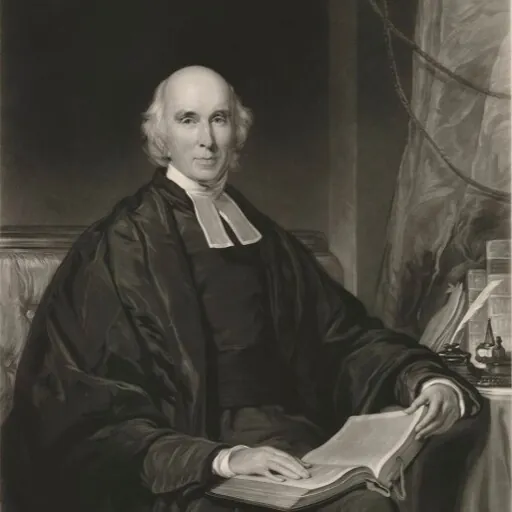
About John Kenrick
Lived 1788 – 1877 (aged 88–89). John Kenrick was a British translator, historian, university teacher, classical philologist and historian of classical antiquity.
Reverend John Kenrick (4 February 1788 – 7 May 1877) was an English classical historian.
Life He was born on 4 February 1788 at Exeter, the eldest son of Timothy Kenrick, Unitarian minister, and his first wife, Mary, daughter of John Waymouth of Exeter. He was educated at the local grammar school run by the Rev. Charles Lloyd and later at the nonconformist academy conducted by his father and the Rev. Joseph Bretland.
In 1807, Kenrick matriculated at Glasgow University. He was the first prizeman in his class for three successive years, won the Gartmore gold medal for an essay on the English constitution in the Tudor period, and a silver medal for an essay on the aberration of light. He graduated MA in 1810. Later that year, Kenrick became classics tutor at Manchester College, York. In 1819, he was given leave of absence to spend a sabbatical year in Germany, reading history at Göttingen. He returned to York in 1820 and began translating German classical works, including August Wilhelm Zumpt's Latin Grammar, Rost and Wusteman's Introduction to Greek Prose Composition and Matthiae's Greek Grammar.
In 1840, when the college returned to Manchester, Kenrick became professor of history, a post he held until his retirement in 1850. He continued to live in York, and travelled to Manchester to deliver lectures. Several of his pupils became celebrated for their writing, most notably John James Tayler (1797–1869), James Martineau (1805–1900), and George Vance Smith (1816–1902).
Kenrick joined the Yorkshire Philosophical Society on its foundation in 1823 and subsequently served on its Council and as a Vice-President. He was appointed the honorary curator of antiquities at the Yorkshire Museum in 1858, succeeding his father-in-law Charles Wellbeloved in the post.
Kenrick died on 7 May 1877 and was buried in York Cemetery.
Family Kenrick married, on 13 August 1821, Laetitia Wellbeloved (1795-1879), daughter of the principal of Manchester College, York, Charles Wellbeloved. They had no children.
Publications 1841. The Egypt of Herodotus. 1850. Ancient Egypt under the Pharaohs. 1855. Phoenicia. 1858. Roman Sepulchral Inscriptions: their relation to archaeology, language, and religion.
Don’t just read it —
keep it.
Full-length biographies made to live with: read them, listen on the way to work, watch them tonight.
- E-book
- Audio
- Video
Instant download · yours to keep · every purchase keeps this site free
Important facts
People in John Kenrick's life
Named in this biography and alive at the same time




Related people
Same field, nearest in time


Contemporaries
People whose lives overlapped John Kenrick's


Frequently asked questions
Who was John Kenrick?
English classical historian (1788-1877)
When was John Kenrick born?
John Kenrick was born on 4 February 1788 in Exeter.
When did John Kenrick die?
John Kenrick died in 1877 in York.
What was John Kenrick's occupation?
John Kenrick was a translator, historian, university teacher, classical philologist and historian of classical antiquity.
What nationality was John Kenrick?
John Kenrick was British.
Sources & further reading
· DBpedia: John Kenrick (historian)
Cite this page
APA: Biography.guide. (2026). John Kenrick. https://biography.guide/john-kenrick-translator/
MLA: "John Kenrick." Biography.guide, https://biography.guide/john-kenrick-translator/.
Chicago: "John Kenrick." Biography.guide. https://biography.guide/john-kenrick-translator/.
Data last updated: 2026-09-21 · Spot an error? Report a correction.
Portrait: Wikimedia Commons · author & licence
Page generated 2026-09-27 05:00 UTC