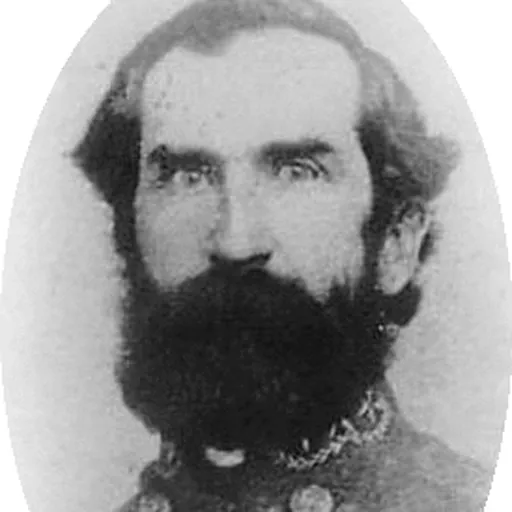
About John K. Jackson
Lived 1828 – 1866 (aged 38). John K. Jackson was an American jurist.
John King Jackson (February 2, 1828 – February 27, 1866) was an American lawyer and soldier. He served as a Confederate general during the American Civil War, mainly in Florida and the Western Theater of the conflict. Afterward Jackson resumed his law practice until dying from pneumonia a year after the war ended.
Early life and career John King Jackson was born in 1828 in Augusta, Georgia. He received his education first at Richmond Academy in his home state, and later at the University of South Carolina in Columbia, where he graduated "with honors" in 1846. Jackson then began to study law and was admitted to his state's bar association in 1848, practicing in Augusta until 1861.
In 1849, Jackson married a woman from Columbia County named Virginia L. Hardwick. The couple had three sons together, named Thomas M., William E., and Hardwick. He also was active as an officer in the Georgia State Militia, elected a lieutenant and later a captain. By 1861 was serving as a lieutenant colonel, in command of an Augusta infantry battalion.
Civil War service When the American Civil War began in 1861, Jackson chose to follow his home state and the Confederate cause. In April he entered the Confederate Army as lieutenant colonel of the 5th Georgia Volunteer Infantry Regiment, and in May was elected its commander and colonel. Jackson's regiment was ordered to Pensacola, Florida, where he also commanded the post at Pensacola that May and June.
Jackson was in command of one of the three battalions which fought in the Confederate defeat during the Battle of Santa Rosa Island on October 8, 1861. Jackson and his regiment remained in Florida for the rest of 1861.
During the Kentucky Campaign of 1862, Jackson and his brigade were ordered from Knoxville to Bridgeport, Alabama, where they were to guard Confederate communications along the railways bridges from Chattanooga to Murfreesboro. Jackson next saw combat during the Stones River Campaign of late 1862. On December 25 Bragg, by now the army's commander, ordered Jackson to leave the bare minimum of his command to protect the rail bridges and join the main force gathering at Murfreesboro. Sent to Lt. Gen. Leonidas Polk for orders, Jackson and his men participated in the Battle of Stones River from December 31 to January 2, 1863. He fought with distinction during the Battle of Chickamauga on September 19–20, 1863, where one of his regiments, the 5th Georgia, "lost sixty-one per cent in that battle, the second heaviest loss of all the regiments engaged." He participated in the Chattanooga campaign that October and November, most notably in the Battle of Missionary Ridge, where his brigade and that of Brig Gen. John C. Moore greatly slowed the Union breakthrough on November 25.
While the Army of Tennessee fell back to Dalton, Georgia, Jackson and his brigade were transferred to Maj. Gen. William H. T. Walker's division on February 20, 1864. He participated in the Atlanta campaign until July 3, when he was separated from the Army of Tennessee. Following the actions at Savannah, Jackson was sent to Branchville, South Carolina, where he was to establish military depots as the quartermaster of the Army of Tennessee. He then went to Cheraw, next to Goldsboro, North Carolina, and finally his home town of Augusta, all for the same purpose. Jackson was in this role when Gen. Joseph E. Johnston surrendered his forces on April 26, 1865, which included the Army of Tennessee. He was paroled from Augusta on May 17 and returned to his civilian life.
Postbellum career and death After the American Civil War ended in 1865, Jackson resumed his career as a lawyer in Augusta, Georgia. Several of the state's banks hired Jackson to obtain financial relief from the Georgia General Assembly on behalf of their stockholders, many of whom were returning Confederate officers. He was on this mission when he was stricken with pneumonia while in Milledgeville, located in Baldwin County, Georgia.
Don’t just read it —
keep it.
Full-length biographies made to live with: read them, listen on the way to work, watch them tonight.
- E-book
- Audio
- Video
Instant download · yours to keep · every purchase keeps this site free
Important facts
People in John K. Jackson's life
Named in this biography and alive at the same time


Related people
Same field, nearest in time





Contemporaries
People whose lives overlapped John K. Jackson's



Frequently asked questions
Who was John K. Jackson?
Confederate Army general (1828–1866)
When was John K. Jackson born?
John K. Jackson was born on 2 February 1828 in Augusta.
When did John K. Jackson die?
John K. Jackson died on 27 February 1866 in Milledgeville.
What was John K. Jackson's occupation?
John K. Jackson was a jurist.
What nationality was John K. Jackson?
John K. Jackson was American.
Sources & further reading
Cite this page
APA: Biography.guide. (2026). John K. Jackson. https://biography.guide/john-k-jackson/
MLA: "John K. Jackson." Biography.guide, https://biography.guide/john-k-jackson/.
Chicago: "John K. Jackson." Biography.guide. https://biography.guide/john-k-jackson/.
Data last updated: 2026-09-23 · Spot an error? Report a correction.
Portrait: Wikimedia Commons · author & licence
Page generated 2026-09-27 05:08 UTC