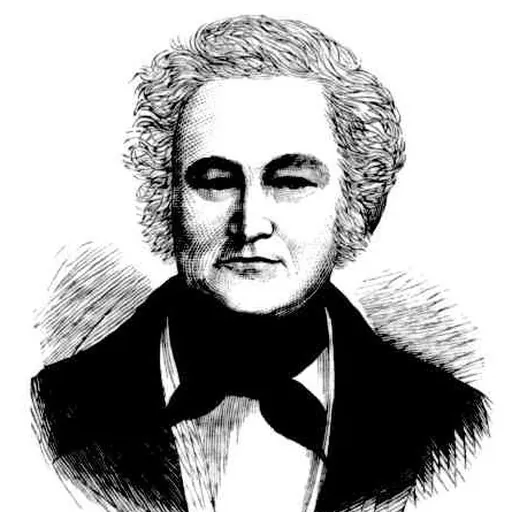
John Hawdon
Australian colonial settler
About John Hawdon
Lived 1801 – 1881 (aged 79–80).
John Hawdon John Hawdon (1801—1881) was an English-born colonial settler of New South Wales. He is associated with the area around Moruya, particularly Kiora and Tuross Head, on the South Coast of New South Wales, Australia, although he was also a pioneering landholder of other areas of the colony. He had a reputation as a 'land taker', all his land having been taken from its traditional owners, either by a land grant or squatting licence. Early life and family background Hawdon was born at Wackerfield (near Staindrop), Durham, England, prematurely, on 29 June 1801. His father was also named John and his mother was Elizabeth (née Hunt). His father, John Hawdon (1770—1845), was described as a 'yeoman', indicating that he came from a social stratum above a free-born labourer but was not a member of the gentry. As well as farming, Hawdons' father was an officer in the Staindrop Gentlemen and Yeomanry (later Staindrop Volunteer Cavalry), a volunteer force raised during the Napoleonic Wars; initially he was a second lieutenant, later rising to the rank of captain.
Hawdons' father's 520 acre farm was mainly used to breed and grow sheep. The land had in earlier times been owned by the Hawdon family, but was, by Hawdon's father's time, a part of the estate associated with Raby Castle. The family came well prepared, bringing with them a piano and many animals including "eight dogs, about 40 sheep, pigs, and poultry in abundance, a cow, a goat with two kids", He also brought with him letters-of-introduction to prominent colonists including, Thomas Iceley, Rev. William Cowper, Rev. Samuel Marsden, and Dr. James Bowman (who was married to a daughter of John Macarthur and Elizabeth Macarthur).
Landholdings and farming After arriving in the colony, he rented land at the Cowpastures, known as 'Elderslie',
Hawdon used his time at 'Elderslie' to search the colony himself, looking for suitable land that would be his land grant. He identified various pieces of land—near Lake George, Bong Bong, and Myrtle Creek—but his attempts to be granted those pieces of land fell through for various reasons. Still searching for land, he rode from Braidwood, down the Deua River valley, and found some land on the southern side of the Moruya River. In March 1831, he applied for that land. He moved onto the land, beginning cultivation and building stockyards, barns and fences. However, in July 1831, he was informed that, as the land lay just outside the limits of settlement, the land grant would not be given to him. The four years that he had, to take up a grant and settle on it, had expired, but he successfully sought an extension, until October 1831. He finally found his land, around the junction of Moogandoora Creek and the Moruya River, in September 1831.
Hawdon was granted 2560 acres of land at Kiora, in 1831, and moved there from 'Elderslie', in 1832. Kiora lay on the northern side of the Moruya River, at the southern-most limit of the Nineteen Counties, in which settlement was allowed by the colonial government. He had a house built there, known as 'Kiora House'. In the same year, 1832, as a squatter, he took up land at Howlong, on the Murray River, which he used for grazing cattle. Both Hawdon brothers were early members of the Melbourne Club.
It was Hawdon who wrote to the Governor in 1836, pointing out the dependence of the settlers on the safe anchorage and port at Broulee, leading to the surveying of a township there in 1837, by James Larmer.
Wanting more land, from 1836, Hawdon squatted on a huge piece of land south of the Moruya River, comprising the areas known today as Congo, Bergalia, Tuross Head and Bodalla. This squatting run was referred to as 'Bergalia'. In 1843, he established an outstation at Bodalla. In 1848, he was able to obtain a Crown Lease over 30,000 acres of land in the area, much of it prime land. A large portion of the Crown Lease, around Bodalla, later became part of the estate of Thomas Suttcliff Mort, although Hawdon retained some land near Tuross Head, 'Kyla Park', and the original land grant at Kiora.
In time, he would also own land near Mildura, and at Mount Greenock and Dandenong Creek, in the Port Phillip District, later the colony of Victoria.
Once Hawdon moved to Kiora, the settlers were living close by the local Yuin people. Local people, having heard Hawdon calling his wife "My dear", also did so, believing that was her true name.
For many years, he employed at least three Aboriginal men as servants—'Mister Campbell', the coach-driver, dressed in black livery, 'Mister Walker', and 'Benson'. It was within the traditional land of his own Yuin people. In 1883, there was stated to be five males, three females, and six children living there, with some attending Turlinjah Public School. At some time after his death, in 1917, the reserve was revoked. It is now mainly private land, with a strip of Crown Land on the lakeshore. In the days before Moruya was established, the magistrates sat at nearby Broulee.
Hawdon and William Oldrey had been pivotal in establishing the Broulee bench, effectively the only judicial body south of Wollongong, which was responsible for the coastal area between Batemans Bay and Twofold Bay. The two were embroiled in an ongoing feud with another early settler in the area, Francis Flanagan. That difficulty was later complicated by Flanagan also being appointed a magistrate of the Broulee bench, in April 1844, by Governor Gipps.
Hawdon was not comfortable sentencing escaped convicts; when recaptured, their punishment would be flogging. His attitude was unusual for the colonial magistrates of the time, many of whom—particularly the ex-military officers, such as William Sandys Elrington—seemed unrestrained in handing down harsh sentences. His daughter recalled that, if he suspected the presence of any absconding convicts, he would loudly announce that he would return later, at a particular time, to make a thorough search, allowing them time to slip away discreetly. The second was a criminal case of assault. The eventual outcome was that Hawdon lost his commission as a magistrate.
Gold rush On 1 August 1851, it was reported that alluvial gold had been discovered in the bed of the Moruya/Deua River, from a point close to the western boundary of Hawdon's Kiora estate and further upstream. Prospectors soon made far richer finds, further upstream still, on the Deua's tributary. Araluen Creek, and on that creek's tributary, Majors Creek. Around late 1851, Hawden and two of his sons attempted to drain the waterhole at the bottom of a base of the cascade waterfall on Majors Creek, in which they expected to find large nuggets of gold. Later, he provided credit to gold miners needing supplies.
Family, later life, and death He married Margaret Katherine Potts (1809–1886)
Hawdon lived out his last years, in retirement, on his two South Coast landholdings, which after the years of convict assigned labour were used mainly for dairy farming. He lived in a world transformed irrevocably, especially for the dispossessed Yuin people, in just over four decades of his lifetime.
Hawdon's younger brother, William, had taken over the running of the family farm in England upon his father's death in 1845. William's two surviving sons did not follow him into farming. William died in 1879 and, about this time, Hawdon made a visit to England, possibly to wind up the family's farming interests there. He returned to New South Wales in 1880, thereby severing a family connection to the area around Wackerfield that reportedly dated from the Elizabethan era. They lie in the old Kiora (private) cemetery, with five of their children, among a total of 26 grave sites. His eldest son John lies, far away, in Mildura, one of the first settlers to be buried there.
Legacy Hawdon's letters are held in the collection of the State Library of New South Wales.
His legacies include the townships of Moruya and Broulee. Although he founded neither in person, he did much that led to their establishment.
His property, near Tuross Head, 'Kyla Park'—owned by Hawdon family descendants, until 1970—is remembered by the name of a street and a recreation reserve in Tuross Head. Some of the property itself has been developed for housing. A rural portion is preserved, for use as grazing land or for other semi-rural uses, under a local heritage management plan.
Don’t just read it —
keep it.
Full-length biographies made to live with: read them, listen on the way to work, watch them tonight.
- E-book
- Audio
- Video
Instant download · yours to keep · every purchase keeps this site free
Important facts
People in John Hawdon's life
Named in this biography and alive at the same time




Contemporaries
People whose lives overlapped John Hawdon's






Frequently asked questions
Who was John Hawdon?
Australian colonial settler (1801–1881)
When was John Hawdon born?
John Hawdon was born in 1801 in England.
When did John Hawdon die?
John Hawdon died in 1881 in Kiora.
Sources & further reading
· DBpedia: John Hawdon (colonial settler)
Cite this page
APA: Biography.guide. (2026). John Hawdon. https://biography.guide/john-hawdon/
MLA: "John Hawdon." Biography.guide, https://biography.guide/john-hawdon/.
Chicago: "John Hawdon." Biography.guide. https://biography.guide/john-hawdon/.
Data last updated: 2026-09-22 · Spot an error? Report a correction.
Portrait: Wikimedia Commons · author & licence
Page generated 2026-09-27 05:02 UTC