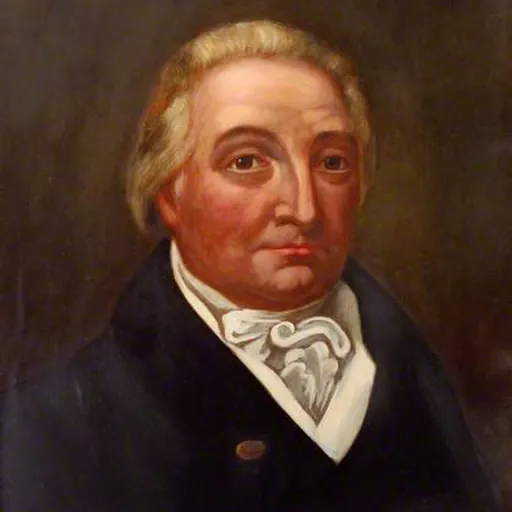
About John Harriott
Lived 1745 – 1817 (aged 71–72). John Harriott was an inventor.
John Harriott (1745–1817) was an English seafarer, now known for his part in founding the Marine Police Force. He was resident magistrate at the Thames police-court from 1798 to 1816.
Life Harriott was born at Great Stambridge, near Rochford, Essex, where his father, who had been in the Royal Navy and merchant marine, had settled a couple of years earlier. After a little schooling he was placed in the navy, served in the West Indies and the Levant, and was shipwrecked on the Mewstone Rock.
Harriott served in the Seven Years' War, under Admiral George Pocock at the Battle of Havana (1762), and during the recapture of Newfoundland. After the peace of 1763 he entered the merchant service, went up the Baltic Sea, and, as mate, made voyages in the American and West Indian trade. He spent several months among Native Americans in 1766; and then returned home.
Works Harriott published:
Tables for the Improvement of Landed Estates, and for Increasing the Growth of Timber thereon; An Address at a Parish Meeting at St. John's, Wapping, on the formation of an Armed Association, London, 1803; The Religion of Philosophy as contradistinguished from Modern French Philosophy, and as an Antidote to its pernicious effects lately so evident in the prevalence of Assassination and Suicide, pp. xvii, 152, London, 1812.
Struggles through Life, London, 3 vols., his autobiography, went through several editions, the last containing a chapter on the Abuses of Private Madhouses.
Harriott was also a patentee of the following inventions:
Patent 2197, 31 Oct. 1797, cog-wheel, crab, or capstan, with gear, to work ships' pumps, and for propelling; 2610, 13 April 1802 (with Thomas Strode, smith, of Wapping), engine for raising weights and working mills; 2713, 13 June 1803 (with Hurry & Crispin of Gosport), improved method of making and working windlasses; 3130, 10 May 1808, fire-escapes.
Family Harriott was three times married, and left a widow and several children and grandchildren. In 1797 the East India Company gave appointments to two of his sons: John Staples Harriott, afterwards a colonel of Bengal infantry, who lost a leg at the battle of Delhi in 1803, when serving under Lord Lake, and Thomas Harriott, lieutenant in the Indian navy, who commanded the Psyche gun-brig at the taking of Java.
Don’t just read it —
keep it.
Full-length biographies made to live with: read them, listen on the way to work, watch them tonight.
- E-book
- Audio
- Video
Instant download · yours to keep · every purchase keeps this site free
Important facts
People in John Harriott's life
Named in this biography and alive at the same time

Related people
Same field, nearest in time


Contemporaries
People whose lives overlapped John Harriott's




Frequently asked questions
Who was John Harriott?
British sailor and a founder of the Thames police (1745-1817)
When was John Harriott born?
John Harriott was born in 1745.
When did John Harriott die?
John Harriott died in 1817.
What was John Harriott's occupation?
John Harriott was an inventor.
Sources & further reading
· DBpedia: John Harriott (sailor)
Cite this page
APA: Biography.guide. (2026). John Harriott. https://biography.guide/john-harriott/
MLA: "John Harriott." Biography.guide, https://biography.guide/john-harriott/.
Chicago: "John Harriott." Biography.guide. https://biography.guide/john-harriott/.
Data last updated: 2026-09-21 · Spot an error? Report a correction.
Portrait: Wikimedia Commons · author & licence
Page generated 2026-09-27 05:00 UTC