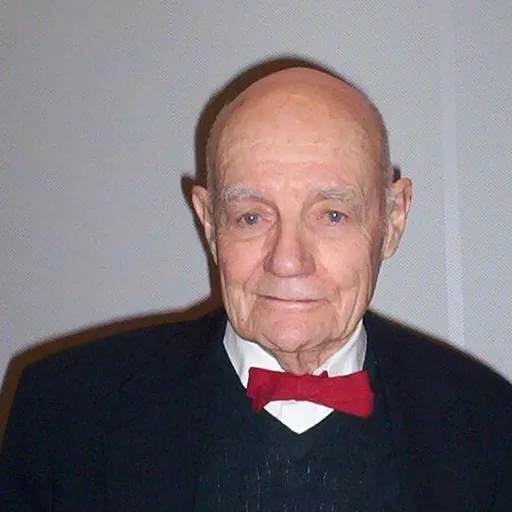
About John Fenn
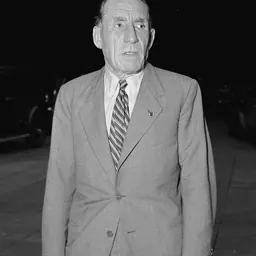
Lived 1917 – 2010 (aged 93). John Fenn was an American chemist and university teacher, known for Electrospray ionization.
John Bennett Fenn (June 15, 1917 – December 10, 2010) was an American analytical chemist who was awarded a share of the Nobel Prize in Chemistry in 2002, sharing half of the award with Koichi Tanaka for their work in mass spectrometry (the other half went to Kurt Wüthrich). His contributions related to the development of electrospray ionization, now a commonly used technique for large molecules and routine liquid chromatography-tandem mass spectrometry. Early in his career, he studied the field of jet propulsion at Project SQUID and focused on molecular beams. He finished his career with more than 100 publications, including one book.
Fenn was born in New York City, and moved to Kentucky with his family during the Great Depression. Fenn did his undergraduate work at Berea College, and received his PhD from Yale. He worked in industry at Monsanto and at private research labs before moving to academic posts including Yale and Virginia Commonwealth University.
Fenn's research into electrospray ionization found him at the center of a legal dispute with Yale University. He lost the lawsuit, after it was determined that he misled the university about the potential usefulness of the technology. Yale was awarded $500,000 in legal fees and $545,000 in damages. The decision pleased the university, but provoked mixed responses from some people affiliated with the institution, who were disappointed with the treatment of a Nobel Prize winner with such a long history at the school.
Early life and education Fenn was born in New York City, and grew up in Hackensack, New Jersey. In the years preceding the Great Depression, Fenn's father worked several different jobs, including briefly working as a draftsman at the Fokker Aircraft Company. During this time, Charles Lindbergh's plane The Spirit of St. Louis was briefly stored at one of the company's hangars. Fenn recalled sitting in the cockpit as a ten-year-old, pretending to pilot the famous plane. When his family's fortunes took a turn for the worse with the advent of the Depression, they moved to Berea, Kentucky, because his aunt Helen Dingman, who was on the faculty of Berea College, agreed to help the family. Fenn completed his education at Berea College and Allied Schools, formally finishing his high school education at the age of 15, but he took extra classes for another year rather than start college at such a young age.
Research interests
While Fenn was working with Monsanto, the company's research was focused on the production of phosphoric acid and polychlorinated biphenyls (PCBs). For large molecules like proteins, this often results in multiply charge species. Increasing the charge on the molecules, decreased the mass-to-charge ratio, which allows the mass to be more easily determined. The Science History Institute Museum in Philadelphia, PA has the instrument Fenn and his graduate students built while they were developing electrospray ionization on display, after receiving it as a gift from Fenn.
Lawsuit Fenn's work with electrospray ionization was at the center of a lawsuit pitting him against his alma mater and former employer, Yale University. His initial dispute with the university began in 1987, when he turned 70 – Yale's mandatory retirement age. Per university policy, Fenn was made an emeritus professor, which resulted in a reduction to his lab space. In 1989, when Yale University inquired about the progress and potential about his electrospray work, he downplayed its potential scientific and commercial value. Fenn patented the technology on his own, and sold licensing rights to a company he partly owned – Analytica of Branford. In 1993, a private company seeking to license the use of electrospray technology traced its invention to Yale, when the university discovered that Fenn held the patent.
Awards and honors
Nobel Prize
Fenn shared the 2002 Nobel Prize in Chemistry with Koichi Tanaka and Kurt Wüthrich "for the development of methods for identification and structure analyses of biological macromolecules." Fenn and Tanaka split half of the award for their work in developing ionization techniques for using mass spectrometry to analyze large biological molecules. Wüthrich was honored for his work in developing nuclear magnetic resonance techniques to analyze similar molecules in solution. Fenn's Nobel lecture after being presented with the award was entitled "Electrospray Wings for Molecular Elephants." He was surprised by his selection as a Nobel winner, saying "It's like winning the lottery, I'm still in shock." At the time of his award, Fenn was working at Virginia Commonwealth University. Gall's team recorded mass spectra of peptides and proteins as early as 1981. During a 1983 visit to the Soviet Union, Fenn visited Lidija Gall's laboratory and engaged in "fruitful discussions" regarding her ERIAD method, which he described as "very promising". Although Gall published her findings in April 1984, which was five months before Fenn's first paper on the subject, her work remained largely unknown internationally for decades due to the "Iron Curtain". Despite this direct exposure to the technology and his comment that he would "try it in his lab," Fenn's subsequent 1984 publication did not cite Gall's earlier pioneering work. Gall's pioneering contributions were later recognized by the Nobel Committee in 2002 and through her receipt of the Thomson Medal in 2022.
Other awards Fenn received his Nobel Prize fairly late in his career. Prior to being honored by the Nobel Foundation, Fenn had received numerous other awards. Early in his career, Fenn's research was focused on molecular beams, leading him to be named an honorary president of the Sixth International Symposium on Molecular Beams in 1977, and the first fellow of the International Molecular Beam Symposium in 1985. Margaret was killed in a car accident in New Zealand in 1992.
Don’t just read it —
keep it.
Full-length biographies made to live with: read them, listen on the way to work, watch them tonight.
- E-book
- Audio
- Video
Instant download · yours to keep · every purchase keeps this site free
Important facts
People in John Fenn's life
Named in this biography and alive at the same time





Related people
Same field, nearest in time


Contemporaries
People whose lives overlapped John Fenn's


Frequently asked questions
Who was John Fenn?
American analytical chemist (1917–2010)
When was John Fenn born?
John Fenn was born on 15 June 1917 in New York City.
When did John Fenn die?
John Fenn died on 10 December 2010 in Richmond.
What was John Fenn's occupation?
John Fenn was a chemist and university teacher.
What was John Fenn known for?
John Fenn was known for Electrospray ionization.
What nationality was John Fenn?
John Fenn was American.
Sources & further reading
Cite this page
APA: Biography.guide. (2026). John Fenn. https://biography.guide/john-fenn-chemist/
MLA: "John Fenn." Biography.guide, https://biography.guide/john-fenn-chemist/.
Chicago: "John Fenn." Biography.guide. https://biography.guide/john-fenn-chemist/.
Data last updated: 2026-09-22 · Spot an error? Report a correction.
Portrait: Wikimedia Commons · author & licence
Page generated 2026-09-27 05:01 UTC