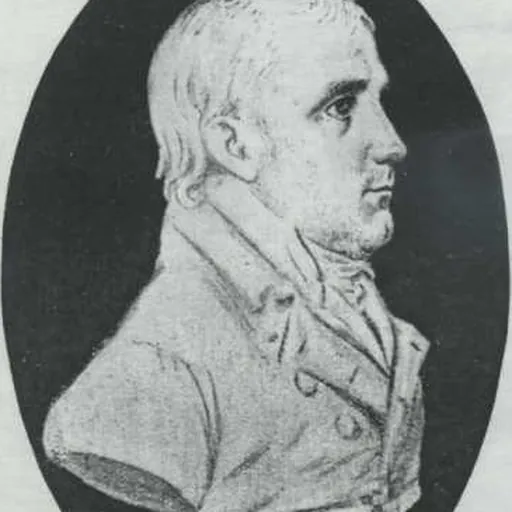
About John Fendall, Jr.
Lived 1762 – 1825 (aged 63). John Fendall, Jr. was a civil servant.
John Fendall (9 October 1762 – 10 November 1825) was a colonial official in the British East India Company, a member of the Supreme Council of Bengal, and the last British governor of Java.
Early life and service in East India Company
Fendall was born on 9 October 1762 in St Andrew Holborn, London. He began service in the East India Company in 1778 at the age of 16, before becoming First Assistant to the Collector of Murshidabad, Sir John D’Oyly. In 1788 he became Acting Magistrate of Murshidabad, and in 1790, Acting Collector for the East India Company in the Murshidabad district.
In 1790 he had become Collector of Midnapur and had attained the status of Senior Merchant. He returned to London in 1809 for the first time in 31 years. The voyage at that time took 5 ½ months to complete.
Governor of Java Fendall returned to Calcutta in 1815 and was informed he had been appointed Lieutenant-Governor of Java, an island the British acquired following the Invasion of Java in 1811. On 12 March 1816 by the last advice from Batavia, John relieved a sickly Sir Stamford Raffles as Lieutenant-Governor of Java, an island which is now a part of the Republic of Indonesia. Upon his arrival, Fendall was faced with significant administrative arrears and a treasury that was almost depleted, challenges he began to address immediately. Fendall ensured that the ailing Raffles continued to receive the courtesies due to the position of Lieutenant-Governor.
The British proceeded to restore sovereignty of the territory to the Sultan in November 1816.
Dispute with Colonel Yule During his tenure in Java, Fendall appears to have disapproved a financial claim made by a certain Colonel Yule. As a result, Yule followed him to Calcutta and demanded that he should alter his decision. After Fendall refused, Yule responded by brushing the papers against his face in a confrontational manner, suggesting Fendall take it as a personal insult. This, Fendall was quite ready to do and sent for a friend, named Assey, to take a challenge to the Colonel. Assey refused to have anything to do with a challenge, in spite of Fendall’s protests, and took the matter to various members of Council. The Council agreed that Fendall could not be called on to defend an official act in such a way and that Yule’s conduct was highly insubordinate. As the Governor-General agreed with them, Fendall was forbidden to fight and his opponent apologised to escape being tried by court martial.
Supreme Council appointment Fendall was transferred to Bengal, and was appointed a member of the Supreme Council of Bengal on 20 May 1820, which constituted membership in the Bengal Civil Service. In 1823 was appointed President of the Board of Trade on the Bengal Establishment. During his time on the Council, he took part in deliberations concerning land revenue policy, as evidenced by his participation in the council’s proceedings on specific dates in 1820, showing his endorsement for a fixed revenue system in the northern territories under British administration.
Fendall died on 10 November 1825 in Calcutta
Personal life Fendall married first in 1790, Mary Farquharson (1761–1818), the daughter of John Farquharson of Yateley, Hampshire, England, a scion of the family of Farquharson of Fingean. They had seven children, William Fendall (1793–1888), Mary Fendall (later Mary D'Oyly) (1794–1885), Harriet Fendall (later Harriet Thompson) (1797–1842), Harriet Fendall (later Harriet Moultrie) (1797–1867), Louisa Fendall (1799–1899), James Fendall (1801–1866) and Sophia Fendall (1805–1808).
Fendall married second, Harriet "Henrietta" Halcott (died 1871) in 1820. They had one son, Thomas Halcott Fendall (1825–1865).
Fendall had two residences. One was at Harewood Square, Marylebone, London, England. The other was 67 Great Portland St., Marylebone, London, England, a house that had belonged to his grandfather.
Don’t just read it —
keep it.
Full-length biographies made to live with: read them, listen on the way to work, watch them tonight.
- E-book
- Audio
- Video
Instant download · yours to keep · every purchase keeps this site free
Important facts
People in John Fendall, Jr.'s life
Named in this biography and alive at the same time

Related people
Same field, nearest in time



Contemporaries
People whose lives overlapped John Fendall, Jr.'s




Frequently asked questions
Who was John Fendall, Jr.?
British colonial administrator
When was John Fendall, Jr. born?
John Fendall, Jr. was born on 9 October 1762 in St Andrew Holborn.
When did John Fendall, Jr. die?
John Fendall, Jr. died on 10 November 1825 in Kolkata.
What was John Fendall, Jr.'s occupation?
John Fendall, Jr. was a civil servant.
Sources & further reading
· Wikipedia: John Fendall, Jr.
Cite this page
APA: Biography.guide. (2026). John Fendall, Jr.. https://biography.guide/john-fendall-jr/
MLA: "John Fendall, Jr.." Biography.guide, https://biography.guide/john-fendall-jr/.
Chicago: "John Fendall, Jr.." Biography.guide. https://biography.guide/john-fendall-jr/.
Data last updated: 2026-09-20 · Spot an error? Report a correction.
Page generated 2026-09-27 05:09 UTC