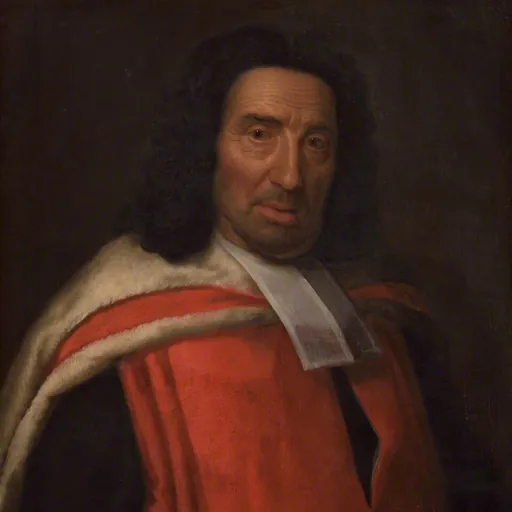
John Ellys
English academic
About John Ellys
Lived 1633 – 1716 (aged 82–83).
Sir John Ellys or Ellis (c. 1634 – 1716) was an English academic, Master of Gonville and Caius College, Cambridge from 1703.
Early life He was born at Huntingfield in Suffolk, into a well-known East Anglian family; the Ellyses of Great Yarmouth, his relations, are mentioned for example in the Journal of Rowland Davies, and Anthony Ellys was a great-nephew, son of Anthony Ellys who was mayor there. His father was John Ellis or Ellys, of Raveningham or Frostenden, with two brothers, Anthony and Thomas. The Perlustration of Great Yarmouth by Charles John Palmer gives his mother as Mary Barre of Syleham.
Fellow and associate of Newton After studying in a number of Suffolk schools, Ellys matriculated at Caius in 1648, aged 14. He graduated B.A. in 1652, and M.A. in 1655. He was then a Fellow of Caius from 1659 and in 1703 (N.S.) became Master, He helped Newton with astronomical observations, and was one of the few who knew Newton at Cambridge who visited his rooms.
Ellys was also noted as a leading tutor across the university, popular and distinguished; and was not ordained, but held the degree of M.D. A tutorial pupil, Henry Wharton, was taught by Newton, and is thought to have been the only undergraduate student to have seen Newton's mathematical papers. It has been argued that Ellys was introducing his pupils to Newtonian thought by the 1690s. William Whiston also claimed credit for the Newtonian edge to Clarke's Rohault translation (which however went to several editions); and Richard Laughton was thought by W. W. Rouse Ball to have been another Newtonian influence on Clarke. Ellys, however, is now considered a more likely source.
After Thomas Plume died in 1704, Ellys, Newton and John Flamsteed were asked to set up the Plumian Chair. Ellys pushed for the initial appointment of Roger Cotes. He then had to pacify Flamsteed and another trustee over the arrangements made for Cotes in Trinity College.
Ellys was Vice-Chancellor of the university at the time of Queen Anne's visit in 1705, and was knighted by her with Newton and James Montagu. These honours were intended to help the Whig political cause, and were engineered by Charles Montagu, 1st Earl of Halifax, brother of James Montagu. Ellys, however, is considered non-political. Apart from his interest in the new Cartesian and Newtonian scientific advances, there is little to indicate Ellys's views: it has been suggested that he was a Tory, and not concerned with Newton's theology.
When Whiston was deprived of the Lucasian Chair, Ellys lined up with Richard Bentley in trying to make Christopher Hussey his successor in 1711. Newton remained above the fray, and the outsider Nicholas Saunderson was narrowly elected.
Later life As Master of Caius Ellys tried, from 1709, to exercise a veto in college business, causing the Visitor to intervene in 1714. His ongoing conflicts in old age with the Fellows earned him the nickname "Devil of Caius".
Ellys was buried in the Church of St Cyriac and St Julitta, Swaffham Prior. A memorial inscription recorded by Francis Blomefield states he was in his 86th year. He had contributed for the purchase of the rectory of Broadwey in Dorset for the college in his lifetime, but left nothing further in his will. His successor Thomas Gooch was a former tutorial pupil of his.
Don’t just read it —
keep it.
Full-length biographies made to live with: read them, listen on the way to work, watch them tonight.
- E-book
- Audio
- Video
Instant download · yours to keep · every purchase keeps this site free
Important facts
People in John Ellys's life
Named in this biography and alive at the same time





Contemporaries
People whose lives overlapped John Ellys's





Frequently asked questions
Who was John Ellys?
English academic
When was John Ellys born?
John Ellys was born in 1633.
When did John Ellys die?
John Ellys died in 1716.
Sources & further reading
Cite this page
APA: Biography.guide. (2026). John Ellys. https://biography.guide/john-ellys/
MLA: "John Ellys." Biography.guide, https://biography.guide/john-ellys/.
Chicago: "John Ellys." Biography.guide. https://biography.guide/john-ellys/.
Data last updated: 2026-09-22 · Spot an error? Report a correction.
Portrait: Wikimedia Commons · author & licence
Page generated 2026-09-27 05:01 UTC