
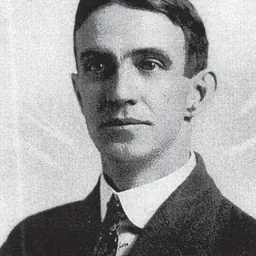
John David Provoo
American Buddhist priest
About John David Provoo
Lived 1917 – 2001 (aged 84). John David Provoo was an American.
John David Provoo (August 6, 1917 – August 28, 2001) was a United States Army staff sergeant and practicing Buddhist who was convicted of treason for his conduct as a Japanese prisoner of war during World War II. His conviction was later overturned on a technicality, and he became a Buddhist priest.
Childhood Provoo was born in San Francisco, California, on August 6, 1917. He worked for a time in a federal bank in San Francisco, and in 1940 moved to Japan to study in a Buddhist monastery near Tokyo. He was captured by Japanese forces in the Battle of Corregidor in 1942 and made a prisoner of war.
According to his fellow prisoners, Provoo used his fluent Japanese to rise to a position of power in the POW camp and he abused his fellow prisoners to gain additional privileges from the Japanese. One POW wrote in his memoirs that Provoo was so hated by his fellow prisoners that one had tried to kill him by putting ground glass in his food, and that Provoo later threatened to kill a colonel named Cooper.
After the war, Provoo was arrested, but then released in 1946 after eight months of investigation which concluded that there was no evidence he had collaborated with the Japanese. He re-enlisted in the army six weeks later. The story made the front page of the New York Times the following day.
His trial finally began on October 27, 1952. General Jonathan Wainwright testified for the defense in the trial's seventh week. He testified that he had never met Provoo nor heard any reports about him during the war, but described his experiences in Japanese POW camps, including the fact that he performed manual labor as the Japanese ordered. Lawyers had to shout their questions at him, as his exposure to loud shell bursts during the war had left him with a severe hearing impairment. The government called 34 witnesses, including 20 who traveled to New York from Japan to testify.
After a fifteen-week trial, on February 11, 1953, the jury found Provoo guilty on charges of offering his services to the Japanese Army, helping to cause the execution of a fellow prisoner, and making two propaganda broadcasts on behalf of the Japanese. He was the eighth U.S. citizen convicted of treason after World War II, and only the second whose conviction related to actions during imprisonment in a POW camp. When his sentence was announced the following week, the court spared him from execution on grounds of his emotional instability and sentenced him to life imprisonment and a $10,000 fine. In total, the costs of Provoo's trial were estimated at $1 million.
On August 27, 1954, a unanimous three-judge panel of the Second Circuit Court of Appeals overturned his conviction on the grounds that the cross-examination about his alleged homosexuality had prejudiced the jury and the venue was improper. Judge Thomas Walter Swan wrote: The prosecution asked the U.S. Supreme Court to review the case, but that court upheld the lower court's ruling in a per curiam ruling without recorded dissent on October 17, 1955.
Later years Provoo found it difficult to recover from being tried for treason. He said it felt like "towing a shipwreck" behind him. In September 1957, he was arrested in Lincoln, Nebraska, and pleaded guilty to a charge of contributing to the delinquency of a minor, a 16-year-old runaway boy from Maryland. He was sentenced on August 29, 1958, to three years in the men's reformatory.
After his release from prison, Provoo went to Japan to resume his Buddhist studies. At the Nichiren-shū Buddhist School, he was promoted to a high position, roughly equivalent to that of bishop in the Catholic Church. He returned to the United States to teach Buddhism, hoping to allow others to learn without having to relocate and learn Japanese as he had. In 1967 he settled on the island of Oahu where he led a Buddhist group. He later led a Buddhist group near the town of Pahoa on the Island of Hawaii. He also started up the non-profit Buddhist School of America. He built a small temple and some cabins. He lived there and usually had a few students living with him. As a Buddhist teacher, he went by the Buddhist name "Nichijo Shaka".
He died at Hilo Medical Center on August 28, 2001. His ashes were buried at the Hawaii Veteran's Cemetery No. 2.
Don’t just read it —
keep it.
Full-length biographies made to live with: read them, listen on the way to work, watch them tonight.
- E-book
- Audio
- Video
Instant download · yours to keep · every purchase keeps this site free
Important facts
People in John David Provoo's life
Named in this biography and alive at the same time



Contemporaries
People whose lives overlapped John David Provoo's

Frequently asked questions
Who was John David Provoo?
American Buddhist priest
When was John David Provoo born?
John David Provoo was born on 6 August 1917.
When did John David Provoo die?
John David Provoo died on 28 August 2001.
What nationality was John David Provoo?
John David Provoo was American.
Sources & further reading
· Wikipedia: John David Provoo
Cite this page
APA: Biography.guide. (2026). John David Provoo. https://biography.guide/john-david-provoo/
MLA: "John David Provoo." Biography.guide, https://biography.guide/john-david-provoo/.
Chicago: "John David Provoo." Biography.guide. https://biography.guide/john-david-provoo/.
Data last updated: 2026-09-20 · Spot an error? Report a correction.
Page generated 2026-09-27 05:04 UTC