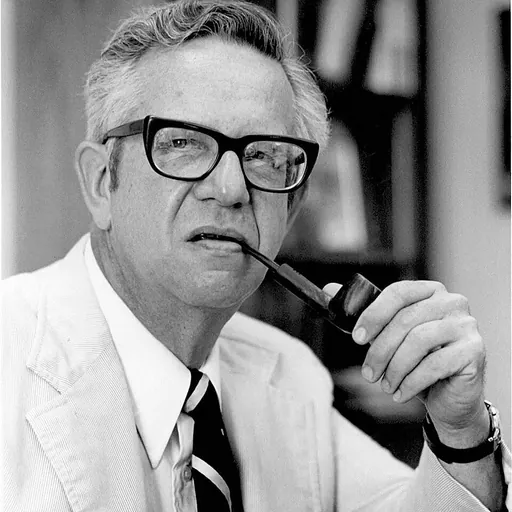
About John D. Hoffman
Lived 1922 – 2004 (aged 81). John D. Hoffman was an American chemist, known for Hoffman nucleation theory.
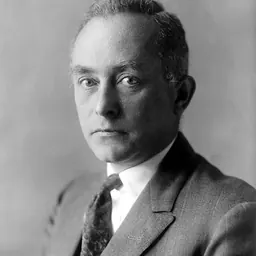
John Drake Hoffman (November 26, 1922 – February 21, 2004) was an American chemist and author who was awarded the Soldier's Medal, the United States Army's highest award for an act of valor in a non-combat situation, and the only one awarded to a member of the Manhattan District. After the war he worked for the National Bureau of Standards, becoming the director of its national measurements laboratory. He was a professor and director of the engineering materials program at the University of Maryland from 1982 to 1985, director of the Michigan Molecular Institute, and a professor of materials science and engineering at Johns Hopkins University.
Early life John Drake Hoffman was born in Washington, D.C., on November 26, 1922. He grew up in Bethesda, Maryland, and attended Bethesda-Chevy Chase High School. He entered Franklin & Marshall College in Pennsylvania, graduating with a B.S. in chemistry in 1942.
Manhattan Project Hoffman served in the U.S. Army during World War II. In 1944,
Post-war Hoffman left the army in 1946, and entered Princeton University, where he earned M.S. and Ph.D. degrees, He married Barbara Smith in 1949. They had three sons: James, John and Robert. After her death in 1980, he married Dolores Garcia. Through his second marriage he acquired two stepdaughters, Carol Wichers and Valerie Wichers-Calder.
After graduation, Hoffman worked at General Electric as a researcher from 1949 to 1954. He then joined the National Bureau of Standards as a research chemist. He became the chief of the Dielectrics Section in 1957, and of the Polymers Division in 1964. In 1967, he became the director of the Institute for Materials Research. Finally, in 1978, he became the Director of the National Measurement Laboratory. He retired from the Bureau of Standards in 1982. He was a professor at the University of Maryland from 1982 to 1985, and Director and CEO of the Michigan Molecular Institute from 1985 to 1990. Finally, he was professor of materials science and engineering at Johns Hopkins University. He was awarded the Department of Commerce Gold Medal in 1965, the Samuel Wesley Stratton Award of the National Bureau of Standards in 1967, and the Presidential Rank Award of Meritorious Executive. He published over 60 scientific papers, but is best remembered for his 1961 work with John I. Lauritzen on Hoffman nucleation theory.
Hoffman died from congestive heart failure at George Washington University Hospital on February 21, 2004.
Don’t just read it —
keep it.
Full-length biographies made to live with: read them, listen on the way to work, watch them tonight.
- E-book
- Audio
- Video
Instant download · yours to keep · every purchase keeps this site free
Important facts
People in John D. Hoffman's life
Named in this biography and alive at the same time




Related people
Same field, nearest in time




Contemporaries
People whose lives overlapped John D. Hoffman's





Frequently asked questions
Who was John D. Hoffman?
American chemist (1922–2004)
When was John D. Hoffman born?
John D. Hoffman was born on 26 November 1922 in Washington, D.C..
When did John D. Hoffman die?
John D. Hoffman died on 21 February 2004 in Washington, D.C..
What was John D. Hoffman's occupation?
John D. Hoffman was a chemist.
What was John D. Hoffman known for?
John D. Hoffman was known for Hoffman nucleation theory.
What nationality was John D. Hoffman?
John D. Hoffman was American.
Sources & further reading
Cite this page
APA: Biography.guide. (2026). John D. Hoffman. https://biography.guide/john-d-hoffman/
MLA: "John D. Hoffman." Biography.guide, https://biography.guide/john-d-hoffman/.
Chicago: "John D. Hoffman." Biography.guide. https://biography.guide/john-d-hoffman/.
Data last updated: 2026-09-20 · Spot an error? Report a correction.
Page generated 2026-09-27 05:10 UTC