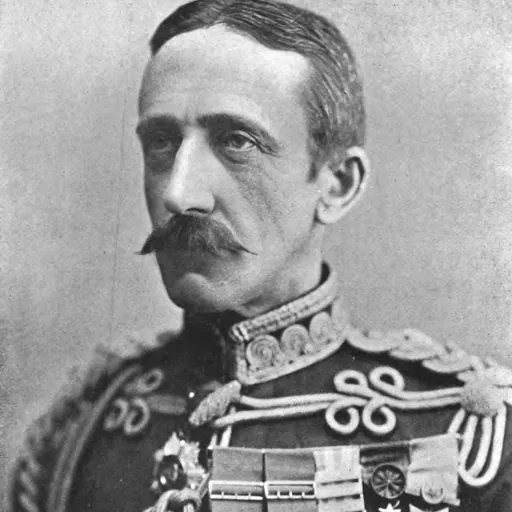
About John Charles Ardagh
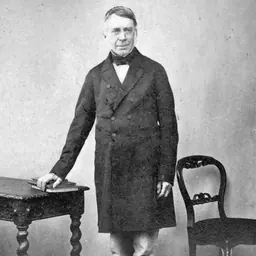
Lived 1840 – 1907 (aged 67). John Charles Ardagh was a British engineer, military personnel and private secretary.
Major-General Sir John Charles Ardagh (9 August 1840 – 30 September 1907), was a British Army officer, surveyor and colonial administrator.
Biography Early life and education Ardagh was the second son of Anglo-Irishman William Johnson Ardagh (1798-1872), vicar of Rossmire, County Waterford, and Sarah Cobbold, of Ipswich. After attending school at Waterford, in 1857 Ardagh entered Trinity College, Dublin, intending to follow his father into the church. He won a prize in Hebrew and honours in mathematics, but eventually decided on a military career, taking first place in the examinations to enter the Royal Military Academy at Woolwich in 1858,
Military engineer After training at the Royal School of Military Engineering at Chatham, Ardagh supervised the construction of Fort Popton, one of the new defensive works at Milford Haven, built under the terms of the Defence Act of 1860. After further employment on other defence works, in April 1868 he was appointed secretary of Sir Frederick Grey's committee to report on the fortifications under construction, and in September 1869 he accompanied Sir William Jervois on a tour of inspection of the defence works at Halifax and Bermuda. He attended the Staff College from February 1873, passing his final examinations in December 1874. Between September 1878 and September 1879 he was employed on the international commission to delineate the frontiers of Bulgaria. and was finally promoted to major on 22 September 1880. On 3 June 1881 he was appointed British commissioner for the delimitation of the frontier between Turkey and Greece. In spite of obstacles the work was completed by the end of October. and was promoted to brevet lieutenant-colonel on 18 November 1882. He was mentioned in Lord Wolseley's despatch at the end of the campaign, and also received the British war medal with clasp for Tel-el-Kebir, the Khedive's bronze star, and the fourth class of the order of the Osmanieh.
In October 1884, when an expedition to relieve Khartoum was organised, Ardagh favoured an approach overland via Suakin and Berber, but the commander Lord Wolseley resolved to travel by boat up the Nile. Ardagh was appointed commandant at Cairo, with the grade of assistant adjutant-general. His energy, devotion, and quiet cheerfulness helped to expedite the fatal enterprise, and at the end of the disastrous campaign receiving the Order of the Medjidieh (3rd class). On 30 December, as chief staff officer of a combined British and Egyptian force, he took part in the battle of Ginnis, when a large army of the Khalifa, endeavouring to invade Egyptian territory, was defeated with great loss. For his services Ardagh was mentioned in despatches. and on 26 January 1887 he was gazetted a colonel on the staff. to 1893 he was aide-de-camp to the Commander-in-Chief of the Army. In October 1888 he became, with the permission of the War Office, private secretary to the Viceroy of India, the Marquis of Lansdowne. Apart for a period of absence through illness in 1892, he remained with Lord Lansdowne through his term of office. He returned to England in May 1894, after serving briefly under Lansdowne's successor, Lord Elgin. and a Knight Commander of the Order of the Indian Empire in 1894.
South African War Ardagh served as commandant of the School of Military Engineering at Chatham from April 1895 until April 1896, He was promoted to major-general on 14 March 1898.
On the outbreak of the South African War in October 1899, Ardagh's department was criticized for providing poor intelligence on the military strength and preparations the Boers had made for war. In response, Ardagh, in spite of a limited staff and inadequate funds, compiled a full statement of the numbers and military resources of the Boer forces, estimating that the defence of the British colonies would require 40,000 men, while to carry the war into the enemy's country would require 200,000. Copies of this report were eventually laid before both houses of parliament at Ardagh's request. Meanwhile a copy of Military Notes on the Dutch Republic, a study prepared in secret by Ardagh's intelligence branch, fell into the hands of the Boers after the Battle of Talana Hill on 20 October 1899, and was later published. These documents, which were corroborated by evidence laid before the royal commission after the war, absolved Ardagh of all blame. but was still employed by the Foreign Office. He succeeded Lord Pauncefote on the Permanent Court of Arbitration at the Hague, and was appointed by the British government as a director of the Suez Canal Company. and he was invested with the insignia by King Edward VII at Buckingham Palace on 18 December 1902.
Ardagh also served as a member of council of the British Red Cross Society from 1905, representing the British Army, and in June 1906 was one of four delegates of the British government, at the conference held by the Swiss government for the revision of the Geneva Convention of 1864. His last public duty was to act as a delegate of the central committee of the British Red Cross Society at the Eighth International Conference in London in June 1907, after which he received the Red Cross Commemoration Medal for his services during the Russo-Japanese War from the Empress Marie Feodorovna of Russia.
Ardagh died on 30 September 1907 at Glynllivon Park, Carnarvon, and is buried at the Church of St Mary & All Saints, Broomfield, near Taunton, Somerset.
Personal life On 18 February 1896, Ardagh married Susan, the widow of the 3rd Earl of Malmesbury and the daughter of John Hamilton of Fyne Court, Somerset.
In addition to his military activities, Ardagh served on the council of the Royal Geographical Society, was an associate of the Institution of Civil Engineers, and was a member of the Royal Society's Geodetic Arc Committee in 1900. He was made an honorary Legum Doctor by Trinity College, Dublin, in 1897. In October 1894, he published an article on British rule in Egypt in the Quarterly Review, and contributed occasionally to other periodicals. He was also a skilled artist, and 140 of his water-colour drawings were presented by his wife to the Royal Engineers Institute at Chatham. A biography, also written by his wife, was published in 1909.
Publications
Don’t just read it —
keep it.
Full-length biographies made to live with: read them, listen on the way to work, watch them tonight.
- E-book
- Audio
- Video
Instant download · yours to keep · every purchase keeps this site free
Important facts
People in John Charles Ardagh's life
Named in this biography and alive at the same time


Related people
Same field, nearest in time

Contemporaries
People whose lives overlapped John Charles Ardagh's


Frequently asked questions
Who was John Charles Ardagh?
British Army officer (1840-1907)
When was John Charles Ardagh born?
John Charles Ardagh was born on 9 August 1840 in Waterford.
When did John Charles Ardagh die?
John Charles Ardagh died on 30 September 1907 in Caernarfon.
What was John Charles Ardagh's occupation?
John Charles Ardagh was an engineer, military personnel and private secretary.
What nationality was John Charles Ardagh?
John Charles Ardagh was British.
Sources & further reading
· Wikipedia: John Charles Ardagh
· DBpedia: John Charles Ardagh
Cite this page
APA: Biography.guide. (2026). John Charles Ardagh. https://biography.guide/john-charles-ardagh/
MLA: "John Charles Ardagh." Biography.guide, https://biography.guide/john-charles-ardagh/.
Chicago: "John Charles Ardagh." Biography.guide. https://biography.guide/john-charles-ardagh/.
Data last updated: 2026-09-23 · Spot an error? Report a correction.
Portrait: Wikimedia Commons · author & licence
Page generated 2026-09-27 05:06 UTC