
About John Chapman
Lived 1896 – 1963 (aged 66). John Chapman was an Australian military officer.
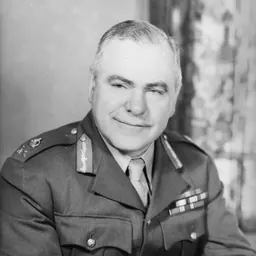
Major General John Austin Chapman, (15 December 1896 – 19 April 1963) was a professional soldier in the Australian Army. Joining the army in 1913, he served as a junior officer during the First World War and saw action on the Western Front. After the war he was appointed to a number of staff and teaching positions prior to the outbreak of the Second World War. Appointed chief of staff, 7th Division, he served during the Syrian Campaign in 1941 before taking up important staff positions in Australia. He retired from the army in 1953 after 41 years of service and died in Sydney in 1963 at the age of 67.
Early life John Austin Chapman was born on 15 December 1896 in Braidwood, New South Wales, the son of Austin Chapman, the Braidwood representative on the New South Wales Legislative Assembly. He attended Christian Brothers schools in Sydney and Melbourne before entering Royal Military College, Duntroon in 1913.
Military career First World War
Upon graduation from Duntroon in 1915, Chapman was commissioned as a lieutenant in the Australian Army. Volunteering for the Australian Imperial Force (AIF), his first assignment was to 30th Battalion,
Chapman, now a captain, was wounded due to a gas attack in November, and this necessitated his evacuation to England for treatment. He returned to the battalion in May 1917 as adjutant and served in this capacity until October. Promoted to major, he was attached to the Australian Corps and 5th Division headquarters. During the Hundred Days Offensive, he was acting brigade major of the 8th Brigade.
He was later awarded the Distinguished Service Order (DSO) for his actions of 28 August 1918, when he carried out a reconnaissance of the front lines under heavy fire.
Interwar period Chapman remained in the army after the cessation of hostilities, returning to Australia in June 1919. He married the following October, to Helena Mary de Booten, originally from Chile. The couple would go on to have four children.
Second World War Lieutenant General Sir Thomas Blamey (left) talking with Jessie Vasey and Lieutenant Colonels George Vasey and John Chapman (right) on board the troop transport Strathallan in December 1939.
Still in England when the Second World War broke out in September 1939, he was posted to the British 52nd (Lowland) Infantry Division as a staff officer but returned to Australia in January 1940, having been promoted to lieutenant colonel in November 1939.
Based in Melbourne, he was responsible for training at army headquarters before transferring to the reformed AIF in April 1940. Commencing on 8 June 1941, the division participated in the two-month-long Syrian Campaign against the Vichy French during which Chapman earned a recommendation for a Bar to his DSO. This was duly gazetted and awarded in 1944.
Major General J. A. Chapman and staff, at the airfield, immediately after their arrival at Mareeba, 13 March 1944.
After the conclusion of the Syrian campaign, Chapman was promoted to temporary brigadier in August and became responsible for the AIF Base Area in the Middle East. He later returned to Australia as deputy adjutant and Quartermaster General, based in Brisbane. Promoted to major general in September 1942, he was appointed as Deputy Chief of the General Staff in October 1944. He served in this capacity until March 1946. After completing his four-year term in the United States (and being awarded a Legion of Merit), he had a spell as General Officer Commanding, Central Command before commencing his final post of Quartermaster General and member of the military board in February 1951. He was honoured with an appointment as Companion of the Order of the Bath in June 1952.
Later life Chapman retired in December 1953 after 41 years of service in the army. He died of cancer at his home in Mosman on 19 April 1963, survived by two sons and a daughter. His wife had predeceased him in 1961. He was buried with military honours in Northern Suburbs cemetery, Sydney.
Don’t just read it —
keep it.
Full-length biographies made to live with: read them, listen on the way to work, watch them tonight.
- E-book
- Audio
- Video
Instant download · yours to keep · every purchase keeps this site free
Important facts
People in John Chapman's life
Named in this biography and alive at the same time




Related people
Same field, nearest in time

Contemporaries
People whose lives overlapped John Chapman's



Frequently asked questions
Who was John Chapman?
Australian Army officer (1896–1963)
When was John Chapman born?
John Chapman was born on 15 December 1896 in Braidwood.
When did John Chapman die?
John Chapman died on 19 April 1963 in Mosman.
What was John Chapman's occupation?
John Chapman was a military officer.
What nationality was John Chapman?
John Chapman was Australian.
Sources & further reading
· DBpedia: John Chapman (Australian Army officer)
Cite this page
APA: Biography.guide. (2026). John Chapman. https://biography.guide/john-chapman-military-officer/
MLA: "John Chapman." Biography.guide, https://biography.guide/john-chapman-military-officer/.
Chicago: "John Chapman." Biography.guide. https://biography.guide/john-chapman-military-officer/.
Data last updated: 2026-09-25 · Spot an error? Report a correction.
Page generated 2026-09-27 05:11 UTC