
About John Cecil Russell
Lived 1839 – 1908 (aged 68–69). John Cecil Russell was a military personnel.
Major-General John Cecil Russell (6 December 1839 – 30 March 1909) was a British Army cavalry officer. While studying at the New College of the University of Oxford, Russell served in the university's Rifle Volunteer Corps. He purchased a commission in the 11th Light Dragoons in 1860 and almost immediately transferred to the 10th Light Dragoons. Russell rose to the rank of captain by purchase before transferring to the 12th (The Prince of Wales's) Royal Regiment of Lancers in 1872. Russell served with Major-General Garnet Wolseley in the 1873–1874 Anglo-Ashanti War and was considered a member of the Wolseley ring of men associated with the general. In 1875 he was appointed an equerry in waiting to Edward, Prince of Wales, and became an extra equerry in 1878.
Russell saw action in Southern Africa against the Pedi King Sekhukhune and, through his connections, received a post with the British forces for the Anglo-Zulu War of 1879, with the local rank of lieutenant-colonel. The British commander, Lord Chelmsford, appointed Russell to command the mounted contingent of the main Central Column. On the day of the British defeat at the Battle of Isandlwana, he was away with Chelmsford on a reconnaissance expedition. Russell was afterwards reassigned to Evelyn Wood's Left Column. On 28 March, Russell led part of the British force in the Battle of Hlobane, but was criticised for his perceived abandonment of a detachment commanded by Redvers Buller which was attacked by the Zulu. Russell's subordinate, Lieutenant Edward Browne, denounced Russell as a coward in a letter to Wood. At Wood's recommendation, Russell was removed from operations and assigned to a depot in the rear.
Russell returned to his regiment in 1880 and commanded them on a posting to India. He became a colonel in 1884 and from 1887 commanded a cavalry depot in Kent. He was promoted to major-general in 1895 and retired from the army in 1898. When the Prince of Wales acceded to the throne as Edward VII in 1901, Russell became an extra equerry to the king, and the following year was appointed Colonel of the Regiment of the 12th Lancers. He died at his home in Canterbury, Kent, and is buried in that city.
Early career
John Cecil Russell was born in Edinburgh on 6 December 1839, the only son of Alexander James Russell and Magdalene Stein. The family crest, derived from the Russells of Ashiesteel, was a fountain proper (a roundel with blue and white wavy bands) and the motto was . Through his paternal grandmother Russell also had connections to the Murrays of Polmaise and the principal branch of Clan Robertson. Russell resigned his commission in the Rifle Volunteer Corps on 19 June 1860.
Russell purchased a commission as a cornet in the 11th Light Dragoons on 18 September 1860, and transferred to the 10th Light Dragoons on 16 October. His regiment was then garrisoned in Norwich, England. It was renamed the 10th (The Prince of Wales's Own) Royal Hussars in 1861 and transferred to Yorkshire.
In 1863, the 10th Royal Hussars were posted as part of the garrison in Ireland where, on 28 June 1864 Russell was appointed an instructor of musketry. He purchased a lieutenant's commission in the regiment on 16 August 1864, and was appointed adjutant on 18 October, serving in that role until 2 April 1869. The 10th Royal Hussars were deployed in response to the Fenian Rising of 1867, but saw no action; they returned to England in 1868, being posted to the Aldershot Garrison. Later that year, Russell passed the examination for entry to the Staff College, ranking 19th out of 28 candidates, but there was space to admit only the top 16 candidates.
In June 1869, Russell was appointed aide-de-camp to the brigadier-general commanding the cavalry troops at the Aldershot Garrison. He purchased his captaincy in the 10th Royal Hussars on 28 May 1870. Russell transferred to the 12th (The Prince of Wales's) Royal Regiment of Lancers on 3 August 1872.
Russell wrote Notes on Cavalry Service, a military manual that was published by Cassell, Petter & Galpin in London in 1873. The book was written in the aftermath of the Franco-Prussian War where infantry, armed with breechloading rifles, demonstrated their ability to rapidly shoot down charging cavalry. Russell concluded that cavalry remained valuable for reconnaissance work, for screening other units and for exploiting opportunities quickly; but also recognised the value of mounted infantry, which could rapidly redeploy on the battlefield by horse before dismounting to lay down fire with rifles or carbines. He recommended that new units be raised to carry out the mounted infantry role so as not to dilute the "cavalry spirit" of the existing units.
From 5 December 1873, Russell participated in the 1873–1874 Anglo-Ashanti War. From 9 February to 20 March 1874, he served as deputy assistant-adjutant and quartermaster-general. He was appointed an equerry in waiting to Edward, Prince of Wales on 1 March 1875. Russell's regiment was posted to India in 1877, but he remained at court. He resigned his position as equerry on 5 July 1878 to seek active service but was retained by Edward in the honorary role of extra equerry.
Russell was sent to the recently-annexed Transvaal on special duties, arriving on 29 May 1878, and fought in the First Sekhukhune War against the Pedi people. On 27 March, Chelmsford's military secretary, Henry Hope Crealock, wrote to Russell to inform him his local rank was being rescinded and he was to revert to his brevet rank of major. This undermined Russell's position among the officers of Wood's column and he was outraged when he received this letter on 11 April. British movements at Hlobane. Russell's advance to Devil's Pass via Ntendeka and withdrawal in yellow. Buller's approach up Hlobane from the east and withdrawal via Devil's Pass in red. alt=see caption, Buller's route passes first to the south of the mountain; Russell's party ascends Ntendeka from the west, and reaches Devil's Pass before turning and withdrawing westward. In late March, Wood ordered Russell and Buller to attack Hlobane, a mountain stronghold of the AbaQulusi Zulu clan. At 4am on 28 March, Russell left camp with a party of 640, which included his mounted infantry and Natal Native Horse, but also the irregular Kaffrarian Rifles and some African auxiliary infantry. Reaching the mountain around dawn, Wood's orders were for Russell to ascend the Ntendeka Mountain to the west, and to pass onto Hlobane by Devil's Pass. Buller's men were to ascend from east of Hlobane. On reaching Devil's Pass, Russell considered it impassable for horses and sent Lieutenant Edward Browne and a party of dismounted men to Buller to warn him of this, though Browne was unable to locate Buller. While Russell's men were seizing Zulu cattle on Ntendeka, they spotted the main Zulu army approaching from the southeast and Russell sent a message to alert Wood to this.
The Zulu secured the eastern flank of Hlobane, leaving Devil's Pass as Buller's only escape route. Russell meanwhile had withdrawn to the base of Ntendeka, where he considered he could support a withdrawal by Buller along the south side of Hlobane. Russell then received a message from Wood, who thought him still on the mountain, ordering him to move to "Zunguin Nek", from where he could cover Buller's retreat. "Nek" is a Southern African term for a ridge of land connecting two peaks. Wood intended his order to refer to the ridge connecting Ntendeka to Zungwini Mountain, but Russell, who was already very close to this location, interpreted the order as requiring him to take up position on the ridge connecting Zungwini to Kambula mountain, further to the west and of no use to Buller. Buller's unit descended Devil's Pass, covered only by Browne's small party which had remained on the Ntendeka. Buller's men were harried closely during their retreat and suffered heavy casualties before reaching Russell's force and returning to Kambula. Russell's quick withdrawal had also left behind his auxiliary infantry, 80 of whom were killed.
On the following day, 29 March, the Zulu attacked the British camp in the Battle of Kambula. With the Zulu army assembled before the British post, Russell's mounted contingent were ordered to provoke the Zulus into attacking the camp by riding to within of the Zulu and opening fire. When the Zulu charged, some of Russell's soldiers struggled to remount and he rode to the aid of a trooper of the Frontier Light Horse. Russell was unhorsed in the confusion and had to be rescued by Lieutenant Browne; troops of the Natal Native Horse saved the dismounted trooper. Browne received the Victoria Cross and Russell was commended by Wood to Chelmsford, though it is likely later communications from Wood and Buller persuaded him no medal was warranted. After the Zulu were defeated in a fruitless assault on the camp, the mounted troops participated in the pursuit of the retreating force. Buller, in the thick of the pursuit, told Crealock he had to ride a mile (1.6 km) back to assume command of Russell's unit after he refused to advance, fearful of exposing his flanks.
In his formal report on the battle of Hlobane, Wood criticised Russell's actions and came close to accusing him of cowardice. Buller and Browne were furious with Russell. On the day of the Battle of Kambula, Russell had apologised to Buller, saying: "you are quite right. My metier is not South African fighting". Buller told Russell he would never serve on a joint operation with him again. A week after the battle, Wood wrote to Crealock noting his lack of faith in Russell as a reconnaissance officer for failing to report on two companies of British infantry who had been threatened with attack by a large Zulu force. On 10 April, Browne handed a letter to Wood denouncing Russell for cowardice at Hlobane and stating he and his men would never serve under him again. Wood forwarded the letter to Chelmsford and recommended Russell be removed from operations and assigned to the remount depot in the rear at Pietermaritzburg; the general concurred and issued the order. The mounted infantry served under Buller's command for the rest of the war. Russell returned to Britain on 4 October 1879.
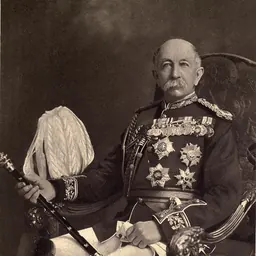
Later career alt=Russell, white-haired and moustached wears a general's uniform and the insignia of a Commander of the Royal Victorian Order around his neck. Russell returned to the 12th Lancers in his substantive rank of captain on 8 May 1880, when the regiment was still garrisoned in India. He was promoted to major on 5 June 1880 and to lieutenant-colonel on 1 July 1881, receiving command of the regiment. In 1887, he was appointed to command the cavalry depot at Canterbury, Kent, a post he held for five years. He was appointed to the honorary position of Colonel of the Regiment of the 12th Lancers on 2 April 1902. A contemporary article in the Evening Despatch considered that this removed the stain on Russell's reputation arising from Hlobane, and noted Field Marshal Frederick Roberts, 1st Earl Roberts, who was Commander-in-Chief of the Forces, had supported the appointment. Russell was appointed a Commander of the Royal Victorian Order on 9 November 1902; appointments to the order are the personal gift of the British monarch.
Personal life and death Russell married Hester Frances, the daughter of the Reverend Charles Thornhill, at Castlebellingham in Ireland on 11 March 1869; the bride's father carried out the marriage service. The couple had seven daughters born between 1869 and 1888, including the artist Joan Russell. Russell's fourth daughter, Hester Frances, married the banker and future Baron Latymer Hugh Burdett Money-Coutts, on 11 June 1900.
During his period commanding the Canterbury depot, Russell lived at the Hoystings, a house in the city. After he left Canterbury, Russell lived for a while on the Isle of Mull in Scotland, and at Bramford Hall in Suffolk, where Arthur Conan Doyle visited him to take part in the shooting of game birds. In 1902, Russell returned to Canterbury, where he lived at Barton Court and served as a Justice of the Peace. He died at his home on 30 March 1909 while recovering from an operation he had undergone in London. Russell's funeral was held at St Martin's Church, Canterbury, and he is buried in the city.
Don’t just read it —
keep it.
Full-length biographies made to live with: read them, listen on the way to work, watch them tonight.
- E-book
- Audio
- Video
Instant download · yours to keep · every purchase keeps this site free
Important facts
People in John Cecil Russell's life
Named in this biography and alive at the same time




Related people
Same field, nearest in time


Contemporaries
People whose lives overlapped John Cecil Russell's


Frequently asked questions
Who was John Cecil Russell?
British cavalry officer (1839–1909)
When was John Cecil Russell born?
John Cecil Russell was born in 1839.
When did John Cecil Russell die?
John Cecil Russell died in 1908.
What was John Cecil Russell's occupation?
John Cecil Russell was a military personnel.
Sources & further reading
· Wikipedia: John Cecil Russell
Cite this page
APA: Biography.guide. (2026). John Cecil Russell. https://biography.guide/john-cecil-russell/
MLA: "John Cecil Russell." Biography.guide, https://biography.guide/john-cecil-russell/.
Chicago: "John Cecil Russell." Biography.guide. https://biography.guide/john-cecil-russell/.
Data last updated: 2026-09-20 · Spot an error? Report a correction.
Page generated 2026-09-27 05:22 UTC