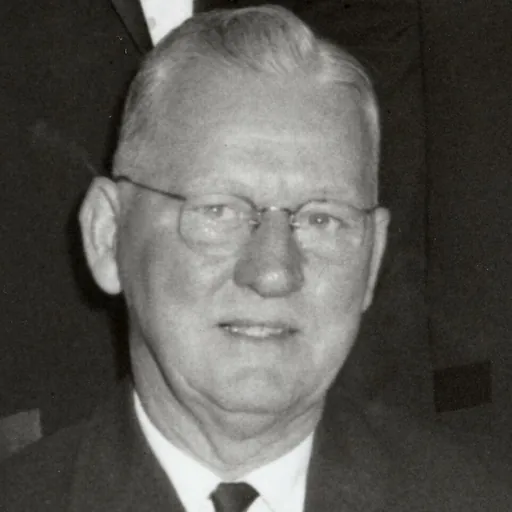
About John Bernard Hynes
Lived 1897 – 1970 (aged 72). John Bernard Hynes was an American politician.
John Bernard Hynes (September 22, 1897 – January 6, 1970), was an American politician from Boston, Massachusetts who served three terms as the mayor of Boston from 1950 to 1960, after having served as acting mayor in 1947. As mayor, Hynes focused on shifting Boston away from the high tax and spending policies of his predecessor, James Michael Curley, and began Boston's urban renewal, eventually leading to the construction of buildings such as the Prudential Center and Boston City Hall. He also established the Freedom Trail.
Along with his successors John F. Collins and Kevin White, Hynes is considered responsible for the modernization of Boston.
Early life John Bernard Hynes was born in the South End neighborhood of Boston, Massachusetts, on September 22, 1897, the son of Bernard and Margaret Hynes (née Higgins). His parents had immigrated from Ireland.
Upon leaving grammar school, he worked for a telephone company. He served in the United States Signal Corps during World War I.
Early political career Hynes began his career at city hall in 1920 as a clerk in the health department. He later transferred to the auditing department and was chief clerk in the mayor's office during James Michael Curley's 1922 to 1926 term. On January 4, 1926, Hynes became the city's assistant budget commissioner. He earned his high school and college diplomas through evening classes, graduating from Suffolk University Law School in 1927. On June 18, 1929, he was appointed assistant city clerk. In August 1943, Hynes was commissioned a major in the United States Army, later being promoted to lieutenant colonel. He was discharged that December due to a reoccurrence of a chronic ear issue and returned to the city clerk's office. On September 1, 1945, he became Boston's city clerk.
Acting mayoralty On June 26, 1947, Mayor James Michael Curley was sentenced to six to eighteen months in prison for mail fraud. The city charter allowed the president of the Boston City Council to serve as acting mayor in the mayor's absence, but his powers were limited unless the mayor was deceased. The Massachusetts General Court passed emergency legislation to bypass council president John B. Kelly, who had recently been acquitted on bribery charges and was in ill health, and to grant full mayoral powers to Hynes (who as city clerk was second in the line of succession) until Curley's release from prison.
Curley, upon his return from prison, commented to the press, "I have accomplished more in one day than has been done in the five months of my absence." Stung by this off-hand but disparaging comment about his performance as acting mayor, Hynes decided to challenge Curley in the November 1949 election and defeated him through tapping into widespread discontent with Curley's high tax policies and engagement with city bosses.
Mayoralty As mayor, Hynes primarily focused on lowering Boston's tax rate, which had been spiraling due to the policies of Mayor Curley, and bringing urban renewal to Boston. He was also named Democratic National Committeeman for Massachusetts.
Personal life and death He lived in a modest house on Druid Street in Boston's Dorchester neighborhood with his wife, Marion, and their five children. Of them, John "Jack" Hynes Jr. later became a longtime Boston news anchor and the father of John Hynes III, Marie "Darby" Hynes Gallagher became a special education teacher in the Boston city school system, Richard Hynes taught at Boston University, and Barry T. Hynes served on the Boston City Council, later becoming its president, and was Boston's city clerk. His second daughter, Nancy died in her forties due to illness.
Hynes was known for his warm demeanor and love towards Boston's traditions, as well as for composing poetry. He was buried in St. Joseph Cemetery in West Roxbury and was survived by his wife and children.
Legacy After his death, the John B. Hynes Memorial Auditorium, located in the Back Bay neighborhood of Boston, was named for him, as well as its replacement, the Hynes Convention Center.
Hynes, along with his successors, John Collins and Kevin White, are seen as most responsible for the modernization of the city of Boston.
Don’t just read it —
keep it.
Full-length biographies made to live with: read them, listen on the way to work, watch them tonight.
- E-book
- Audio
- Video
Instant download · yours to keep · every purchase keeps this site free
Important facts
People in John Bernard Hynes's life
Named in this biography and alive at the same time




Related people
Same field, nearest in time





Contemporaries
People whose lives overlapped John Bernard Hynes's


Frequently asked questions
Who was John Bernard Hynes?
mayor of Boston
When was John Bernard Hynes born?
John Bernard Hynes was born on 22 September 1897 in Boston.
When did John Bernard Hynes die?
John Bernard Hynes died on 6 January 1970 in Carney Hospital.
What was John Bernard Hynes's occupation?
John Bernard Hynes was a politician.
What nationality was John Bernard Hynes?
John Bernard Hynes was American.
Sources & further reading
· Wikipedia: John Bernard Hynes
· DBpedia: John Hynes (politician)
Cite this page
APA: Biography.guide. (2026). John Bernard Hynes. https://biography.guide/john-bernard-hynes/
MLA: "John Bernard Hynes." Biography.guide, https://biography.guide/john-bernard-hynes/.
Chicago: "John Bernard Hynes." Biography.guide. https://biography.guide/john-bernard-hynes/.
Data last updated: 2026-09-21 · Spot an error? Report a correction.
Portrait: Wikimedia Commons · author & licence
Page generated 2026-09-27 04:59 UTC