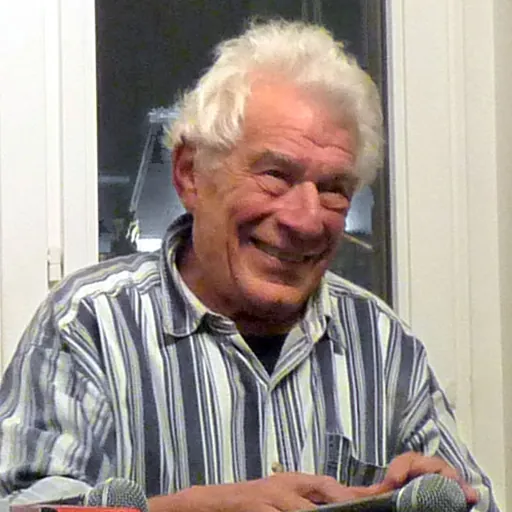
About John Berger
Lived 1926 – 2017 (aged 90). John Berger was a British and French screenwriter, art historian, painter, novelist, journalist and poet.
John Peter Berger ( ; 5 November 1926 – 2 January 2017) was an English art critic, novelist, painter and poet. His novel G. won the 1972 Booker Prize. His essay on art criticism Ways of Seeing, written as an accompaniment to the BBC series of the same name, is hugely culturally influential and continues to be widely read today. He lived in France for over fifty years.
Early life Berger was born on 5 November 1926 the first of two children of Miriam and Stanley Berger.
His grandfather was from Trieste, now Italy, and his father, Stanley, raised as a non-religious Jew who adopted Catholicism, had been an infantry officer on the Western Front during the First World War and was awarded the Military Cross and an OBE.
Berger was educated at St Edward's School, Oxford. He enrolled at the Chelsea School of Art and exhibited works at a number of London galleries in the late 1940s. As a statement of political commitment, he titled an early collection of essays Permanent Red.
Berger was never a formal member of the Communist Party of Great Britain (CPGB): rather he was a close associate of it and its front, the Artists' International Association (AIA), until the latter disappeared in 1953. He was active in the Geneva Club, a discussion group that overlapped with British communist circles in the 1950s.
Published work In 1958, Berger published his first novel, A Painter of Our Time, which tells the story of the disappearance of Janos Lavin, a fictional exiled Hungarian painter, and his diary's discovery by an art critic friend called John. The work was withdrawn by the publisher under pressure from the Congress for Cultural Freedom a month after its publication. The subsequent episodes concern the image of woman as a sexualized object in Western culture, expressions of property ownership and wealth in European oil painting, and modern advertising. The series, the first of several close collaborations with director Mike Dibb, has had a lasting influence, and in particular introduced the concept of the male gaze, as part of his analysis of the treatment of the nude in European painting. It soon became popular among feminists, including the British film critic Laura Mulvey, who used it to critique traditional media representations of the female character in cinema.
Berger's novel G., a picaresque romance set in Europe in 1898, won the James Tait Black Memorial Prize and the Booker Prize in 1972. Berger donated half the Booker cash prize to the British Black Panthers, and retained the other half to support his work on the study on migrant workers, which became A Seventh Man; he asserted that both endeavors represented aspects of his political struggle. In his acceptance speech at the Booker Prize ceremony, Berger said the prize's sponsor, Booker McConnell, had a long history of slavery and exploitation in the Caribbean, and this was why he wanted to donate the money to the British Black Panthers and fund the writing of his book on migrant workers.
Berger's sociological writings include A Fortunate Man: The Story of a Country Doctor (1967) and A Seventh Man: Migrant Workers in Europe (1975).
Berger and photographer Jean Mohr, his frequent collaborator, sought to document and understand the experiences of peasants.
Their subsequent book, Another Way of Telling, discusses and illustrates their documentary technique and treats the theory of photography through Berger's essays and Mohr's photographs. His studies of individual artists include The Success and Failure of Picasso (1965), a survey of that modernist's career, and Art and Revolution: Ernst Neizvestny, Endurance, and the Role of the Artist in the USSR (1969). His major fictional work of the 1980s, the trilogy Into Their Labours (consisting of the novels Pig Earth, Once in Europa, and Lilac and Flag), treats the European peasant experience from its farming roots to contemporary economic and political displacement and urban poverty. The cooperative was active until the early 1980s.
In later essays, Berger wrote about photography, art, politics, and memory. He published in The Shape of a Pocket a correspondence with Subcomandante Marcos, and penned short stories that appeared in The Threepenny Review and The New Yorker. His sole volume of poetry is Pages of the Wound, though other volumes, such as the theoretical essays And Our Faces, My Heart, Brief as Photos, contain poetry. His 2007 collection of essays on the uses of art as an instrument of political resistance, Hold Everything Dear, was titled after the poem by Gareth Evans. Berger's later novels include To the Wedding, a love story dealing with the AIDS crisis, and King: A Street Story, a novel about homelessness and shantytown life told from the perspective of a stray dog.
Berger's 1980 volume About Looking includes an influential chapter, "Why Look at Animals?" It is cited by numerous scholars in the interdisciplinary field of animal studies. The chapter was later reproduced in a Penguin Great Ideas selection of essays of the same title. In Bento's Sketchbook (2011) Berger combines extracts from Baruch Spinoza, sketches, memoir, and observations in a book that contemplates the relationship of materialism to spirituality. According to Berger, what could be seen as a contradiction "is beautifully resolved by Spinoza, who shows that it is not a duality, but in fact an essential unity". The book has been described as "a characteristically sui generis work combining an engagement with the thought of the 17th-century lens grinder, draughtsman, and philosopher Baruch Spinoza, with a study of drawing and a series of semi-autobiographical sketches".
Other work In 1999, Berger voiced twin brothers Archie and Albert Crisp in the video game Grand Theft Auto: London 1969.
He was a member of the Support Committee of the Russell Tribunal on Palestine.
John Berger funeral, Quincy, 7 January 2017. Pic.: Amarjit Chandan Personal life Berger married
In the mid-1950s, he married the Russian translator Anya Bostock, with whom he had two children, Katya Berger and Jacob Berger. The couple divorced in the mid-1970s.
Legacy In July 2009, Berger donated his archive to the British Library including literary manuscripts, drafts, research notes and unpublished material, correspondence, press cuttings and professional papers. The archive contains some early and marginal examples of Berger’s graphic work, but is chiefly literary in nature, and its organisation is largely that of Berger’s wife Beverly. The physical archive is described as "369 files, 9 boxes and 1 book".
Awards 1972: Booker Prize 1972: James Tait Black Memorial Prize 2009: Golden PEN Award
Literary works Fiction Novels and novella A Painter of Our Time (1958) Marcel Frishman (with George Besson) (1958) The Foot of Clive (1962) Into Their Labours trilogy (1991): Pig Earth (1979), Once in Europa (1987), Lilac and Flag (1990)
Plays A Question of Geography (with Nella Bielski) (1987) Les Trois Chaleurs (1985) Boris (1983) Goya's Last Portrait (with Nella Bielski) (1989)
Screenplays Jonah Who Will Be 25 in the Year 2000 (with Alain Tanner) (1976) La Salamandre (The Salamander) (with Alain Tanner) (1971) Le Milieu du monde (The Middle of the World) (with Alain Tanner) (1974) Une ville à Chandigarh (A City at Chandigarh) (1966)
Poetry Pages of the Wound (1994)
Non-fiction Essays and articles The Look of Things: Selected Essays and Articles (1972) Why Look at Animals? (2009) Confabulations (Essays) (2016) Albrecht Dürer: Watercolours and Drawings (1994) Titian: Nymph and Shepherd (with Katya Berger) (1996) Lying Down to Sleep (with Katya Berger) (2010) Bento's Sketchbook (2011) Understanding a Photograph (Geoff Dyer, ed.) (2013) Daumier: The Heroism of Modern Life (2013) Portraits: John Berger on Artists (Tom Overton, ed.) (2015) Seeing Through Drawing
Other A Seventh Man (with Jean Mohr) (1975) I Send You This Cadmium Red: A Correspondence between John Berger and John Christie (with John Christie) (2001) My Beautiful (with Marc Trivier) (2004) The Red Tenda of Bologna (2007) War with No End (with Naomi Klein, Hanif Kureishi, Arundhati Roy, Ahdaf Soueif, Joe Sacco and Haifa Zangana) (2007) From I to J (with Isabel Coixet) (2009) Railtracks (with Anne Michaels) (2011) Cataract (with Selçuk Demirel) (2012) Flying Skirts: An Elegy (with Yves Berger) (2014) Cuatro horizontes (Four Horizons) (with Sister Lucia Kuppens, Sister Telchilde Hinkley and John Christie) (2015) Lapwing & Fox (Conversations between John Berger and John Christie) (2016) John by Jean: Fifty Years of Friendship (Jean Mohr, ed.) (2016) A Sparrow's Journey: John Berger Reads Andrey Platonov (CD: 44:34 & 81-page book with Robert Chandler and Gareth Evans), London: House Sparrow Press in association with the London Review Bookshop (2016) Smoke (with Selçuk Demirel) (2017) What Time Is It? (with Selçuk Demirel) (, ed.) (2019) Over To You. Letters Between a Father & Son. Tate Publishing (2024)
Film The Seasons in Quincy: Four Portraits of John Berger (2016), directed by Tilda Swinton, Colin MacCabe, Christopher Roth and Bartek Dziadosz. Taskafa: Stories of the Street (2013), directed by Andrea Luka Zimmerman. Visioni di case che crollano (Case sparse) (2002), directed by Gianni Celati.
Reviews Harkness, Allan (1983), Berger: A Seventh Man?, review of A Seventh Man and Another Way of Telling, in Hearn, Sheila G.(ed.), Cencrastus No. 12, Spring 1983, pp. 46 & 47,
Don’t just read it —
keep it.
Full-length biographies made to live with: read them, listen on the way to work, watch them tonight.
- E-book
- Audio
- Video
Instant download · yours to keep · every purchase keeps this site free
Important facts
People in John Berger's life
Named in this biography and alive at the same time







Related people
Same field, nearest in time


Contemporaries
People whose lives overlapped John Berger's

Frequently asked questions
Who was John Berger?
British painter, writer and art critic (1926-2017)
When was John Berger born?
John Berger was born on 5 November 1926 in London Borough of Hackney.
When did John Berger die?
John Berger died on 2 January 2017 in Antony.
What was John Berger's occupation?
John Berger was a screenwriter, art historian, painter, novelist, journalist and poet.
What nationality was John Berger?
John Berger was British and French.
Sources & further reading
Cite this page
APA: Biography.guide. (2026). John Berger. https://biography.guide/john-berger/
MLA: "John Berger." Biography.guide, https://biography.guide/john-berger/.
Chicago: "John Berger." Biography.guide. https://biography.guide/john-berger/.
Data last updated: 2026-09-21 · Spot an error? Report a correction.
Portrait: Wikimedia Commons · author & licence
Page generated 2026-09-27 05:01 UTC