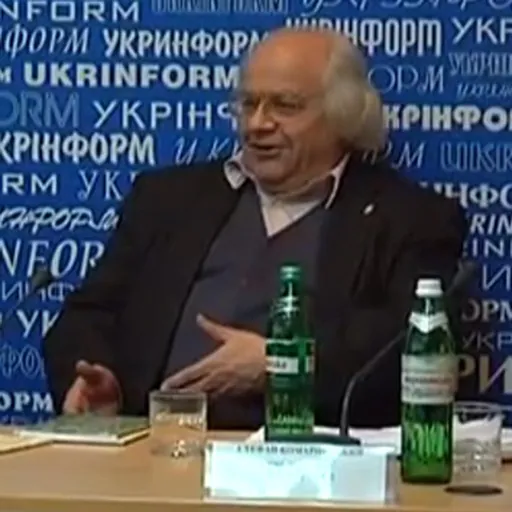
About Ivan Drach
Lived 1936 – 2018 (aged 81). Ivan Drach was a Russian and Ukrainian screenwriter, poet, politician, literary critic, prose writer and playwright, known for People's Movement of Ukraine and Soviet dissident movement.
Ivan Fedorovych Drach (; 17 October 1936 – 19 June 2018) was a Ukrainian poet, screenwriter, literary critic, politician, and political activist.
Drach played an important role in the founding of Rukh – the People's Movement of Ukraine – and led the organisation from 1989 to 1992.
Early life Drach was born to a family of collective farmers His father worked in a beet sugar refinery and Drach's mother worked on a farm.
Education After finishing high school, Ivan Drach complied with military service, after which he studied in the Faculty of Language and Literature of Kyiv University from 1959 to 1963. Drach would write in his diaries and then note in later interviews that students at University looked down on him for his peasantry and Ukrainian language.
Poetry career At this time, Drach visited the popular "Klub tvorchoyi molodi" ["Club for Creative Young People" (CCY)] and took part in literary evenings with reading of innovative poems. The Club started in the period of Khrushchev thaw became a gathering place of a Ukrainian Nationalism movement in Literature and Arts known as the Sixtiers.
Drach made his debut in 1961 with the publication of his poem-tragedy Knife in the Sun in the Kyiv literary newspaper. He worked in the newspapers "Literary Ukraine" and "Fatherland." Ivan Dziuba introduced Knife in the Sun in Literaturna hazeta as a sign the last vestiges of Stalinism were falling.
In January 1962, Ivan Drach spoke at the Third Plenum of the Ukrainian Writers' Union. Toles Honchar, Soviet Ukrainian poet-laureate and president of the Union welcomed the Sixtiers to the Union and Drach served as unofficial spokesperson for the young poets:
create the art of communism, of which Soviet Ukrainian will form a part; that young intellectuals are enthusiastic about Western European and that several "forgotten" Ukrainian writers and artists of the past ought to be remembered and treated with dignity.
At the Fourth Plenary Session of the Soviet Writers' Union, in March 1963, Drach fell under criticism of Leonid Novychenk who compared Drach to Yevhen Yevtushenkoa a Russian poet of Ukrainian background who Novychenk calle a " very uneducated man, both generally and in the sense of Marxist education, and Marxist worldview." In response Drach published a satirical poem "Ode to an Honest Coward."
Drach complied with new reality and his second collection of poetry "Solar Prominences of the Heart" was noted by critics as returning to social realism and losing the literary devices and focusing on transmitting important socialist ideals. Other shestydesiatnyky did not follow suit, and many were arrested. Drach spoke up against these arrests, and in fact mentioned them while speaking at the United Nations. Legend has it Drach escaped his KGB handlers in New York City and wandered into a Cafe where he met Alan Ginsberg.
The Fifth Congress of the Ukrainian Hriters' Union, held in November 1966 would defend Drach's work and declare it free of formalism and literary twists.
In 1976, he won the USSR State Prize for his work, The Root and the Crown. In the aftermath of the 1986 Chernobyl disaster, Drach was involved in a growing movement of Ukrainian dissident intellectuals that demanded larger cultural autonomy for Ukraine and an honest conversation in the Soviet Union about the stalinist government's actions in Ukraine, particularly the Holodomor.
After the beginning of Perestroika, he resumed contacts with dissident circles. Together with Vyacheslav Chornovil, Mykhailo Horyn, and a number of other Ukrainian activists, in 1989 he created Rukh or People's Movement of Ukraine, first official Ukrainian pro-reform organization. Ivan Drach was the first chairman of Rukh from 8 September 1989 to 28 February 1992.
Political career
He was co-chairman of the NRU with Chornovil and Horyn from 28 February to 4 December 1992. In the spring of 1990, Ivan Drach was elected to the Verkhovna Rada from Artemivsk (No. 259) constituency by the 66.38% of voters. After retiring from his office in the NRU in late 1992, Ivan Drach retired from politics in 1994. He promoted the use of the Ukrainian language and whilst serving as Ukraine's minister of communication, he proposed wide-ranging measures, including setting quotas for Ukrainian-language broadcasts and tax breaks for Ukrainian publishing.
Death
Ivan Drach died 19 June 2018 in Feofania Hospital, Kyiv, following an undisclosed illness. As a faithful Kosomol member Drach was initially surprised by the criticism he received from Party officials following 1962. By 1963, however, Drach had adopted a more dissident tone.
Drach, according to interviews drew on many sources. World War II, Taras Shevchenko, Alexander Pushkin, Walt whitman and Pablo Neruda played the strongest role informing his style. Drach also said Francisco Goya, Pablo Picasso, and Marc Chagall as influences, as well as other modern poets in different languages.
Awards Hero of Ukraine (19 August 2006). Order of Prince Yaroslav the Wise 3rd class (17 October 2011). Order of Prince Yaroslav the Wise 4th class (19 August 2001). Order of Prince Yaroslav the Wise 5th class (16 October 1996). Antonovych prize (1991) USSR State Prize (1976) Order of the Red Banner of Labor (16 November 1984)
Poetry collections ' (The Sunflower, 1962) ' (Protuberances of the Heart, 1965) (Poems, 1967) (Everyday Ballads, 1967) (To the Sources, 1972) (The Root and the Crown, 1974) (The Kyivan Sky, 1976) (Duma about the Teacher, 1977) (The Solar Phoenix, 1978) (The Sun and the Word, 1979) (American Notebook, 1980) (The Saber and the Kerchief, 1981) (Dramatic Poems, 1982) (A Kyivan Amulet, 1983) (1985), Khram sontsia (A Temple of the Sun, 1988) (A Letter to a Viburnum Tree, 1990) (Fire from the Ashes, 1995)
Movies screenwriting
Propala Hramota
Don’t just read it —
keep it.
Full-length biographies made to live with: read them, listen on the way to work, watch them tonight.
- E-book
- Audio
- Video
Instant download · yours to keep · every purchase keeps this site free
Important facts
People in Ivan Drach's life
Named in this biography and alive at the same time



Related people
Same field, nearest in time


Contemporaries
People whose lives overlapped Ivan Drach's




Frequently asked questions
Who was Ivan Drach?
Ukrainian writer, screenwriter (1936–2018)
When was Ivan Drach born?
Ivan Drach was born on 17 October 1936 in Telizhyntsi.
When did Ivan Drach die?
Ivan Drach died on 19 June 2018 in Feofaniya Clinical Hospital.
What was Ivan Drach's occupation?
Ivan Drach was a screenwriter, poet, politician, literary critic, prose writer and playwright.
What was Ivan Drach known for?
Ivan Drach was known for People's Movement of Ukraine and Soviet dissident movement.
What nationality was Ivan Drach?
Ivan Drach was Russian and Ukrainian.
Sources & further reading
Cite this page
APA: Biography.guide. (2026). Ivan Drach. https://biography.guide/ivan-drach/
MLA: "Ivan Drach." Biography.guide, https://biography.guide/ivan-drach/.
Chicago: "Ivan Drach." Biography.guide. https://biography.guide/ivan-drach/.
Data last updated: 2026-09-23 · Spot an error? Report a correction.
Portrait: Wikimedia Commons · author & licence
Page generated 2026-09-27 05:07 UTC