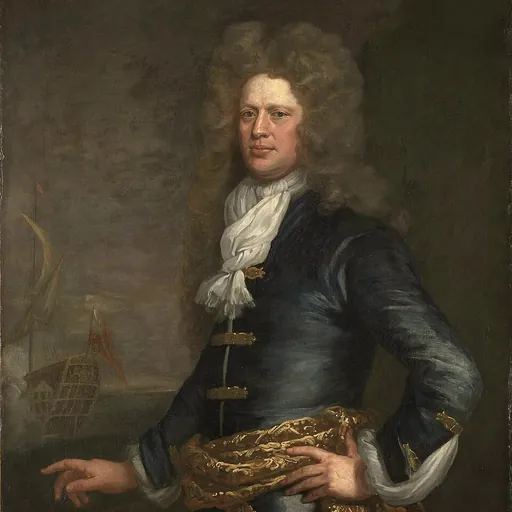
About John Balchen
Lived 1670 – 1744 (aged 74). John Balchen was a naval officer.
Admiral of the White Sir John Balchen (2 February 1670 – 4 October 1744) was a Royal Navy officer with a long and distinguished career during the late 17th and early 18th centuries. In the course of his service at sea, Balchen saw action in numerous battles against the French and Spanish navies across 60 years and three separate wars. He was twice captured by the French in action, both times being exonerated and commended for the defence of his ships against overwhelming odds.
Balchen died in the shipwreck of the 100-gun first-rate HMS Victory off the Casquets in the Channel Islands during operations to deter French blockading of Spanish and Portuguese ports during the War of the Austrian Succession. A capable and efficient officer, Balchen never found the wealth and prestige fellow officers secured in other commissions, a fact which remained a source of frustration to him until his elevation to knighthood shortly before his death.
Nine Years' War Balchen was born in February 1670, the only surviving child of John Balchen, gentleman, and his wife, Ann Edspur. Home educated, Balchen took a commission in the Royal Navy aged 15 and, seven years later, gained promotion to lieutenant. For most of this period Balchen was stationed in the West Indies and, during his service there, was lucky in his health; the West Indies command was considered very dangerous during this period, mortality rates amongst sailors stationed there being very high due to malaria and yellow fever. The high death rate led to rapid promotion for those who survived, and Balchen was made Post Captain at the relatively young age of 27 during the Nine Years' War. Balchen had spent the war aboard HMS Dragon and HMS Cambridge under Admiral John Neville, who was impressed enough with his subordinate to give him command of the prize ship HMS Virgin, the safe conduct of which to England earned him the step to captain. In 1731, after a period in command of the 60-gun HMS Dreadnought, Balchen took over the 80-gun HMS Princess Amelia and commanded her in support of a Spanish landing at Livorno. Balchen returned in December and, in 1734, was promoted to Vice-Admiral, spending the next five years at his estates in England. . Balchen chafed at being forced to remain ashore and was not pleased when he was forcibly retired in April 1744, aged 74.
Balchen's fleet was successful in driving off the French, who retired in the face of his superior fleet without firing a shot, and Hardy's convoy was escorted safely to Gibraltar. On the way to the Portuguese Coast, Balchen finally made his fortune in prize money, capturing six heavily laden French West Indiamen. On his return journey however, the fleet was sailing through the Western Approaches in early October when it was hit by a violent storm. Scattered across the Channel, they one by one returned to England in a battered and leaking condition until, a few days later, only HMS Victory was missing. Victory, Balchen's flagship, was, at the time, one of the largest ships in the world, holding a broadside of 100 guns. She was also very new, having been completed less than seven years before.
Frigates were dispatched across the English Channel to search for the missing battleship, which was last seen on the horizon on 4 October. Captain Thomas Grenville of the frigate HMS Falkland landed at Guernsey in the Channel Islands to reprovision and there heard from locals that wreckage and part of a topmast had washed up on the island's shores. Further investigation proved that the wreckage had indeed come from the Victory, which was believed to have run into the Casquets, a group of rocks nearby. Other wreckage was washed up on Jersey and Alderney, whose inhabitants had heard distress guns the night before the wreck but were unable to provide aid in the severe storm. Of the 1,150 sailors aboard Victory, none was ever recovered.
Legacy Balchen's death was met with national mourning in Britain, where he was regarded as an expert and veteran commander of great talent in seamanship, tactics and ship construction. where it can still be seen. The relief commemorates Balchen's career, that of his son and also the men lost on the Victory in 1744 who have no other permanent memorial. Balchen is remembered in the Oxford Dictionary of National Biography as "a hard-working, thoroughgoing professional, recognised for his readiness to accept duty whenever and wherever required."
Don’t just read it —
keep it.
Full-length biographies made to live with: read them, listen on the way to work, watch them tonight.
- E-book
- Audio
- Video
Instant download · yours to keep · every purchase keeps this site free
Important facts
People in John Balchen's life
Named in this biography and alive at the same time


Related people
Same field, nearest in time


Contemporaries
People whose lives overlapped John Balchen's



Frequently asked questions
Who was John Balchen?
Royal Navy admiral (1670-1744)
When was John Balchen born?
John Balchen was born on 2 February 1670 in Godalming.
When did John Balchen die?
John Balchen died on 4 October 1744 in Les Casquets.
What was John Balchen's occupation?
John Balchen was a naval officer.
Sources & further reading
Cite this page
APA: Biography.guide. (2026). John Balchen. https://biography.guide/john-balchen/
MLA: "John Balchen." Biography.guide, https://biography.guide/john-balchen/.
Chicago: "John Balchen." Biography.guide. https://biography.guide/john-balchen/.
Data last updated: 2026-09-23 · Spot an error? Report a correction.
Portrait: Wikimedia Commons · author & licence
Page generated 2026-09-27 05:04 UTC