
About Johannes V. Jensen
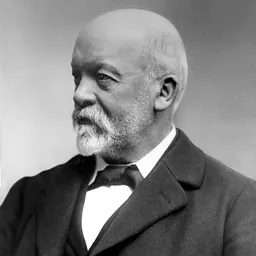
Lived 1873 – 1950 (aged 77). Johannes V. Jensen was a Danish writer, poet, novelist, essayist, translator-interpreter and journalist.
Johannes Vilhelm Jensen (; 20 January 1873 – 25 November 1950) was a Danish author, known as one of the great Danish writers of the first half of 20th century. He was awarded the 1944 Nobel Prize in Literature "for the rare strength and fertility of his poetic imagination with which is combined an intellectual curiosity of wide scope and a bold, freshly creative style". One of his sisters, Thit Jensen, was also a well-known writer and a very vocal, and occasionally controversial, early feminist.
Jensen began his literary career by writing pulp fiction, but he made the move into more serious literature by the late 1890s. His early novels depict his disillusionment with large, modern cities. His historical novel The Fall of the King (1933) focuses on King Christian II. It was reportedly an "indictment of Danish indecision and lack of vitality, which Jensen saw as a national disease".
Early years He was born in Farsø, a village in north Jutland, Denmark, as the son of a veterinary surgeon and he grew up in a rural environment. While studying medicine at the University of Copenhagen he worked as a writer to fund his studies. After three years of studying he chose to change careers and devote himself fully to literature.
Literary works
Jensen began his career writing pulp fiction, but made the move into more serious literature with the publication of Danskere (1896, Danishmen), soon followed by Einar Elkjær (1898). Both early novels depict disillusionment with large, modern cities. From there, Jensen went on to write Himmerland Stories (1898–1910), comprising a series of tales set in the part of Denmark where he was born.
During 1900 and 1901 Jensen wrote his first most significant novel, Kongens Fald (translated into English as The Fall of the King in 1933), a modern historical novel centered on King Christian II. Literary critic Martin Seymour-Smith said it is an "indictment of Danish indecision and lack of vitality, which Jensen saw as a national disease. Apart from this aspect of it, it is a penetrating study of sixteenth-century people."
In 1906 Jensen published his first collection of poetry, Digte 1906 (i.e. Poems 1906), would give rise to his reputation as an early leading Modernist in Denmark.
In addition to his novels, short stories, and poetry, Jensen also wrote a few plays, and many essays, notable for their grand narratives, futurism, jingoism, and interest in anthropology and the philosophy of evolution. In the short autobiographical account of his career which he wrote on receiving the Nobel Prize, Jensen said he was motivated to "introduce the philosophy of evolution into the sphere of literature ... I was prompted to do this because of the misinterpretation and distortion of Darwinism" by the Nazis.
Late career Jensen's most popular literary works were all completed before 1920, a year which also marked his initiation of the Museumcentre Aars in the town of Aars in Himmerland. After this he mostly concentrated on ambitious biological and zoological studies in an effort to create an ethical system based upon Darwinian ideas. He also hoped to renew classical poetry.
By his own account, Jensen often wrote for newspapers, though he never employed by one. At the award ceremony in Stockholm on 10 December 1945 Anders Österling, permanent secretary of the Swedish Academy said:
Jensen had been nominated for the Nobel Prize in Literature 53 times, the first time in 1925. He was nominated every year between 1931 and 1944.
In 1999, The Fall of the King (1901) was acclaimed as the best Danish novel of the 20th century by the newspapers Politiken and Berlingske Tidende, independently of each other.
Johannes V. Jensen Land in northern Greenland was named in his honor.
Don’t just read it —
keep it.
Full-length biographies made to live with: read them, listen on the way to work, watch them tonight.
- E-book
- Audio
- Video
Instant download · yours to keep · every purchase keeps this site free
Important facts
People in Johannes V. Jensen's life
Named in this biography and alive at the same time


Related people
Same field, nearest in time

Contemporaries
People whose lives overlapped Johannes V. Jensen's


Frequently asked questions
Who was Johannes V. Jensen?
Danish author (1873-1950)
When was Johannes V. Jensen born?
Johannes V. Jensen was born on 20 January 1873 in Farsø.
When did Johannes V. Jensen die?
Johannes V. Jensen died on 25 November 1950 in Copenhagen.
What was Johannes V. Jensen's occupation?
Johannes V. Jensen was a writer, poet, novelist, essayist, translator-interpreter and journalist.
What nationality was Johannes V. Jensen?
Johannes V. Jensen was Danish.
Sources & further reading
· Wikipedia: Johannes V. Jensen
Cite this page
APA: Biography.guide. (2026). Johannes V. Jensen. https://biography.guide/johannes-v-jensen/
MLA: "Johannes V. Jensen." Biography.guide, https://biography.guide/johannes-v-jensen/.
Chicago: "Johannes V. Jensen." Biography.guide. https://biography.guide/johannes-v-jensen/.
Data last updated: 2026-09-20 · Spot an error? Report a correction.
Page generated 2026-09-27 05:24 UTC