
About Johannes Stark
Lived 1874 – 1957 (aged 83). Johannes Stark was a German physicist and university teacher, known for Stark effect.
Johannes Stark (; 15 April 1874 – 21 June 1957) was a German physicist who received the Nobel Prize in Physics in 1919 for his discovery of the Stark effect.
A supporter of Adolf Hitler from 1924, Stark was one of the main figures, along with fellow Nobel laureate Philipp Lenard, in the antisemitic Deutsche Physik movement, which sought to remove Jewish physicists from German institutions. In 1947, he was found guilty as a "Major Offender" by a denazification court, but this was reduced to "Lesser Offender" in 1949 after appeal.
Education Johannes Stark was born on 15 April 1874 in Schickenhof (now part of Freihung), Germany.
Stark was educated at the Gymnasium in Bayreuth, and later in Regensburg. In 1894, he entered the Ludwig-Maximilians-Universität München, where he studied physics, mathematics, chemistry, and crystallography. In 1897, he received his Ph.D. in Physics with a thesis, written under Eugen von Lommel, titled Untersuchungen über einige physikalische, vorzüglich optische Eigenschaften des Russes (Investigations into some physical, especially optical, properties of soot). Stark stayed at the Ludwig-Maximilians-Universität München as an assistant to von Lommel until 1900.
Career and research In 1900, Stark became a Privatdozent at the University of Göttingen. In 1906, he was appointed Extraordinary Professor at Königliche Technische Hochschule in Hanover, and in 1909 became Professor at RWTH Aachen University. From 1917 to 1922, he worked as a professor at the University of Greifswald and the University of Würzburg.
In 1919, Stark was awarded the Nobel Prize in Physics "for his discovery of the Doppler effect in canal rays and the splitting of spectral lines in electric fields" (the latter is known as the Stark effect).
From 1933 until his retirement in 1939, Stark was President of the Physikalisch-Technische Reichsanstalt, while also President of the Notgemeinschaft der Deutschen Wissenschaft.
It was Stark who, as the editor of the Jahrbuch der Radioaktivität und Elektronik, asked in 1907, then still rather unknown, Albert Einstein to write a review article on the principle of relativity. Stark seemed impressed by relativity and Einstein's earlier work when he quoted "the principle of relativity formulated by H. A. Lorentz and A. Einstein" and "Planck's relationship M0 = E0/c2" in his 1907 paper in Physikalische Zeitschrift, where he used the equation e0 = m0c2 to calculate an "elementary quantum of energy", i.e. the amount of energy related to the mass of an electron at rest. While working on his article, Einstein began a line of thought that would eventually lead to his general theory of relativity, which in turn became (after its confirmation) the start of Einstein's worldwide fame. This is ironic, given Stark's later work as an anti-Einstein and anti-relativity propagandist in the Deutsche Physik movement.
Stark published more than 300 papers, mainly regarding electricity and other such topics.
Affiliation with Nazism
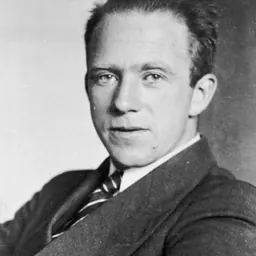
From 1924 onwards, Stark supported Hitler. During the Nazi regime, Stark attempted to become the Führer of German physics through the Deutsche Physik (Aryan Physics) movement (along with fellow Nobel laureate Philipp Lenard) against the "Jewish physics" of Albert Einstein and Werner Heisenberg (who was not Jewish). After Werner Heisenberg defended Albert Einstein's theory of relativity, Stark wrote an angry article in the official SS newspaper Das Schwarze Korps, calling Heisenberg a "White Jew".
In his 1934 book, Nationalsozialismus und Wissenschaft (National Socialism and Science), Stark maintained that the priority of the scientist was to serve the nation—thus, the important fields of research were those that could help German arms production and industry. He attacked theoretical physics as "Jewish" and stressed that scientific positions in Nazi Germany should only be held by pure-blooded Germans.
Writing in Das Schwarze Korps, Stark argued that even if racial antisemitism were to triumph, it would only be a 'partial victory' if 'Jewish' ideas were not similarly defeated: "We also have to eradicate the Jewish spirit, whose blood can flow just as undisturbed today as before if its carriers hold beautiful Aryan passes".
In 1947, following the defeat of Germany in World War II, Stark was classified as a "Major Offender" and received a sentence of four years' imprisonment (later suspended) by a denazification court. This verdict was modified in 1949 by the Appelate Tribunal in Munich, reducing the sentence to "Lesser Offender" and a fine of 1000 marks.
Stark spent the last years of his life on his estate (called Gut Eppenstatt) near Traunstein in Upper Bavaria, where he died on 21 June 1957 at the age of 83. He is buried at the mountain cemetery in Schönau am Königssee.
Awards and honors In addition to the Nobel Prize, Stark received various awards, including the Baumgartner Prize of the Vienna Academy of Sciences (1910), the Vahlbruch Prize of the Göttingen Academy of Sciences (1914), and the Matteucci Medal of the Rome Academy. In 1970, the International Astronomical Union honored him with a crater on the far-side of the Moon, without knowing about his Nazi activities. The name was dropped on August 12, 2020.
Publications Die Entladung der Elektricität von galvanisch glühender Kohle in verdünntes Gas. (Sonderabdruck aus 'Annalen der Physik und Chemie', Neue Folge, Band 68). Leipzig, 1899 Der elektrische Strom zwischen galvanisch glühender Kohle und einem Metall durch verdünntes Gas. (Sonderabdruck aus 'Annalen der Physik und Chemie', Neue Folge, Band 68). Leipzig, 1899 Aenderung der Leitfähigkeit von Gasen durch einen stetigen elektrischen Strom. (Sonderabdruck aus 'Annalen der Physik', 4. Folge, Band 2). Leipzig, 1900 Ueber den Einfluss der Erhitzung auf das elektrische Leuchten eines verdünnten Gases. (Sonderabdruck aus 'Annalen der Physik', 4. Folge, Band 1). Leipzig, 1900 Ueber elektrostatische Wirkungen bei der Entladung der Elektricität in verdünnten Gasen. (Sonderabdruck aus 'Annalen der Physik', 4. Folge, Band 1). Leipzig, 1900 Kritische Bemerkungen zu der Mitteilung der Herren Austin und Starke über Kathodenstrahlreflexion. Sonderabdruck aus 'Verhandlungen der Deutschen Physikalischen Gesellschaft', Jahrgang 4, Nr. 8). Braunschweig, 1902 Prinzipien der Atomdynamik. 1. Teil. Die elektrischen Quanten., 1910 Schwierigkeiten für die Lichtquantenhypothese im Falle der Emission von Serienlinien. (Sonderabdruck aus 'Verhandlungen der Deutschen Physikalischen Gesellschaft', Jg. XVI, Nr 6). Braunschweig, 1914 Bemerkung zum Bogen – und Funkenspektrum des Heliums. (Sonderabdruck aus 'Verhandlungen der Deutschen Physikalischen Gesellschaft.', Jg. XVI, Nr. 10). Braunschweig, 1914 Folgerungen aus einer Valenzhypothese. III. Natürliche Drehung der Schwingungsebene des Lichtes. (Sonderabdruck aus `Jahrbuch der Radioaktivität und Elektronik', Heft 2, Mai 1914), Leipzig, 1914 Methode zur gleichzeitigen Zerlegung einer Linie durch das elektrische und das magnetische Feld. (Sonderabdruck aus 'Verhandlungen der Deutschen Physikalischen Gesellschaft.', Jg. XVI, Nr. 7). Braunschweig, 1914 Die gegenwärtige Krise der deutschen Physik, ("The Thoroughgoing Crisis in German Physics") 1922 Natur der chemischen Valenzkräfte, 1922 Hitlergeist und Wissenschaft, 1924 together with Philipp Lenard Die Axialität der Lichtemission und Atomstruktur, Berlin 1927 Atomstruktur und Atombindung, A. Seydel, Berlin 1928 Atomstrukturelle Grundlagen der Stickstoffchemie., Leipzig, 1931 Nationalsozialismus und Katholische Kirche, ("National Socialism and the Catholic Church") 1931 Nationalsozialismus und Katholische Kirche. II. Teil: Antwort auf Kundgebungen der deutschen Bischöfe., 1931 Nationale Erziehung, 1932 Nationalsozialismus und Wissenschaft ("National Socialism and Science") 1934
Physik der Atomoberfläche, 1940 Jüdische und deutsche Physik, ("Jewish and German Physics") with Wilhelm Müller, written at the Ludwig-Maximilians-Universität München in 1941 Nationale Erziehung, Zentrumsherrschaft und Jesuitenpolitik, undated Hitlers Ziele und Persönlichkeit ("Hitler's Aims and Personality"), undated
Don’t just read it —
keep it.
Full-length biographies made to live with: read them, listen on the way to work, watch them tonight.
- E-book
- Audio
- Video
Instant download · yours to keep · every purchase keeps this site free
Important facts
People in Johannes Stark's life
Named in this biography and alive at the same time


Related people
Same field, nearest in time


Contemporaries
People whose lives overlapped Johannes Stark's

Frequently asked questions
Who was Johannes Stark?
German physicist (1874-1957)
When was Johannes Stark born?
Johannes Stark was born on 15 April 1874 in Freihung.
When did Johannes Stark die?
Johannes Stark died on 21 June 1957 in Traunstein.
What was Johannes Stark's occupation?
Johannes Stark was a physicist and university teacher.
What was Johannes Stark known for?
Johannes Stark was known for Stark effect.
What nationality was Johannes Stark?
Johannes Stark was German.
Sources & further reading
Cite this page
APA: Biography.guide. (2026). Johannes Stark. https://biography.guide/johannes-stark/
MLA: "Johannes Stark." Biography.guide, https://biography.guide/johannes-stark/.
Chicago: "Johannes Stark." Biography.guide. https://biography.guide/johannes-stark/.
Data last updated: 2026-09-20 · Spot an error? Report a correction.
Page generated 2026-09-27 05:30 UTC