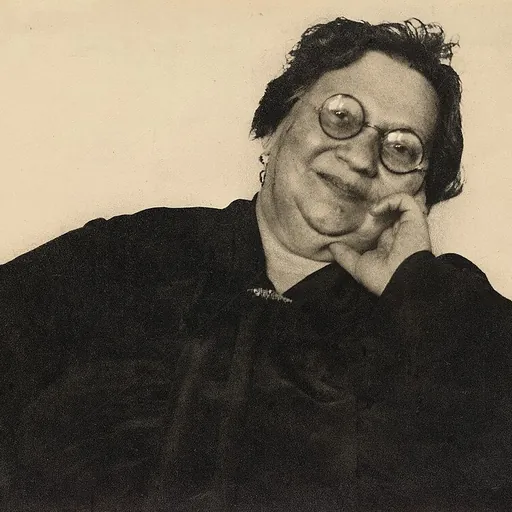
About Johanna Ey
Lived 1864 – 1947 (aged 83). Johanna Ey was a German art dealer, patron of the arts, gallerist and baker.
A sculpture of Johanna "Mutter" Ey by Hannelore Köhler stands in Düsseldorf's Spee'scher Park. Johanna Ey (4 March 1864 – 27 August 1947) was a German art dealer during the 1920s. She became known as Mutter Ey (Mother Ey) for the nurturing support she provided to her artists, who included Max Ernst and Otto Dix.
Biography Ey was born in humble circumstances in Wickrath (today a quarter of Mönchengladbach). At the age of 19 she moved to Düsseldorf. She married and had twelve children, of whom eight died young. In 1910, middle aged and divorced, she opened a bakery in the proximity of the Düsseldorf Academy of Arts. This became a popular meeting place of actors, journalists, musicians and especially painters, who appreciated her policy of granting credit to artists and students. She displayed their works in her shop windows, and became a collector of art by accepting paintings as payment.
In 1916 she closed her café and opened a gallery on the Hindenburgwall (today Heinrich Heine avenue), where she showed works by academic painters. In the years following World War I, however, the gallery became the center of the artists of the "Junge Rheinland" (Young Rhineland) group. Ey initially decided to exhibit their art not for theoretical or economic reasons, but rather because of her personal friendships with the artists, although she quickly became an energetic proponent of modernism. Her support for her artists extended even to darning their socks, and she defended Wollheim and Dix when they were hauled into court on charges that their paintings were immoral.
During the 1920s, she was frequently painted by the artists in her circle, notably by Dix in 1924, and in 1925 by Arthur Kaufmann, who placed her at the center of his composition Contemporaries (Düsseldorf's Intellectual Scene). According to art historian Sergiusz Michalsky, "Johanna Ey's portrait was painted more often than that of any other woman in Germany."
With the rise to power of Hitler in 1933, nearly all the artists associated with Ey were denounced as degenerate artists; most were also political opponents of National Socialism. In April 1934 Johanna Ey gave up running her gallery. She died in Düsseldorf in 1947.
Among the artists associated with Ey's gallery were Max Ernst, Otto Dix, Otto Pankok, Gert Heinrich Wollheim, Ulrich Leman, , Adolf Uzarski, Arthur Kaufmann, , Adalbert Trillhaase, , Jankel Adler, , Franz Monjau, , and Curt Lahs.
Don’t just read it —
keep it.
Full-length biographies made to live with: read them, listen on the way to work, watch them tonight.
- E-book
- Audio
- Video
Instant download · yours to keep · every purchase keeps this site free
Important facts
People in Johanna Ey's life
Named in this biography and alive at the same time





Related people
Same field, nearest in time

Contemporaries
People whose lives overlapped Johanna Ey's



Frequently asked questions
Who was Johanna Ey?
German art dealer (1864–1947)
When was Johanna Ey born?
Johanna Ey was born on 4 March 1864 in Wickrath.
When did Johanna Ey die?
Johanna Ey died on 27 August 1947 in Düsseldorf.
What was Johanna Ey's occupation?
Johanna Ey was an art dealer, patron of the arts, gallerist and baker.
What nationality was Johanna Ey?
Johanna Ey was German.
Sources & further reading
Cite this page
APA: Biography.guide. (2026). Johanna Ey. https://biography.guide/johanna-ey/
MLA: "Johanna Ey." Biography.guide, https://biography.guide/johanna-ey/.
Chicago: "Johanna Ey." Biography.guide. https://biography.guide/johanna-ey/.
Data last updated: 2026-09-23 · Spot an error? Report a correction.
Portrait: Wikimedia Commons · author & licence
Page generated 2026-09-27 05:06 UTC