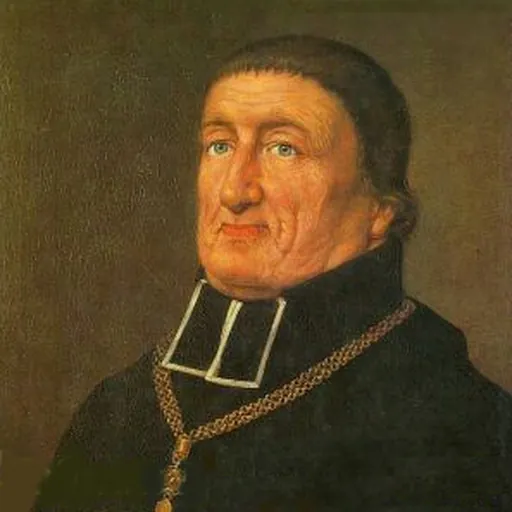
About Johann Michael Sailer
Lived 1751 – 1832 (aged 80). Johann Michael Sailer was a German theologian, university teacher, catholic priest, writer, catholic bishop and translator.
Johann Michael Sailer (17 October 1751 – 20 May 1832) was a German Jesuit theologian and philosopher, and Bishop of Regensburg. Sailer was a major contributor to the Catholic Enlightenment.
Biography Sailer was born at Aresing in Upper Bavaria on 17 October 1751 as the son of a poor Catholic shoemaker and his wife. Until his tenth year, he attended the primary school in his native town. After this he was a pupil in the gymnasium at Munich. In 1770 he entered the Society of Jesus at Landsberg in Upper Bavaria as a novice; upon the suppression of the Society in 1773, he continued his theological and philosophical studies at Ingolstadt. In 1775 he was ordained priest; 1777-80 he was a tutor of philosophy and theology, and from 1780 second professor of dogmatics at Ingolstadt.
Along with many others, he lost his position in 1781 when the Elector Charles Theodore transferred theological instruction to the monasteries. In the years 1781-84, while engaged in literary work, Sailer attracted the attention of the elector and Bishop Clement Wenceslaus. In 1784 the latter called Sailer to Dillingen as professor of pastoral theology and ethics. Sailer held this position for ten years, earning a high reputation.
Sailer lived in an era known as the "Enlightenment", which in its radical form disputed the fundamental dogmas of Christianity. It was characterized by contempt for Christian mysticism, a new worldliness of the clergy, relaxation of ecclesiastical discipline, denial of the primacy of papal jurisdiction, efforts of the State to gain control of the Church, turbulent reforms within the Church, and what many considered to be over-emphasis of intellect in education.
By contrast, Sailer defended fundamental principles of Christianity and traditional practice, striving for a faith to be expressed in charity, for the maintenance of godliness, and for the training of a pious and intelligent clergy. He also insisted that the pulpit should be reserved solely for the preaching of the Gospel, and that the bishops should be in union with the Pope. He upheld the primacy of the papacy and defended the freedom and rights of the Church against the encroachments of the State. He ardently desired ecclesiastical reform, not through unauthorized agencies but by the appointed organs of the Church; and he demanded that education should aim at training both mind and will.
Sailer labored for the Christian ideal by his winning personality, by his utterances as teacher, parish priest and preacher, and by his numerous written works. They were philosophical, theological, devotional and biographical in character. He died on 20 May 1832 in Regensburg.
Sailer attracted numerous people to Christianity and the Catholic Church. Notwithstanding his fruitful activity and his benevolence, Sailer had antagonists who opposed him partly from jealousy, partly from misunderstanding and ill-will; he was accused of heterodoxy, indifferentism and mysticism. If Sailer is judged in connection with his times, these reproaches are unfounded. In his day Sailer was a pillar of the Church. Goyau wrote about Sailer in his L'Allemagne religieuse (Paris, 1905): "With Sailer German piety, both Protestant and Catholic, learned again to pray. This is the peculiar characteristic of his activity. Do not expect from him any religious polemics; he abhorred them; what he really cherished was the idea of a sort of cooperation of the various Christian bodies against the negations of infidelity. Sailer made a breach in Rationalism, by opposing to it a piety in which both Christian bodies could unite" (pp. 294, 295).
The best edition of his works is "J.M. Sailers samtliche Werke unter Anleitung des Verfassers", ed. Joseph Widmer, 40 volumes, Sulzbach, 1830–41; supplementary volume, 1845.
Legacy Johann-Michael-Sailer Gymnasium, a high school in Dillingen, is named after Sailer.
There is a monument to Johann Michael Sailer in Kardinal-von-Waldburg-Strasse, Dillingen and der Donau. It stands outside the Akademie für Lehrerfortbildung und Personalführung, the building in which Johann Michael Sailer was professor of pastoral theology and ethics from 1784 to 1794.
Don’t just read it —
keep it.
Full-length biographies made to live with: read them, listen on the way to work, watch them tonight.
- E-book
- Audio
- Video
Instant download · yours to keep · every purchase keeps this site free
Important facts
People in Johann Michael Sailer's life
Named in this biography and alive at the same time

Related people
Same field, nearest in time




Contemporaries
People whose lives overlapped Johann Michael Sailer's




Frequently asked questions
Who was Johann Michael Sailer?
Catholic bishop
When was Johann Michael Sailer born?
Johann Michael Sailer was born on 17 November 1751 in Aresing.
When did Johann Michael Sailer die?
Johann Michael Sailer died on 20 May 1832 in Regensburg.
What was Johann Michael Sailer's occupation?
Johann Michael Sailer was a theologian, university teacher, catholic priest, writer, catholic bishop and translator.
What nationality was Johann Michael Sailer?
Johann Michael Sailer was German.
Sources & further reading
· Wikipedia: Johann Michael Sailer
· DBpedia: Johann Michael Sailer
Cite this page
APA: Biography.guide. (2026). Johann Michael Sailer. https://biography.guide/johann-michael-sailer/
MLA: "Johann Michael Sailer." Biography.guide, https://biography.guide/johann-michael-sailer/.
Chicago: "Johann Michael Sailer." Biography.guide. https://biography.guide/johann-michael-sailer/.
Data last updated: 2026-09-20 · Spot an error? Report a correction.
Portrait: Wikimedia Commons · author & licence
Page generated 2026-09-27 05:11 UTC